This week's solar eclipse thrilled millions of people in parts of Northern Europe. It also provided an opportunity for a new battle of the best camera phones that's revived the debate about where line lies between AI-powered smartphone photography and complete fiction.
Users of one particular top-of-the-range phone were disappointed that their snaps of the solar eclipse came out looking like photos of a supermoon being eclipsed by another moon. The phone's AI interpreted the sun as the moon and pasted a fake lunar surface texture over it.
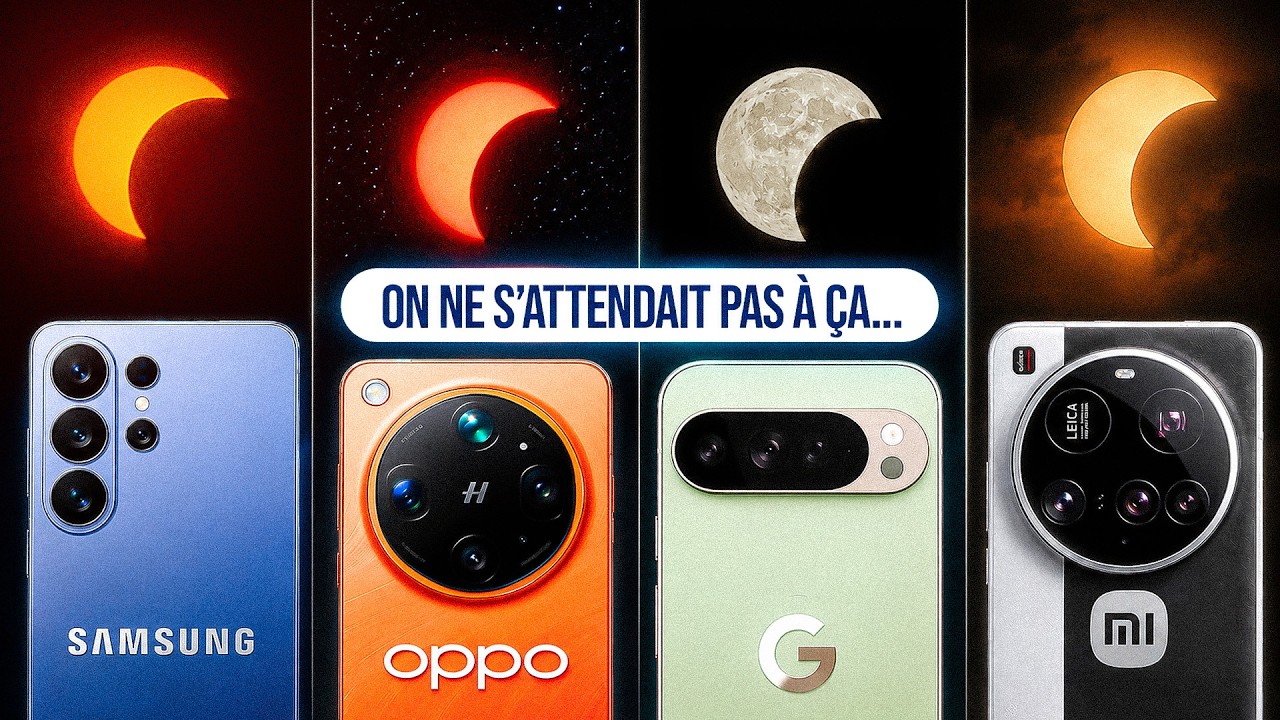
The AI fail is clear in a video by a French tech website below, where the Samsung Galaxy S26 Ultra, Oppo Find X9 Ultra, Xiaomi 17 Ultra, Google Pixel 10 Pro XL are put head to head using the same solar filter and identical testing protocol. One came up sorely lacking (this is another reason why people might want to learn how to make a pinhole camera to view the solar eclipse).
Warning: never look directly at a solar eclipse and never try to photography one without using dedicated solar filters and solar viewers.
There was a famous controversy over Samsung's AI-enhanced moon photos in the past. The company claims that what it's tech does has been misunderstood and insists that it only sharpens real detail rather than generating entirely new imagery.
In Frandroid's comparison video above, Samsung's Galaxy S26 Ultra is actually one of the better performers. Bottom of the class is the Xiaomi 17 Ultra – Ultra in name, but mendacious in nature. Its Leica optical lens designs and colour science went out the window when its 'Supermoon Mode' automatically triggered and pasted a lunar texture over the sun's surface as the moon began to obscure it. All that was missing was Mario twerking.
Others users say they had a similar experience while using the phone during the solar eclipse on Wednesday, with many expressing disappointment by the AI overlay.
"The moon was the other one. It detected a bright sphere in the sky, went into 'supermoon' mode, and straight up invented the entire surface," one person writes.
Xiaomi 17 pro - Fake moon superimposed onto the sunfrom r/Xiaomi
lmfao @Xiaomi AI turned my solar eclipse into a moon pic.twitter.com/hweym1X508August 12, 2026
Foto al eclipse hecha hoy con mi Xiaomi 17 Ultra y un filtro protector de la lente. ¿Notáis algo raro?Pues sí, la luna era la otra. Ha detectado una esfera brillante en el cielo, se ha puesto en modo "superluna", y directamente se ha inventado toda la superficie pic.twitter.com/bwU0GTYTOOAugust 12, 2026
Me pasó, al desactivare el modo súper luna dejó de poner la luna fake... pic.twitter.com/qbBUqNpG4JAugust 13, 2026
It is possible to disable Xiaomi's Supermoon mode if you go into the settings, but the comical AI blunder raises the question, what's the point of taking a photo of the moon, or of any subject if you're not actually capturing what you're seeing? There are plenty of stock photos of supermoons out there, or you could go straight to an AI image generator.
For comparison, here's what the phones tested cost where you are.