



The Apple logo today reflects everything we associate with the tech company. It's clean, minimalist, and somehow looks effortlessly modern and premium despite depicting the shape of a common fruit with a bite taken out of it. But this wasn't always the way. The Apple logo hasn't gone through many changes in its time, but when when it did change, the transformation was big.
The company was born in April 1976, and the first Apple logo was very different to the identity we know today. Fussy and old-fashioned, it looked like a design that could have been etched in the 19th century, hardly something you would associate with the bleeding edge of consumer tech.
As the glowing Apple logo returns with the touchscreen OLED MacBooks, we're taking a look back at the fascinating Apple logo history, from the 1970s to today. For more inspiration, check out our roundup of the best logos of all time.
The Apple logo history: 1976

Is that Steve Jobs reclining under a tree? Of course not. It's Issac Newton, waiting for the theory of gravity to hit him, literally. The first Apple logo looks more like a logo design for an antique book shop or even a pub rather than the world's leading tech company. 'Apple Computer Co' appears in all caps in a ribbon wrapped around what looks like an engraving of the famous English physicist.
Is Newton's Apple moment where Apple took its name from? It seems not. Jobs said in a press conference in 1981 that he just liked Apples, so it seems the connection to Newton was more of an afterthought. The logo was designed by the slot machine entrepreneur Ronald Wayne, who left Apple just days after the company was founded. His logo design didn't last that much longer.
The Apple logo history: 1977

Just one year on, Apple's remaining founders, Steve Jobs and Steve Wozniak wisely decided that they needed a more modern-looking logo for their new company. Just imagine trying to scale down that original logo to put on a machine. Jobs brought in the graphic designer Rob Janoff for the task, and in two weeks the process was complete for the launch of Apple's first personal computer, the Apple II, in April 1977.
Janoff’s design was remarkable for its simplicity. A 2D apple with a bite taken out of it. That alone might have looked a bit too minimalist for the time, but the Apple was given its famous rainbow colouring, making it really stand out among brands of the day.
Was the bite mark in the Apple a tribute to Alan Turing, who killed himself by eating a poisoned Apple? Nope, that's one of those logo urban legends. The reason for the bite was to clarify it clear that the fruit is an Apple since with no reference to help us gauge proportion, it could just as easily be a cherry. The bite also allowed the word 'apple' to initially be placed inside the space in the Apple.
The Apple logo history: 1984

The logo saw a small tweak in 1984 when Landor & Associates were brought in ahead of the launch of the Macintosh. Apple got a new typeface, but the logo was now often used without the name. The colours and shape were tweaked a little too. This design was used right through the post-Steve Jobs period, including in the hilarious 1986 Apple clothing line and all the way up to the launch of the 'Think different' campaign in 1997.
The Apple logo history: 1998

In 1997, Steve Jobs returned to a company that was floundering. His solution was to position Apple as a luxury brand, and that required some tweaks to the logo. The bright rainbow colours were ditched for a solid black apple, and the shape of the logo was also honed, becoming slightly thinner.
The design became even more well known when the glowing Apple logo appeared on the lid of the third-generation PowerBook G3 in 1999. A cut out was used to let the screen's own backlight shine through the case – a technique later repeated for the original Intel MacBook and MacBook Pros. As laptops allowed people to work remotely, that glowing mark became a fixture everywhere from art studios and cafes to on stage in DJ sets and electronic music performances.

There have been a few variations. A translucent blue version of the logo was also developed, reflecting the colour of the Bondi Blue of the new iMac, and a shiny very new millennium lightly embossed aqua Apple logo featured on Apple MacOS X Cheetah in 2001.
The Apple logo today
The Apple logo continues to look very similar today. It's used in black, white and grey (or silver) depending on the application. The grey Apple logo is the one used on the Apple website and the Apple store as its favicon, and it's close enough to silver to give a premium look and to reflect the metallic look of the logo as it appears on devices.
The reverence with which the design is held among many Apple customers is apparent in the excitement that greeted the launch of the November 2026 PROLED XDR MacBook Pros. The introduction of OLED touch displays is all very nice, but what really got people talking was the return of the glowing Apple logo on the lids.

Part of the logo's success can be put down to Apple's broader branding, but the logo itself has a lot going for it. The design is simple but recognisable and memorable and very different from other brands in Apple's sectors. It represents the company's name in a literal way, while also being abstract enough to make sense for a tech company, while the sleek minimalism reflects the look and feel of the products themselves.


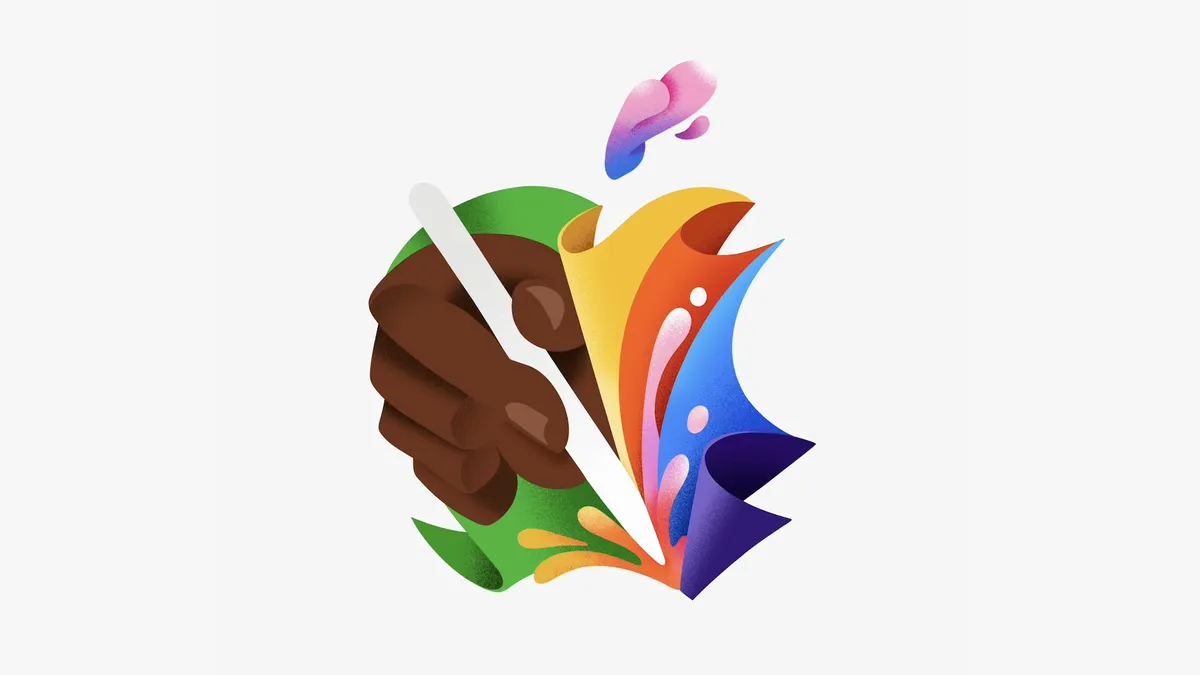


While Apple doesn't tend to mess with the logo proper, the simplicity of the design has allowed it experiment with eye-catching variations to promote its product launch events. It often plays with logo interventions that include clues to what's going to be announced.
The Apple TV logo ident was made by filming a physical copy of the logo made from semi-translucent glass against a background of changing colours.
To discover the stories behind other tech logos see our pieces on the YouTube logo and the Google logo. We also delve into the Coca-Cola logo history. To work on your own designs, make sure you have the best graphic design software.