Our Verdict
The Audeze MM-500 has been declared the Planar-magnetic version of the legendary Sennheiser HD 650, but with actual sub-bass extension, and there's truth in that. These are upper-mid-forward (that is, vocal-forward) headphones backed up by a touch of lower-end warmth and topped with relaxed treble. And even though they are pro headphones, made for mixing and mastering, many audiophiles have picked up on their striking tuning.
For
- +Exceptional build
- +Very comfortable
- +Textured bass
- +Very detailed mids
- +Relaxed, balanced treble
Against
- -Too clampy for some
- -Elevated upper mids can be stuffy
- -Competitive, cheaper alternatives
Why you can trust Creative Bloq Our expert reviewers spend hours testing and comparing products and services so you can choose the best for you. Find out more about how we test.
The MM-500 headphone is the result of years of back and forth between 18-time Grammy-award-winning engineer Manny Marroquin and Californian audio company Audeze. The aim was to create a luxury headphone for mixing and mastering engineers – an audio tool that helps pros nail down the midrange of a mix, inspired by possibly the worst pair of budget bookshelf monitors ever sold.
Spiritually inspired by the crappy Yamaha NS10 speakers, the MM-500 is very much a studio headphone designed to help pros identify issues in the mix. So why the hell am I reviewing it as a non-mixing audiophile? Because its sound profile, although tuned to sniff out audio stinkers, celebrates the vocal region and is an addictive listen. Also, supreme build quality and comfort are universal.
Price: $1,699/£1,699
Release: June 2022
Driver & housing: 90 mm planar magnetic driver, open back
Material: Machined aluminium chassis, spring steel headband, and premium leather ear pads
Cable: 2.3m; 4.4mm termination; dual 4-pin mini-XLR
Impedance: 18Ω
Sensitivity: 100dB/mW
Weight: 495g
At $1,699, the MM-500 headphone is no contender for my list of the best budget audiophile headphones. Out of that list, there's nothing there that sounds as good as the MM-500 to me. But if you are willing to jump from budget to $300 price range, things get far more compelling, as I discuss in the competition section below.
Why the Yamaha NS10?
When listening to record mixing engineer Manny Marroquin talk on the release of the new Audeze MM-520 – an incremental improvement on the MM-500 – he says something curious. The MM-500's tuning was based on the Yamaha NS10 bookshelf speakers, a pair of budget monitors that Manny, and countless other audio pros, have been using for mixing since their 1978 release.
But the NS10 speakers are notoriously shit. They have more issues than a vintage Marvel comic collection. “I wanted a pair of speakers on my head that I could trust,” explains Manny. And there's the answer. Mixing engineers aren't always looking for a perfectly neutral tuning. Sometimes a troublesome sound profile is their best friend.
The NS10 had no bass to speak of – it rolled off massively from 200Hz. Its treble was pretty grotesque, too: Think piercingly harsh and unforgiving. The mids weren't perfect either, as there was a big peak around 1.5-2kHz... So far, so why the hell were these things even used?!
Well, with no enjoyable bass to distract, and once the treble was tamed a little with tissue paper, that mid presentation became gold for tuning the midrange of a track. Any mistakes and fluffs that needed fixing would show up under the NS10's mid-microscope. Add to that an incredibly fast response time, and more and more engineers used them to nail down the heart of a track, before moving over to other, more pleasant-sounding speakers or headphones to work on the lower and higher frequencies. After all, the midrange is what's most audible on the weak speakers that most people still use to listen to music.
"Speakers on my head"
But the MM-500 doesn't sound horrible, so what's the link with the NS10s?
Manny and Audeze didn’t just copy and paste the tuning of the NS10. They took the soul of the speakers (that is, its approach to the midrange), and added an extended bass and a far more pleasant, relaxed treble. Instead of the 1-2kHz NS10 peak, the MM500 elevates 3kHz. The result, as I detail below, is a very vocal-forward tuning.
So these are supreme mixing headphones that are universally loved based on speakers that every mixing engineer uses? Not quite. As with all things audio, the MM-500's mid-forward approach won’t be to everyone’s liking, and some mixing engineers dislike the NS10s, and prefer to mix according to either a neutral sound signature or something with another distinct colouration, such as the Beyerdynamic DT 990 Pro treble guns.
Regardless, the NS10 approach to mixing is still popular and many mixing engineers have taken to using the MM-500 as one of their main mixing tools.
But how do they sound to a non-professional, music-loving audiophile like me?
Sound profile

Overall, the MM-500 is balanced, but I wouldn't call it totally neutral. Though its bass, majority of midrange and treble works well together, the emphasis on elevated upper mids moves vocals up-front and in your face. This can be a lot at times, but then on well-mixed tracks, it can be a tuning that I find addictive; that I want to go back to, to listen again to a familiar track, so hear it through the MM-500 filter. That means the MM-500 is an excellent addition to a headphone collection, but unless you specifically want this tuning, it's a harder sell as someone's sole set.

Midrange: This is no doubt the star of the show here. The MM-500 features a 3kHz, upper-mid peak, which is further emphasised by an immediate scoop after it. The most obvious result of this is it brings vocals to the fore. What stops it from being too glaring is that this peak is partnered with a full 100-400Hz mid-bass, so vocals and instruments sound full with plenty of body.
But this approach can catch you out – it's pretty indiscriminate, and will put a microscope over your favourite music, and anything without a nicely balanced midrange will come up short. When things work out – on vocal-led music or anything with woodwind, such as Crosby, Stills & Nash and Me and My Friends – this headphone becomes addictive. I've actively searched for more music to get my fix of the MM-500's presentation.
Having said all that, the Audeze MM-500's 3kHz colouration is the absolute max I can tolerate. Any more – even a smidge – and it becomes shouty and harsh. This is not a tame, friendly, jolly colouration. It’s a meaningful, big and bold peak that’s put in there for a specific purpose. It’s not meant to sound lovely, smooth or rich. It's enticing and unforgiving. After all, it brings vocals and instruments right up into the foreground so Manny can mix!
It's worth noting that using the MM-500 to listen to isolated vocals in podcasts, and it gets a little fatiguing, and I need to turn the sound down.

Back to music, and the bass is the unsung hero of the show. If there wasn't that full mid-bass and if things didn’t extend into the lower frequencies, that bold upper midrange would definitely be too much. It’s such a juggling act, but the warmth of the linear bass, coupled with the relaxed treble, makes that 2.8/3kHz peak a scalpel, not a cleaver. But it’s close! Playing around with my Luxsin X8 DAC/Amp, adding just 1dB more at 2.8kHz makes it unmanageable.
Now, whether you enjoy the MM-500 sound profile or not, you have to admit that this headphone has been expertly tuned; it's brilliantly balanced. Mess with one area of the frequency response just a little, and the whole thing starts falling down around you... well, apart from adding bass. A bass shelf still sounds pretty awesome.
Without the shelf, the bass is well-textured, and a lot more pronounced and satisfying than the graphs would suggest.
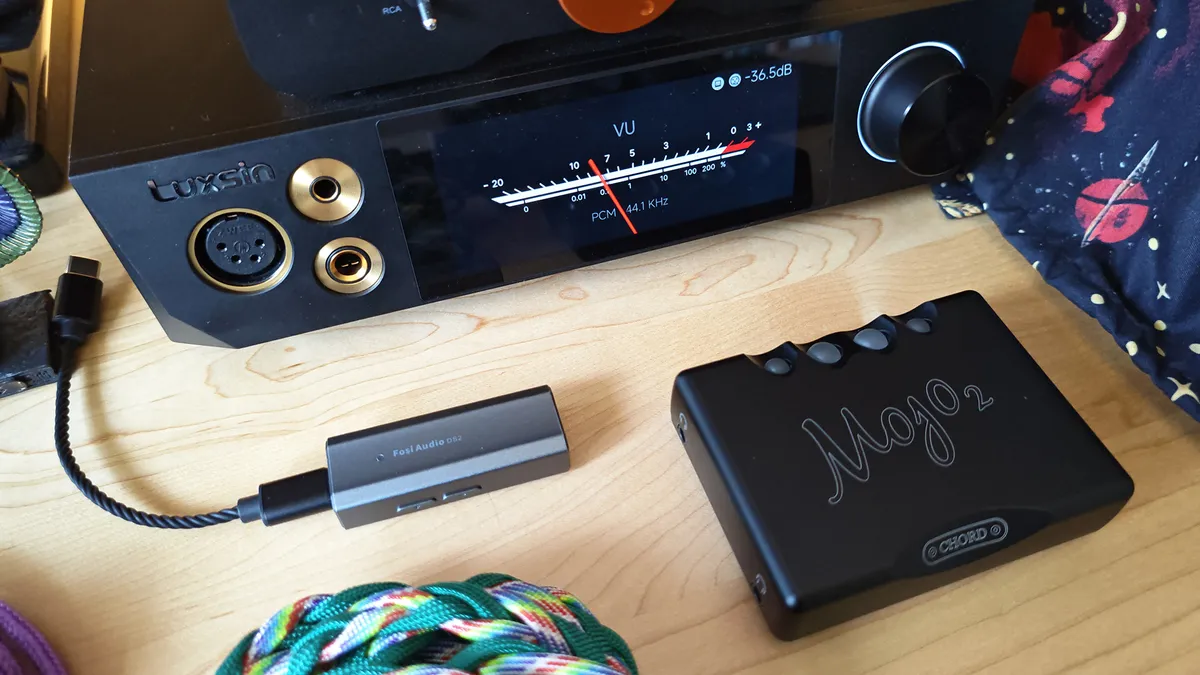
For all my headphone and IEM reviews I play them through the Luxsin X8, Chord Mojo 2, and Fosi DS2 DAC/Amps, as well as my MacBook Air (M5). This ensures sufficient power for peak performance, while providing a transparent source for a clean, detailed signal. My music sources are Spotify Lossless and CDs.
When it comes to the treble, the MM-500 is relaxed yet offers sufficient detail. That's because the lower and mid treble is fairly tame, with focus on the air region of 10kHz and higher.
For my tastes, I could do with a bit more lower and mid treble, as it brings more dimension to more dense and busy tracks. With the MM-500's signature, such tracks can sound a little smeared. Of course, that would be to venture into a more traditional 'Hi-Fi' sound profile, and we have to remember, that's not what the MM-500 is trying to do.
The upshot of this treble presentation is that it's never the limiting factor for a long listening session. That is squarely the upper midrange! This treble could never be described as sibilant or piercing.
Price & value

I can't speak to the value of the MM-500 as a pro headphone. I can only guess that an 18-time Grammy-award-winning mixing artist knows what he's doing, but for a serious take on that, I'd suggest you head over to hear what Panorama Mixing & Mastering has to say.
From an audiophile standpoint, evaluating the MM-500's value is easier. Let's look at the build, sound, comfort and price.
When it comes to the build, the MM-500 is a sturdy set that should last a lifetime. Its leather, aluminium chassis and spring steel headband are beautifully put together, and feel great in my hand and on my head. I also appreciate that I could throw these around a bit without worrying about breaking them... of course they're worth more than I earn so I'd never actually do that, but it's a comforting feeling, nonetheless.
The sound profile, as detailed above, is specialist. But because it does what it aims to do successfully, I've no doubt that it will be someone's end game sound, and therefore worth the investment. Not for nothing were they super reviewer Mark Ryan's new favourite headphones back in 2023 (and he bought his set).
The comfort is excellent. Some people find their clamp force too much, and the ear cups too small, but I didn't experience either of these things. I think the clamp force is ideal for head movements – these things don't slide about. And the ear cups fit ideally around my average-sized head wings.
Then there's the price. Just to be clear, this is not a product that I would/could ever buy, and though I find the sound signature addictive, I wouldn't have the MM-500 as my one and only headphone. As an audiophile, I would instead buy cheaper versions of their vocal-forward sound (such as the HD 650), as well as more traditional 'audiophile' sounding presentations (the $399 HiFiMan Edition XV, for example).
For me, the $1,700 price only makes sense if you are a pro, or if you're a wealthy audiophile who craves this very specific take on a vocal-forward tuning, and wants more quality build than the HD 650 has to offer.
Ultimately, the Audeze MM-500 is only good value to a very specific audiophile, not the majority.
Competition

I've compared the MM-500 with the HEDD D1, Sennheiser HD 650 and HiFiMan HE1000 for different reasons (here's a link to how all these graph).
The D1 is currently my neutral standard, and does an excellent job of highlighting shortcomings and strengths in other headphones. It's basically the headphone that I would personally buy if I had $800 to spend on headphones.
The HD 650 is a warm, vocal-forward set that the MM-500 has already been compared to, so it makes sense to pit them against each other.
Finally, the HiFiMan HE1000 goes for a completely different approach to tuning, but it's currently the best example of that classic 'hi-fi headphone experience' that I'd heard. And it's half the price of the MM-500.
MM-500 Vs HEDD D1

Let’s start with the king! The D1 has a similar vocal-forward, 3kHz peak approach to the MM-500, yet Manny's cans sound almost stuffy compared to the D1 at times. That’s because unlike the MM-500, which follows its peak with a 4.5kHz scoop, the D1 stabilises after its 3kHz peak, giving a fuller upper midrange.
There's also fuller treble to the D1 and a smidge more bass extension… the D1 is basically the best headphone I’ve heard to date, and is the neutral standard against which I compare all other headphones. And it’s half the price of the MM-500! Is it as good as the MM-500 as a mixing set? I have no idea. But purely for audiophile purposes, it remains the one to beat for me, and brings a smoother, brighter, more neutral, uncluttered and richer listen.
If you want neutral, the D1 does it better than the MM-500. If you want a vocal-forward tuning, the MM-500 wins. But only just.
MM-500 Vs HD 650

The MM-500 has been compared to Sennheiser's 2003 classic by many audiophiles, and it makes sense. The HD 650 is also a mid-forward headphone that brings a warm, rich timbre to instruments, in particular vocals. It also goes for a 3kHz peak, and actually outdoes the MM-500 by one or two dB. But unlike the MM-500 (and like the D1), it doesn’t follow it with a scoop. The result is a fuller upper midrange.
On the graphs, it has a slightly similar treble to the MM-500, though the little bit more treble it has goes a long way. I think it's a touch clearer. It also has more bass, from 40-200Hz (it rolls off below 30Hz). The end result is that vocals are sweeter with the HD 650 – warmer and clearer.
It's not a massive difference on all my test tracks, so you might call that nitpicking. What isn't nitpicking is the price difference. The MM-500 retails for $1,699 while the 2003 classic is regularly sold for around $350.
However, the build quality of the MM-500 is in a different world to the mainly plastic HD 650, and I prefer the heft and quality of the MM-500 build over the HD 650.
MM-500 Vs HE1000

The MM-500 fundamentally differs from the HiFiMan HE1000 Stealth. One is a tool for audio professionals, which has been taken on by audiophiles, and the other is designed to bring you a singularly enjoyable music listening experience.
The HE1000 has a lot more going on in the upper midrange than the MM-500... it's also got more in the treble and air regions, too, which means it may be too bright for some. But what it represents is a classic, traditional 'Hi-Fi' sound profile, that's meant to envelop the listener and captivate them with a spacious, vibrant, rich presentation.
On its 2015 release, the HE1000 sold for $3,000, but now you can get them for around $949, making it one of the best value propositions in high end audio. For that, you get a very expansive, light and airy presentation that makes the MM-500 a little stuffy in comparison.
However, all of that is academic if you're after vocal-forward tuning. The MM-500 handily beats the HE1000 for that.
Build & comfort

The MM-500 is very comfortable headphones for me – but I have read that some find their clamp force too much. I didn't find this, and have successfully enjoyed several multiple-hour sessions of music listening (and sometimes just sitting there with them on, having forgotten to press play, and not noticing for far too long. You know you've done it too).
Another element that could cause comfort issues is the size of the ear cups. If you've got slightly bigger than normal – I think the correct word is abnormal – ears, you might find the ear cups a bit snug. Again, this isn't something I had an issue with, but for $1,700 it's good to make sure before buying them.
As for the build, I've mentioned it elsewhere in the review, but these are exceptionally well built. The real leather, aluminium and steel build should last a lifetime, and I feel that I can throw them about with confidence that they'd never break (though at $1,700, I'm unlikely to test that hypothesis out).
Should you buy it?
The MM-500 headphone is clearly an exceptional pro headphone, so why did I give it 4 stars out of 5, not higher?
This will definitely be some audiophiles' end-game headphone, but I don't want everyone who clicks on this review to presume that that means them. At $1,700, with its specialist tuning, this is not a headphone for the majority of people. Those who vibe with the sound will love it. For others, I think it may be too much.
Its strong upper-mid colouration will be loved by people who want vocals and most instruments up front and in your face, at the expense of a sense of spaciousness. Many top reviewers such as DMS and Mark Ryan have stated that they are those people, and have praised this set as an excellent choice.
This is a pro headphone, and so was not designed to be a headphone used purely for music enjoyment. Now, that's irrelevant if you do enjoy listening to music on it. But it's worth noting that the MM-500 is a mixing tool, tuned to cast a spotlight on the midrange. And it will do just that, to the detriment of poorly mixed tracks. This is no generalist, easy-going set that sounds great with everything in your library.
There's also genuinely excellent competition for a lot less money. For me, the Sennheiser HD 650 offers a more enjoyable sound profile, for a fraction of the cost.
However, the MM-500 is certainly distinct, offering an incredibly addictive tuning. I may not reach for it for every listening session, but when I do I'm guaranteed it's going to be memorable.
out of 10
The Audeze MM-500 has been declared the Planar-magnetic version of the legendary Sennheiser HD 650, but with actual sub-bass extension, and there's truth in that. These are upper-mid-forward (that is, vocal-forward) headphones backed up by a touch of lower-end warmth and topped with relaxed treble. And even though they are pro headphones, made for mixing and mastering, many audiophiles have picked up on their striking tuning.