







Until recently, creating 3D models was a manual process. It required expert modellers to move through a lengthy process of measuring, photographing, modelling, unwrapping, and texturing. Depending on the complexity of the object, this could take anything from 10 minutes to several hours or even days.
Thankfully, 3D scanning technology has now advanced to the point where 3D models of real objects can now be created in a fraction of the time. This is ideal for a range of applications, including 3D printing, automotive, manufacturing, and reverse engineering. The resulting 3D models are incredibly accurate and can be created with very little knowledge of 3D modelling workflows.
I've spent countless hours testing all the best 3D scanners and have collated my favourite picks with category winners so you can find the right scanner for your needs. My number one pick overall is the Revopoint Miraco Plus, but I've also included more budget-friendly options.
The best 3D scanner overall


30-second review: The Revopoint Miraco Plus is an excellent all-in-one photogrammetric metrology and 3D scanning device, with excellent accuracy and a flip-out screen on a top-mounted hinge, which our reviewer found to be particularly impressive, making the scanner easier to work with. Though the workflow—especially for larger items—can be fiddly and time-consuming due to the need for marker placement, the results are unmatched in detail and precision. Its performance, flexibility, and thoughtful accessories like magnetic targets and a turntable make it a top-tier option for serious creators.
Pricing: This scanner has a retail price of $2,119 / £1,750, though current market prices show it available for around $1799 / £1,600. That's a significant investment, making it primarily suitable for professionals and serious hobbyists who require metrology-grade scanning capabilities for larger objects.
Features: The Miraco Plus ships with a photogrammetric metrology kit (PMK), which aims to build upon the original structured infrared light system with quadruple depth cameras that was found on the standard Miraco model (which we have also reviewed). It's great for those wanting to scan larger and more complex objects. This scanner is equally adept at capturing small/medium objects, however, which makes it a one-stop solution for those who don’t want to own different scanners for different-sized objects.
The best budget 3D scanner


30-second review: This compact, affordable entry-level 3D scanner is aimed squarely at beginners and hobbyists. While its 0.2mm single-frame accuracy isn’t top-tier, it’s more than adequate for casual use, especially for scanning medium-sized objects for 3D printing or scene building. The INSPIRE works seamlessly with Revopoint’s RevoScan software across desktop and mobile, and even includes texture capture via an RGB camera. It lacks premium features like built-in exposure controls or a carry case, but its portability, ease of use, and low price make it an ideal starting point for newcomers to 3D scanning.
Pricing: This scanner retails for around $449 / £363 and is typically available with free delivery. This makes it an excellent entry-level choice for those wanting to explore 3D scanning without a significant financial commitment.
Features: We found connecting either to a PC or, for true portability, an Android phone, to be straightforward, and the device offers pretty nifty capture speeds for the price at 14-18 fps, faster than the 3DMakerpro Seal 3D, which is a little more expensive. With the lower level of precision, we did find that this option took a bit more trial and error to get the results we wanted, but if you're prepared to persevere, it offers portability and reasonable speed for a very attractive price.
See our full Revopoint INSPIRE 3D Scanner review for more details.
The best 3D scanner for value


30-second review: The 3DMakerPro Eagle represents exceptional value in the LiDAR scanning market, offering professional-grade capabilities at a fraction of the cost of traditional alternatives. Whilst budget scanners focus on basic functionality, this model delivers advanced LiDAR technology, multiple high-resolution cameras, and the ability to scan large spaces with impressive 2cm accuracy. That means it will excel at architectural surveying, film production, and creating detailed point clouds of buildings and large objects.
Pricing: The Eagle is available in two models: the Standard version with one camera retails for $3,499 (£2,592) with limited pre-order pricing at $1,799, whilst the Max version with four 48MP cameras costs $4,399 (£3,260) with pre-order pricing at $2,299. This represents remarkable value compared to professional LiDAR scanners that typically cost upwards of $10,000/£10,000.
Features: The Eagle's LiDAR system delivers extensive scanning capabilities with exceptional precision and coverage angles. It provides a scanning radius of up to 70 metres under 80% reflectivity conditions and achieves scanning accuracy of up to 2cm at a 10-metre distance. The four-camera Max model captures 8K imaging for detailed colour data and texture mapping, making it ideal for creating comprehensive 3D models of large spaces. The scanner includes a 3.5-inch colour display for real-time preview and ships with a professional hard carry case with custom foam inserts.
Its continuous scanning mode allows efficient data capture whilst moving through spaces, perfect for surveying multiple rooms or large outdoor areas. Despite some minor inconveniences like noisy fans and awkward microSD card placement, the scanner's robust build quality, comprehensive feature set, and professional results make it an outstanding choice for those needing serious scanning capabilities without the premium price tag.
The best hybrid 3D scanner


30-second review: The Creality Sermoon P1 combines ultra-precise blue laser scanning with rapid Near-Infrared light in a single standalone unit; no PC required for capture. The blue lasers handle small to medium objects with high detail, while the NIR mode sweeps larger surfaces and faces quickly. Our testing found it handled shiny, curved objects well after some trial and error, and its onboard 8-core processor makes fusion and meshing genuinely fast. It's a premium price for a premium feature set, but the flexibility of switching between two scanning technologies on one device is hard to match.
Pricing: The Sermoon P1 retails at $3,299 / £3,099, occasionally discounted to around £2,799 in the UK. That prices it above standalone rivals like the Revopoint Miraco Plus, but the combination of dual scanning technologies and untethered operation helps justify the premium for professionals who need both precision and flexibility in one device.
Features: The Sermoon P1's big trick is its hybrid optical system: switch between a multi-line blue laser for high-accuracy detail work and rapid NIR structured light for capturing larger surfaces quickly. Both modes ran through the onboard 6-inch full HD touchscreen without needing a computer, powered by a Qualcomm 8-core CPU, 24GB of RAM and 256GB of storage. Two hot-swappable batteries are included as standard – a useful touch for extended field sessions – and the scanner handled dark, glossy and reflective surfaces without needing anti-reflective spray.
Read more: Creality Sermoon P1 Scanner
The best pocket 3D scanner


30-second review: Bit of a curveball, but the iPhone 16 Pro is an excellent 3D scanner. Yes, sometimes the best tool is the one you (may) already have. Since the release of the iPhone 13 Pro, the LiDAR Scanner has been used as part of the AR solution for creatives and as a 3D scanner. A wide range of apps can turn your iPhone into a portable or tripod-mounted 3D scanner.
Pricing: The iPhone 16 Pro starts at $999-£1,199 (£999-$1,199) depending on storage capacity. While expensive solely as a 3D scanner, it becomes cost-effective if you need both a high-end smartphone and 3D scanning capabilities. In other words, it's a good option if you're upgrading your phone anyway.
Features: While not as accurate or sophisticated as the other devices mentioned in my list, the iPhone is still a perfect stepping stone for those artists curious about 3D scanning. And I'm not the only person saying this: Metahuman Animator from Epic Games is a feature of Unreal Engine than can use depth footage from an iPhone to scan an actor's performance and render the mocap data into a 3D, animated model.
See our iPhone 16 Pro review for a general analysis of the phone.
Best money-no-object 3D scanner


30-second review: This is the most advanced and expensive 3D scanner we've reviewed at Creative Bloq, so naturally it was a shoe-in for inclusion in this guide – as long as you've got deep enough pockets for it. Its dual-camera base station has markers all over it, eliminating the need for placing markers on the object you're scanning, which significantly speeds up workflow.
Pricing: As mentioned, this is not what you'd call a cheap option. The nominal cost from the Revopoint website is $4,980 / £4,385 for the Trackit scanner, and while discounts are quite common, you're still looking for a significant outlay. It is, however, a significant timesaver, so could be worth the investment for busy professionals.
Features: This is a hugely impressive scanner that delivered exemplary performance in our testing. The markerless scanning process really is a colossal timesaver, and the lightweight design and long cables make it easy to move the Trackit around to scan larger objects. With a volumetric accuracy of 0.025mm + 0.04mm x L(m) and the ability to scan up to 1.5 million measurements per second, this scanner absolutely chews through tasks. It requires a fair amount of space, and can take a while to set up, so is best for those with their own studio space where they can leave it set up, rather than casual hobbyists. If you're someone who needs (i.e. can financially benefit from) its speed and accuracy, I think this 3D scanner could be one of the soundest investments you make.
See our Revopoint Trackit review for more details on this highly impressive scanner.
The best all-in-one 3D scanner


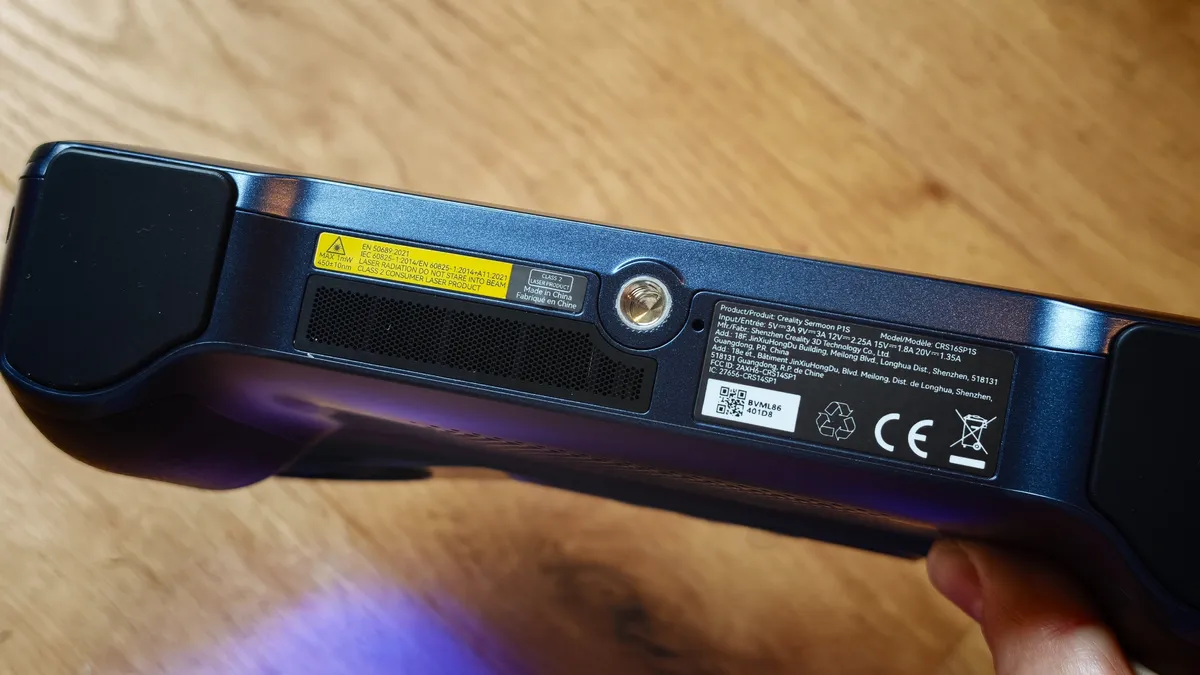

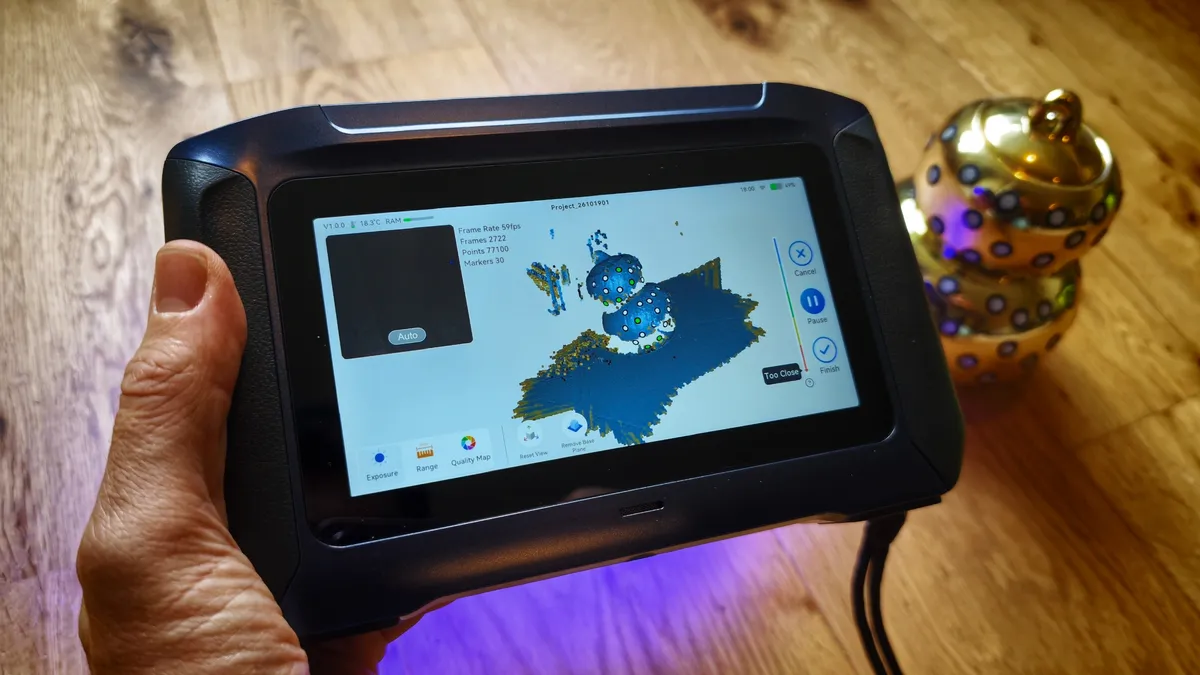
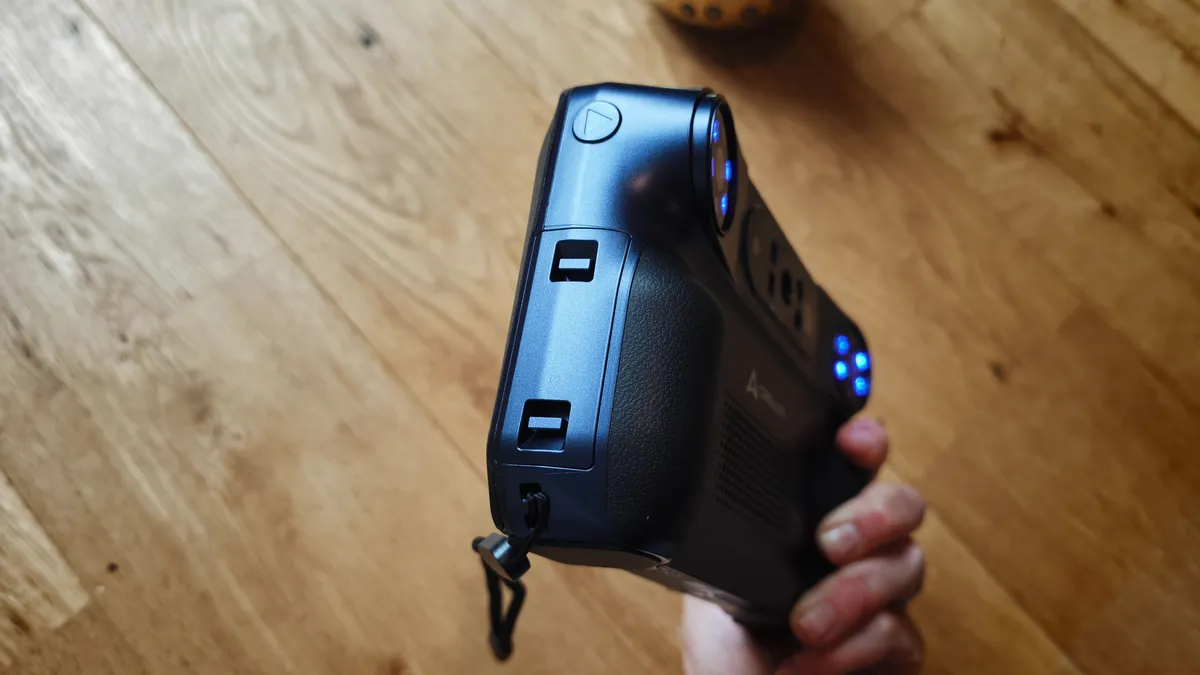


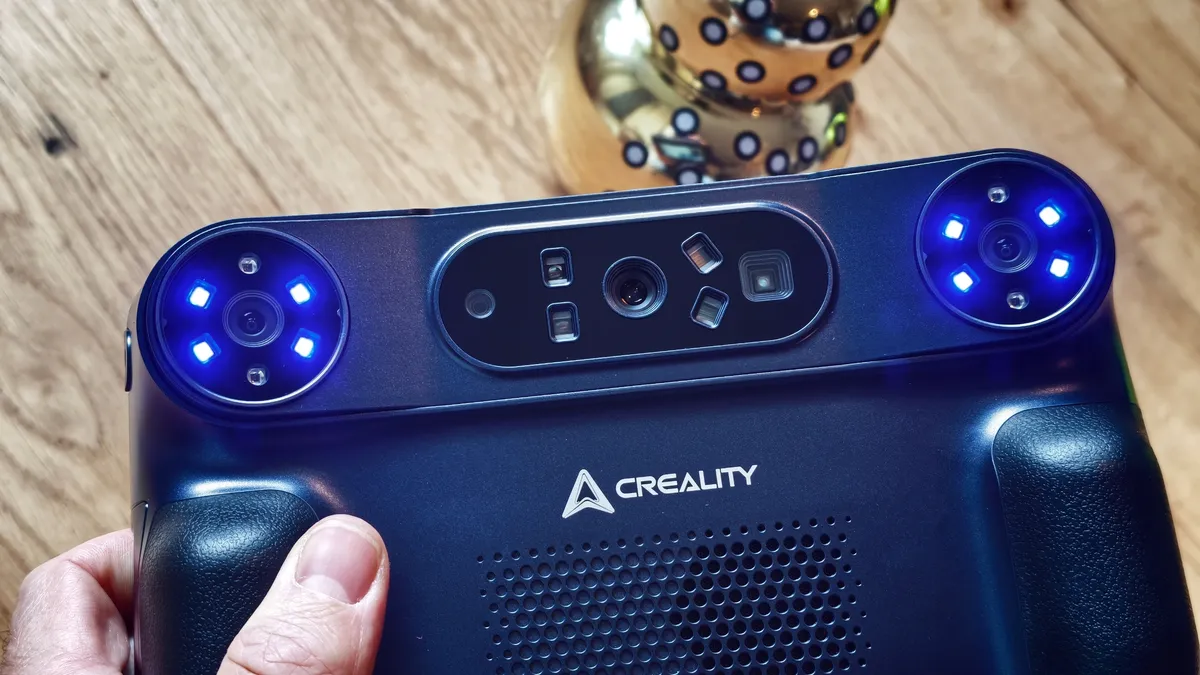

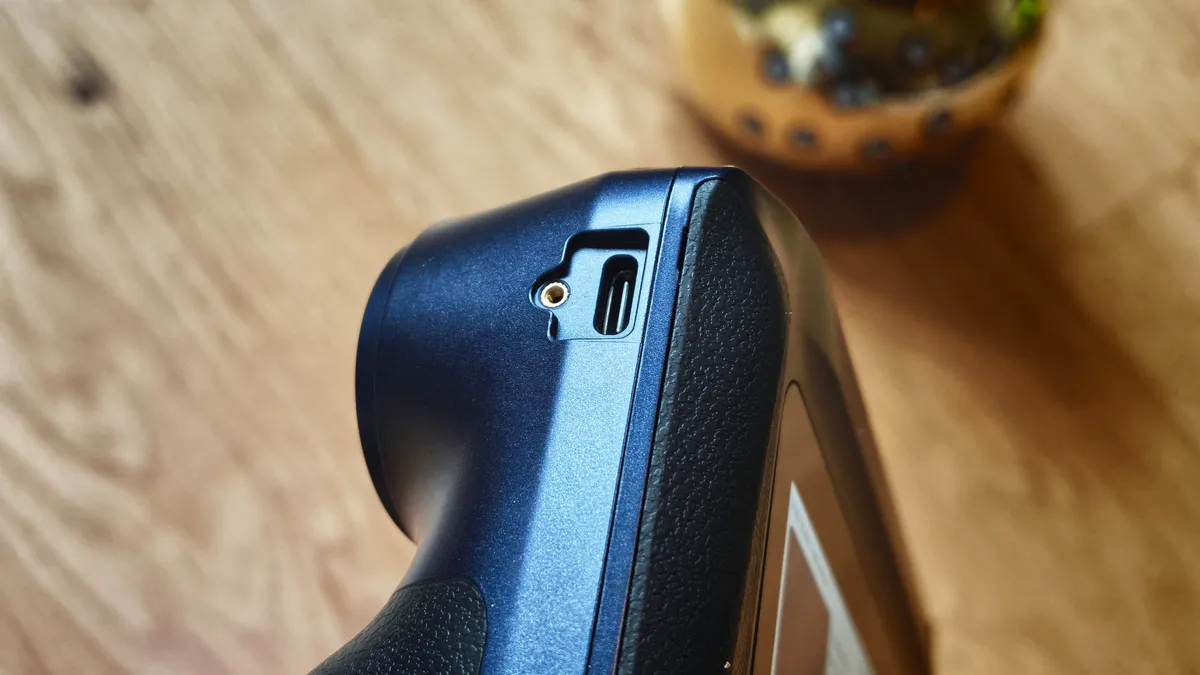

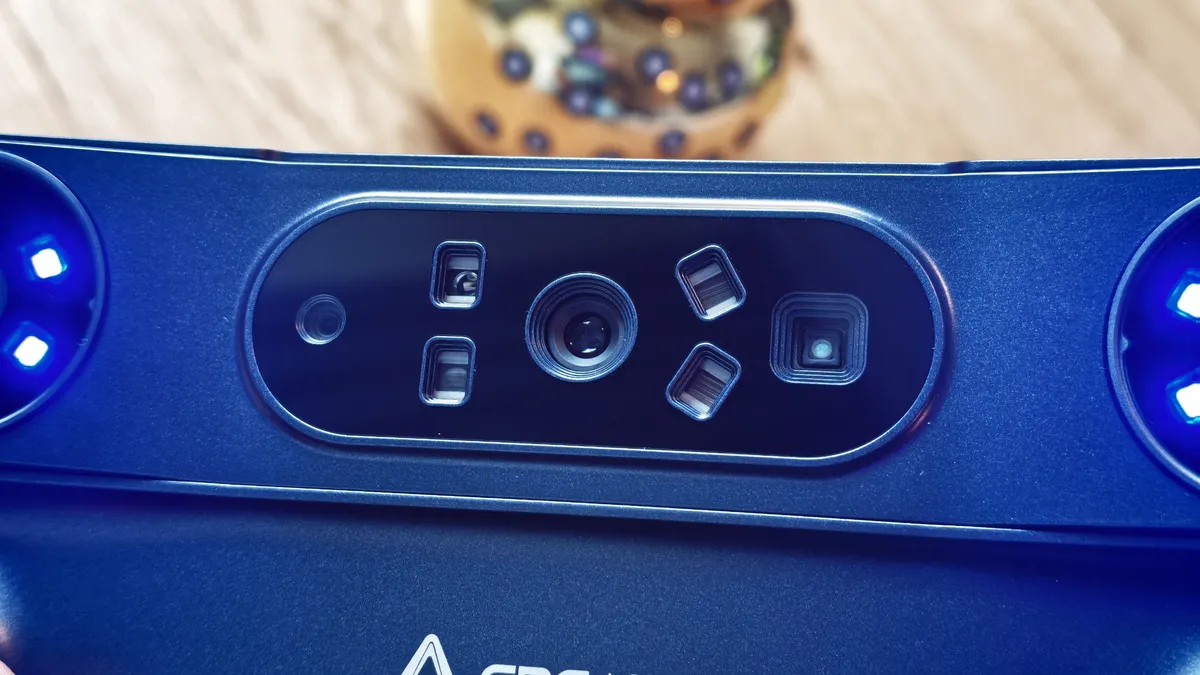


30-second review: The Sermoon P1S is an excellent hybrid scanner for users who need the versatility of laser and near-infrared scanning technologies. I had hoped that it would mark the end of needing scanning spray, but unfortunately it struggled during my shiny object testing. On the whole, though, the P1S delivered accurate results. One of the best things about the scanner is that it boasts an untethered all-in-one workflow courtesy of its powerful onboard processor, built-in software, and large 6-inch display. It also features hot-swappable batteries for a smooth and effective portable scanning solution.
Pricing: The scanner costs £2,199 / $2,229, although since its release it has received several generous discounts. The price puts it squarely in competition with the excellent Revopoint Miraco Plus, although the latter features a 180-degree flippable screen which is useful for some scanning applications.
Features: The P1S is a feature-rich laser and near-infrared scanner that is designed to work with a variety of workflows, including automotive, manufacturing, inspection, arts, antiques, and reverse engineering. Its hybrid capabilities enable users to scan objects ranging from a small 40mm coin all the way up to a large 2.2m length motorbike. One of the most innovative features of the P1S is its onboard software, which includes AI capabilities which can add in scanned data where the scanner struggled to pick up sufficient points. The Sermoon P1S is a fantastic all-in-one scanner with a fast processor and hybrid scanning technologies to deliver results across multiple workflows.
Read more: Creality Sermoon P1S Scanner
3D scanners we've also tested


How to choose the right 3D scanner
To choose the right 3D scanner for you, you need to consider a series of key factors. Firstly, what will you be scanning? Object size, detail level and desired accuracy will all point you towards the kind of scanner you need, and we've mentioned these details for each scanner above.
Also think about budget. 3D scanners range from budget-friendly phone attachments to high-end industrial models costing tens of thousands. Determine how much you're willing to spend and prioritise features accordingly. Another factor is ease of use. Some scanners require extensive training, while others are more user-friendly. Finally, ensure the device's software is compatible with your hardware and operating system.
How we test 3D scanners
When we review 3D scanners, we test their accuracy, reliability, and performance. Our evaluation typically involves a series of comprehensive assessments to validate the scanner's ability to capture and reproduce three-dimensional objects with precision. Initial tests focus on the scanner's calibration, verifying that it accurately interprets spatial dimensions and distances. We also evaluate resolution, examining the device's ability to capture fine details, and speed of operation.
FAQs
Are 3D scanners worth the money?
Why you can trust Creative Bloq Our expert reviewers spend hours testing and comparing products and services so you can choose the best for you. Find out more about how we test.
It is possible to create 3D scans using one of the best smartphones, but the results pale into insignificance when compared to what dedicated 3D scanners are capable of. 3D scanners, like the ones listed in this guide, deliver far greater accuracy, more extensive feature sets, and versatile scanning technologies for scanning a wider array of objects. If you're a serious hobbyist or a 3D scanning professional, then yes, 3D scanners are worth the money.
How much should I pay for a good 3D scanner?
3D scanners can range from around a few hundred dollars/pounds all the way up to several thousands. The more features you want and the greater the accuracy you need, the more money you're going to need to pay. That said, spending around $500 / £400 will provide an accurate 3D scanner that is perfect for hobbyists.
What app do I need to 3D scan on an iPhone?
If you're wanting a cheap and straightforward way to create simple 3D models, then using an app like Polycam on an iPhone or iPad is a great choice (read our iPad generations feature to find which is best for you). This will capture 3D scans using the LiDAR sensor, and you can edit the results in your mobile or tablet.
Are 3D scanners accurate?
The short answer is yes. Most 3D scanners deliver accuracy in the range of 0.01mm and 0.1mm. This is more than sufficient for most workflows and will deliver usable results for most follow-on applications. The general rule is that the greater the accuracy, the larger the file, although jost modern scanning software packages are able to optimise scans to help manage scan density.
Is photogrammetry better than 3D scanning?
Photogrammatery and 3D scanning are suited to different applications. Photogrammetry is good for realism and for scanning large rooms and spaces. 3D scanning is better for creating accurate 3D models of small to medium objects. Depending on what you're scanning, the type of technology will change.