


For a while now, the conversation around AI art has been about what artists stand to lose, whether that's jobs or opportunities, as years spent mastering anatomy, composition and colour theory are all reduced to a well-crafted prompt. We've heard Dave McKean say artists must "revolt against the soulless [AI] machines" and heard how Greg Rutkowski's very name became a style prompt. And yet, against this background, Brazilian visual development and concept artist Daniel Porto has sidestepped the controversy and chosen to focus on the positives AI can offer.
Porto has spent 20 years creating work for global agencies including McCann, Jung von Matt, GUT and StrawberryFrog, earning six places in Lürzer's Archive's Top 200 Digital Artists Worldwide along the way. Today, he blends traditional digital art with AI to create the polished concept art and advertising imagery clients expect. For someone with decades of experience in how things used to be done, he's not afraid to see where AI can be used, but he's also clear: his experience and knowledge as an artist are why he's confident AI can be harnessed.
"The experience got amplified," Porto says, adding: "Everything I built over those years – the drawing, the art direction, the visual repertoire – suddenly has a much shorter path to the screen."
While AI can generate many images in minutes, Porto argues it still can't replace artistic judgement. Knowing which image works, understanding why the lighting feels wrong, spotting bad anatomy, or shaping a visual into something that serves a story are skills built over decades, not downloaded overnight. I spoke to Porto about why using AI is only a small part of his workflow, why Photoshop and Blender remain essential, and why experienced artists may find AI can strengthen their craft rather than diminishing it.
Read below how Daniel Porto combines AI with digital art, Blender and his years of art knowledge. Visit his portfolio site to see the results.

Creative Bloq: You say AI has made your 20 years of experience more valuable. Why?
Daniel Porto: The experience got amplified. The distance between what I could imagine and what I could actually produce was defined by budget, team or time. AI collapsed that distance, but not as a shortcut, not as easy as “prompting”. It's about no longer depending on a huge production structure, or fighting complex processes, to experiment and bring to life whatever is on your mind. Everything I built over those years – the drawing, the art direction, the visual repertoire – suddenly has a much shorter path to the screen.
CB: What can an experienced artist do with AI that a beginner can't?
DP: AI can generate a hundred images in minutes – the value now is in knowing which one to pick, and why. That's the experienced artist's trained eye: judging which results are good, what fits the project, what can help to tell the story. Skills can be trained, and a young professional might even be very skilled. But the maturity to make creative decisions is something only time and repertoire can bring. There are no shortcuts or tutorials for that.


CB: How much of your work comes from prompting, and how much comes from traditional art skills and knowledge?
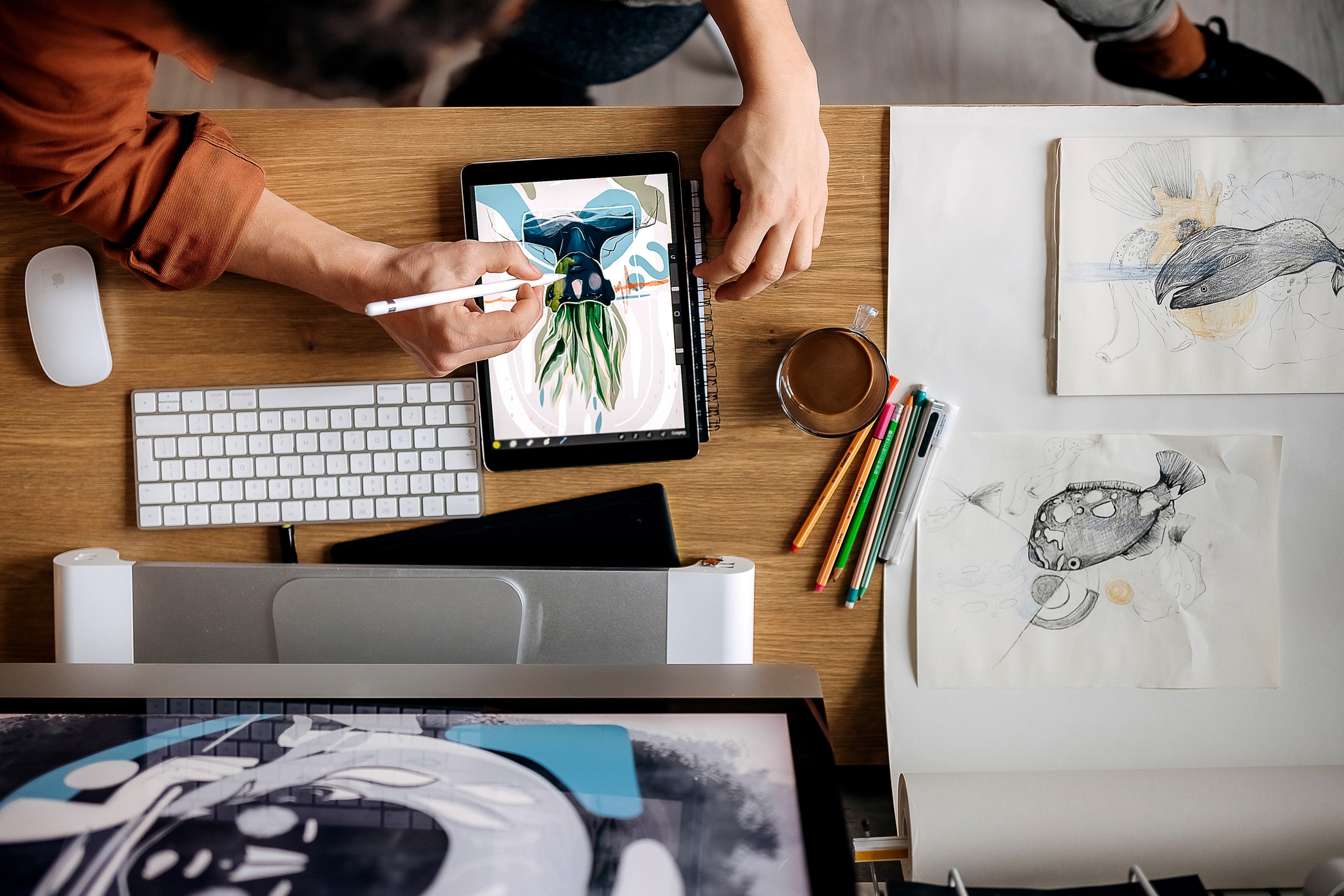
DP: Prompting is a small layer of my work. Most of it still comes from drawing, photobashing and retouching. What people don't see is that a good prompt is just art direction in text form: you can't describe light, lens, composition and mood precisely if you never learned how they work.
CB: Has AI changed the way you approach visual development and concept art?
DP: Absolutely, because it expands the possibilities. I can visualise faster, experiment more, make more mistakes – and mistakes are where the interesting ideas usually live. Before, exploring ten directions for a concept was a luxury few briefings could afford.
CB: Can you describe your typical workflow from idea to finished image?
DP: Once I have the concept in mind, or a briefing, the first step is building a mood board: gathering visuals, references, anything that could feed the idea. Then I start drafting the visual myself – by hand or photobashing, it doesn't matter. Only when there's a clear artistic direction does the prompting begin – generating separate assets, or using my draft as the base for generation with resources like ControlNet and inpainting.
The grand finale is always the retouching: compositing, colour grading, refining lighting and details. The idea is human, the finish is human; AI accelerates everything in between.
I'll share a video breakdown of one piece – the process was different, but it gives a clear idea of how it can look.
CB: What do people get wrong about using AI professionally?
DP: Thinking AI will do everything by itself, and leaving the human out of the process. And you also can blame the AI brands for that – they're always selling “look how easy I am to use, you'll get stunning results doing almost nothing.” What they don't say is that AI has no taste. It doesn't know your client, your brand, or the story you're trying to tell. Someone still has to know what “good” looks like – and that part was never automated.

CB: Which traditional creative skills matter most when working with AI?
DP: Retouching, for post-processing the image. That's the stage where you make it look professional – grading colors and light, fixing the details AI couldn't handle well. But retouching only works because of the fundamentals behind it: light, composition, anatomy, perspective. That's what tells you what to fix – and what to throw away.
CB: How have clients' expectations changed since AI entered the creative industry?
DP: Not long ago – something between one or two years – the possibilities were more limited and expectations were sky-high. Clients thought you could do anything because "it's AI". That created a lot of misunderstanding – accounts promising things that were impossible to deliver. Today the demand is bigger than ever, and agencies and production companies have gotten much better at managing expectations and bringing them in line with what's actually possible. The conversation matured: it stopped being "AI can do anything" and became "what is the smartest way to use it on this job.
CB: Where do you think AI still falls short for professional artists?
DP: Video generation, mainly. Keeping a character consistent across shots, holding temporal coherence in longer sequences, or directing the camera and motion with real precision – all of that still takes a lot of workarounds. In my case, I block the scene in Blender and use it as a guide for motion and composition – it's also how I keep proportions accurate, something AI often gets wrong, especially when you're working with real products. We need finer control over the results, not just prettier outputs. Things are moving fast, though.


CB: What advice would you give experienced creatives who are unsure about AI?
DP: Don't fight it. Embrace it, experiment, break it, and build your own workflow. Your experience is not threatened by these tools. If you have vision and repertoire, this is the best moment of your career to use them.
CB: In five years' time, what do you think the role of a creative director will look like in an AI-enabled industry
DP: Technically, everyone will have access to the same technology – execution is on a level playing field. It is being democratised; vision is not. So the question becomes: whose creative vision is the most interesting? The creative director gets to think bigger. The impossible shots – the ones that always died in the budget meeting – are now on the table. Whoever has a unique eye will be worth their weight in gold – AI will make craft and uniqueness more valuable than ever.