



If design truly mattered inside most organisations, nobody would be asking whether software was about to replace it. Nobody worries that spreadsheets will replace pilots or that judges are one software update away from being substituted by flowcharts.
We instinctively understand that professions which own judgement are insulated from improvements in tooling. Better instruments do not threaten the surgeon; they extend the surgeon's abilities. Better navigation systems do not threaten the pilot; they increase the pilot's range. The professions that become anxious when new tools arrive are usually those whose authority has already been quietly transferred elsewhere.
The current anxiety around AI is therefore less a story about technology than a confession about status. It reveals something many organisations have been reluctant to acknowledge: design has spent years surrendering decision-making authority while retaining responsibility for execution. The concern is not that machines have suddenly become creative. It is that design has increasingly been treated as production.
The Apple effect

This is not the first time the discipline has mistaken symptoms for causes. Every generation receives its own version of the apocalypse. Desktop publishing was supposed to eliminate graphic design. CAD software was expected to make industrial designers obsolete. Template libraries, offshore studios, design systems and no-code platforms all arrived with predictions that human-made design was about to become irrelevant. None of them did any such thing. What they did do was expose how much of design's value organisations believed resided in making things rather than deciding things.
For a brief period, that trajectory appeared to reverse. Apple demonstrated that design was not an aesthetic layer applied at the end of a process but a governing discipline capable of shaping an entire enterprise. Product design, retail, packaging, interfaces, advertising and customer support behaved as parts of the same system. Customers queued overnight to buy products they had never handled. Product launches became global media events. People paid premiums they could rationally avoid. This was not because Apple had discovered a superior type of aluminium. It was because design was influencing everything: what existed, how it behaved and what it meant.
Boards noticed. Chief design officers appeared. "Experience" escaped the marketing department and entered the boardroom. Designers found themselves participating in conversations previously reserved for finance, operations and strategy. For a while, design helped determine what organisations built, not simply how those decisions were communicated.
Another shift

The problem was that the moment was celebrated before it was secured. In many organisations, design's influence rested on exceptional individuals rather than durable systems of governance. When those leaders departed, so did much of the authority. Design was folded back into product, operations and marketing. It became consultative. It facilitated workshops, aligned stakeholders and generated options. Gradually, it stopped deciding. And strategy, as it turns out, is usually controlled by whoever retains the authority to say no.
This shift mattered because design's contribution has never been primarily aesthetic. Design is fundamentally a cognitive discipline. It determines whether complexity feels manageable or overwhelming, whether a service feels trustworthy or suspicious, whether a customer leaves an interaction feeling competent or confused. Features matter, but people rarely experience features directly. They experience interpretation.
Stripe illustrates the point. Financial infrastructure is inherently complex, yet developers actively prefer Stripe because design translates complexity into comprehension. IKEA succeeds for similar reasons. Its famous flat-pack box is not really a packaging decision; it is a business model decision disguised as packaging, influencing manufacturing, logistics and pricing long before aesthetics enter the conversation.
Design as administration
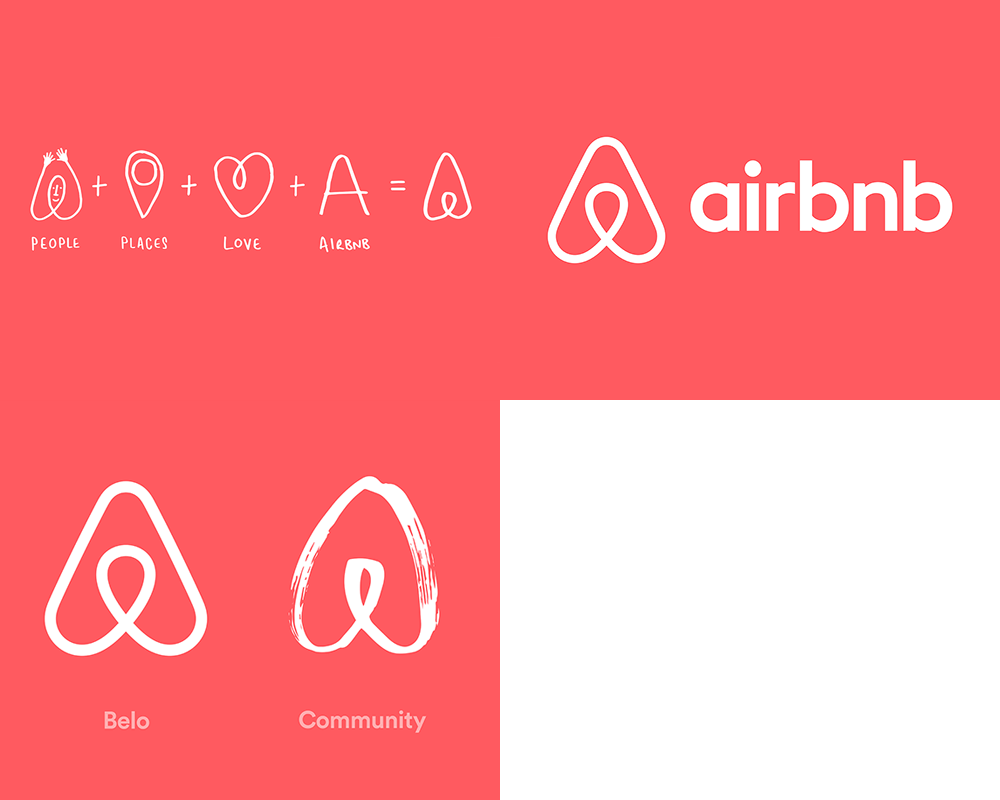
The same principle explains why customers choose products in the first place. People do not buy products and services. They hire them to make progress in their lives. A mortgage is hired to reduce uncertainty. A delivery app is hired to remove friction. Airbnb was not merely selling accommodation; it was selling confidence that staying in a stranger's home could feel predictable and safe. Design governs whether those emotional contracts are honoured or broken.
Once design is reclassified as a support function, decline becomes inevitable. Support functions are expected to be efficient, agreeable and non-disruptive. Their value becomes measured through outputs rather than outcomes. Over time, judgement becomes "opinion", curiosity becomes "scope creep" and healthy disagreement becomes "friction". Design is gradually trained to behave like administration.
Administration, unfortunately, can be automated.
By the time AI appears threatening, the argument has already been lost. If designers are primarily producing assets, layouts and variations, software is simply competing on the same terrain. The deeper failure is that design allowed its influence to be redistributed without contesting the narrative. When products succeed, executives claim vision. When loyalty grows, marketers claim positioning. When users remain engaged, leaders claim culture. Design is embedded in all three outcomes and credited in none of them.
Resistance and challenges
A few organisations still resist this logic. Nike treats design as a driver of meaning rather than decoration, integrating product innovation, storytelling and retail into a coherent expression of the brand. Airbnb continues to treat experience coherence as a strategic asset. In these organisations, AI is not a threat. It removes drudgery, accelerates exploration and amplifies judgement. It behaves as leverage because design still retains authority.
Design does not need to become more efficient. It needs to become harder to override
Which points to the real challenge. Design does not need to become more efficient. It needs to become harder to override.
That means placing design leadership alongside product, engineering and finance, with authority over direction rather than presentation. Until design returns to the centre of decision-making, every technological advance will continue to feel threatening. Not because software is staging a coup, but because authority has quietly migrated elsewhere. And when design gives up the right to decide, it eventually gives up the right to matter.
Creative Bloq is now easier to access than ever before with our on-the-go app, which brings you all the content you know and love from our website, but in a super-streamlined design.

