



Hell Let Loose: Vietnam is the follow up to Expression Games' 2021 hardcore World War II squad-based multiplayer first-person shooter. As the title suggests, the battlefield for the tactical large-scale combat this time is the Vietnam War, a setting that's captured with stunning realism.
Developed in Unreal Engine 5, the game presents the jungles, villages and rice fields of the location with remarkable detail across its huge maps, making for immersive 50v50 player battles. I caught up with Senior Art Director Ryan Playle-Howard to learn how Expression Games brought the setting to life, and what challenges it faced along the way.
If you're inspired, see our pick of the best laptops for game development.

What was the biggest challenge in creating the visual style and realism?
Unquestionably, the biggest challenge was achieving the fidelity, density and variety needed to convincingly represent our version of the Vietnamese jungle. It took a huge effort from a lot of key team members to achieve that.
From the vertical slice through to tool development, there were a wide range of visual and technical challenges we had to navigate. Across the six maps at launch, we have around 24 square kilometres of landscape, so our maps are very large, and a significant amount of that is made up of transitional jungle biomes connecting the more art-directed capture points and POI locations.
At that scale, we couldn't approach the jungle purely by hand. We needed to build a toolset that allowed us to create that density and complexity quickly, but crucially, it still needed to be art and design-led. Getting that balance right was difficult and became a heavily iterative process throughout development.
Our move to Unreal Engine 5 allowed us to utilise its Procedural Content Generation (PCG) framework, but a considerable amount of development went into maturing those tools into something capable of populating maps of this size effectively. Arguably, that work is still evolving as we expand into new biomes and locations for future live-service content.
Then came the challenge of building an asset library with enough variety, fidelity, and believability to support that system. You very quickly notice repetition in a natural environment if there isn't enough variation, particularly at this scale. At the same time, all of that density still has to perform across our different platforms. We had some incredibly capable artists, both technically and visually minded, who worked through those problems.
Ultimately, the challenge wasn't just making a jungle that looked convincing in a screenshot. It was making one that remained convincing across kilometres of playable space. It had to have the density and visual fidelity we wanted, enough variety to feel natural, work with Level Design rather than against it, and still perform at the scale Hell Let Loose demands.

How did you make the Vietnam setting feel authentic without relying on familiar war-movie imagery?
Quite simply, reference, reference, reference.
We deep-dived into a lot of historical documentation, war diaries and first-person accounts, a wealth of imagery captured by troops in the field, as well as film footage and newsreels from the time.
A lot of our locations are based in and around the real battlegrounds of the period, so we could study topographical data from Google Maps and Google Earth based on those real-world locations. We also utilised Digital Elevation Model (DEM) data to match those spaces as closely as we could, while adapting them where necessary to support the mechanics and gameplay.
You can't ignore the amount of pop-culture reference that exists around Vietnam. It's part of the modern lexicon and contains many of those iconic moments that people associate with the conflict and want to experience.
But it's very easy to lose sight of reality and become influenced by someone else's interpretation and the story they wanted to tell. As a franchise, we strive to create as authentic an experience as possible, where possible. Quite often that meant going back to the historical imagery and details rather than leaning too heavily into pop-culture references.

What makes a good Hell Let Loose environment from an artist’s Perspective?
The location needs to bring something new to the title. The visuals, feel, and playspace are always important considerations, but ultimately “gameplay is king.” The art MUST support good gameplay.
Good gameplay in Hell Let Loose needs to offer a lot of variety, not least because of the scale of our maps. Offering a range of scale is hugely important. We require large open areas that support vehicle gameplay, longer-range combat and snipers, contrasted with areas of cover and tighter spaces that create opportunities for close-quarters infantry gameplay.
That variation in scale, or what I refer to as “breathe in and out moments”, helps bring variety to the gameplay, but also gives us opportunities as artists to change the flavour of the environment through lighting, composition and sense of scale. On maps this large, that variation is incredibly important. It helps reinforce progression through the environment, gives the player direction, and allows them to internally map the battlefield and understand where they are within it.
Other important touchpoints are strong zoning and distinctive theming, as well as clear directionality and recognisable “poles” across the map. These all help tell the player where they are, where they’re heading, and encourage them to approach different areas in different ways.
Retaining authenticity is also a key pillar when we build maps. There is always room to adapt reality in support of gameplay, but maintaining the feel and identity of the real-world location is incredibly important. That starts during location scouting and pre-production, so that when we choose a location, we’re already looking for those visual, geographical and thematic touchpoints that will give us the ingredients to build a compelling environment.
For me, a good environment is ultimately one where art, gameplay and authenticity are all working together. It should look distinctive and believable, but it should also help the player read, navigate and understand the battlefield, and create different gameplay experiences as they move through it.
What was the hardest environment to build?
They all had their challenges. The organic environments and development of the PCG tools we used to populate the world proved challenging technically, but as mentioned previously, time and iteration helped us solve a lot of those problems. The toolset continues to improve as we head into live service, and we'll continue to iterate as we bring new biomes and locations to life.
Village authenticity was probably difficult for a different reason. A lot of the photographic reference available to us comes from the American perspective, often during or after combat. Trying to understand and represent what everyday village life actually looked and felt like from that reference isn't always straightforward.
Maintaining a sense of authenticity around village life, without over-engineering or over-populating those spaces just to make them visually interesting, was a real balancing act. We wanted them to feel believable and lived-in, while still being respectful of the reference we had available.

How do you balance detailed environments with the huge battlefields?
This is one of the hardest challenges across the entire title, and really one of the big questions we needed to answer: can we achieve enough density and detail across these huge maps, while supporting the gameplay and layouts we need, and still make the world feel authentic and believable?
No one chooses to break immersion, and oversimplifying the transitional areas between focal points would do exactly that. Those areas make up a significant percentage of our maps. The focused POIs are almost like smaller-scale levels; they're much easier to define, direct and plan for. The bigger challenge is maintaining that quality and believability across everything in between.
Defining strong pipelines and toolsets, and focusing on the big reads around player feel and what actually matters in the frame, helped us prioritise where detail has the most impact.
The key with any pipeline or tool development is not allowing the tools to take control of what you make. They need to support predefined art slices and rulesets created by Art and Design, while importantly still allowing the team to hand-author wherever they choose to.
For example, (Runtime Virtual Texture) RVT spline pathways and exclusion zones allow us to transition between procedurally populated areas and more handcrafted spaces, or carve naturally through the jungle. Our terrain tools, prefabricated POIs and population tools allow artists to rapidly develop the landscape, helping us add variation and environmental storytelling quickly while maintaining a predefined level of quality.
Ultimately, time and budget dictate how far you can handcraft these enormous spaces, so the balance is about using tools to achieve scale without allowing that scale to dictate the art.

How does being a remote studio affect the way your artists work together?
There is a lot to be said for having a shared space where teams can grow together. Whether it’s reviewing work collectively around an OLED in a meeting room, walking over to someone’s desk to share tools, tips and workflows, or simply seeing cool things happening on each other’s monitors. The real benefit of an office is that constant collaboration and rapid sharing of ideas.
As a remote studio, the key for us is finding ways to emulate that as much as possible.
Communication is incredibly important for keeping everyone aligned, not just in terms of pipeline and direction, but the “how, what and why” behind doing something a certain way or pushing for a particular look. Documentation and whiteboards full of references are important, and we absolutely use them, but nothing really beats face time and actually talking through the work with the team.
Iteration, reviews and feedback are a big part of that. Reviewing within a strike team means everyone hears the same feedback at the same time, understands the wider context behind it, and can see how decisions affecting one area might influence their own work. It makes iteration much more collaborative and helps prevent people from disappearing down slightly different paths.
A lot of what we do remotely is about recreating those opportunities. That might be Discord streaming, open Google Meet sessions, regular show-and-tells, or things we trial within each discipline. We’ve run 30-minute seminars where people share expertise, demonstrate techniques, or showcase tools and workflows that other artists might not be using. We also use documentation to capture and define workflows so that knowledge isn’t limited to the people who happened to be in a particular conversation.
Remote working isn’t without its challenges, but we make a conscious effort to get regular face time with the teams and create spaces where that sharing can happen naturally. Ultimately, collaboration makes better games and better art, so being remote means we have to be much more deliberate about creating those opportunities.

How do you keep the art style consistent as the team grows?
Collecting solid reference points, whether that's reference imagery or concepts, and having good pre-production is certainly the ideal starting point.
Real game development doesn't always allow for that. Things evolve, workflows can be defined later than you'd like, and all of it still requires a lot of iteration. But that's the nature of the job!
Where we succeeded best was in establishing vertical slices early to prove out workflows and define clear quality touchpoints, supporting those with good documentation, and leaning on aligned Leads and Seniors who can take responsibility for helping steer the artists around them.
Whether we're working with Hard Surface on vehicles and weapons, Character or Environment, the same principles apply.
If you look at your art team as an army, you lead from the front and give clear direction, but importantly, you need your lieutenants, and you need to trust them. As a team grows, you have to delegate responsibility at different points throughout a project. Maintaining consistency at that scale only really works when you have capable people around you who understand the direction, can reinforce it, and help steer the wider team.

Expression has grown very quickly. How has that changed your art Pipeline?
As the studio has grown, we've had to make sure our art pipelines can scale with the team. When you're smaller, a lot of knowledge can naturally exist between key team members and communication is quick and easy. But as you grow, workflows need to become more clearly defined, documented and repeatable.
That's an iterative process, particularly because the technology and techniques we're using are evolving at the same time. Hell Let Loose was developed in UE4, while Hell Let Loose: Vietnam has moved to UE5, which opened up entirely new workflows for us. Whether that's CPD for asset variation, Lumen for lighting on high-end PC, or more complex approaches to meshes, materials and world-building.
So really we've had two things happening together as we’ve grown: the team has scaled, and the technology has scaled with it. The challenge for the art pipeline is making sure the tools and workflows we build are robust enough for a larger team to use, while still allowing them to evolve as the project and technology develop.
The fundamentals of a good art pipeline haven't changed. We've just had to make sure those foundations can support a much bigger team and a more ambitious game.

Are there any tools or technologies that have really changed how your artists work?
One of the biggest changes for the art team was our transition from Maya to Blender. Moving an established team from one 3D package to another obviously meant adapting workflows and pipelines, but Blender is now heavily utilised across the art team.
Our move to UE5 has also opened up a lot of new opportunities, with PCG and Custom Primitive Data probably being two of the biggest technologies in terms of changing some of our workflows.
PCG has fundamentally changed how we approach world building at scale. Rather than artists having to manually populate huge areas of our maps, we've been able to develop tools that allow them to define the rules of an environment and then rapidly iterate on density, variation and biome types, while still retaining the ability to hand-author where needed.
Custom Primitive Data has been similarly useful for asset variation. It allows us to drive variation through materials without creating large numbers of unique assets or material instances, giving artists much more flexibility to break up repetition across the world whilst still working within our optimisation requirements.

What’s one visual detail in the new game you’re particularly proud of?
There isn't one detail. It's very easy as artists to focus on one element or one piece of the puzzle, but for me it's the whole frame that's important in selling a coherent space and look.
In the heart of the action, when everything is kicking off, characters, vehicles, environments, lighting, VFX, and screen effects are all working together. There are moments on PC where the whole frame really sings.
That's what I'm particularly proud of. When everything comes together like that, you can see the collective effort that went into getting us there, and it feels like it's paid off.
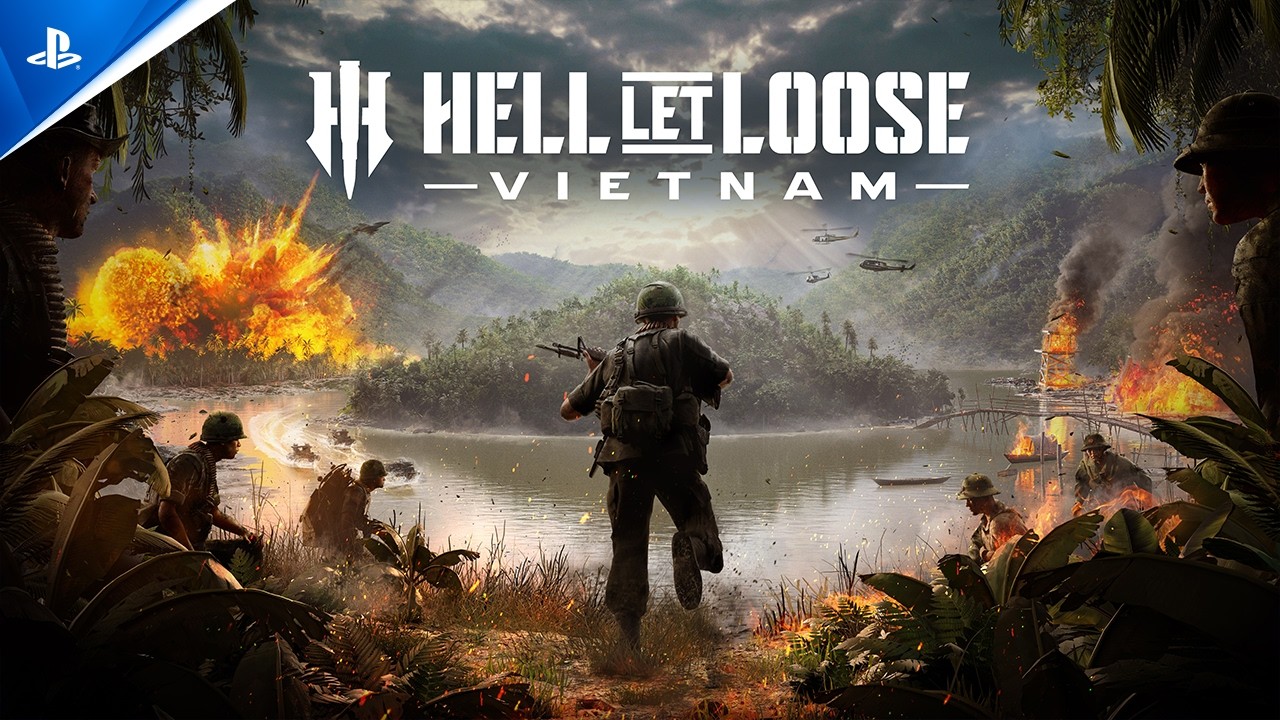
Hell Let Loose: Vietnam is out now. You can find more information on steam.