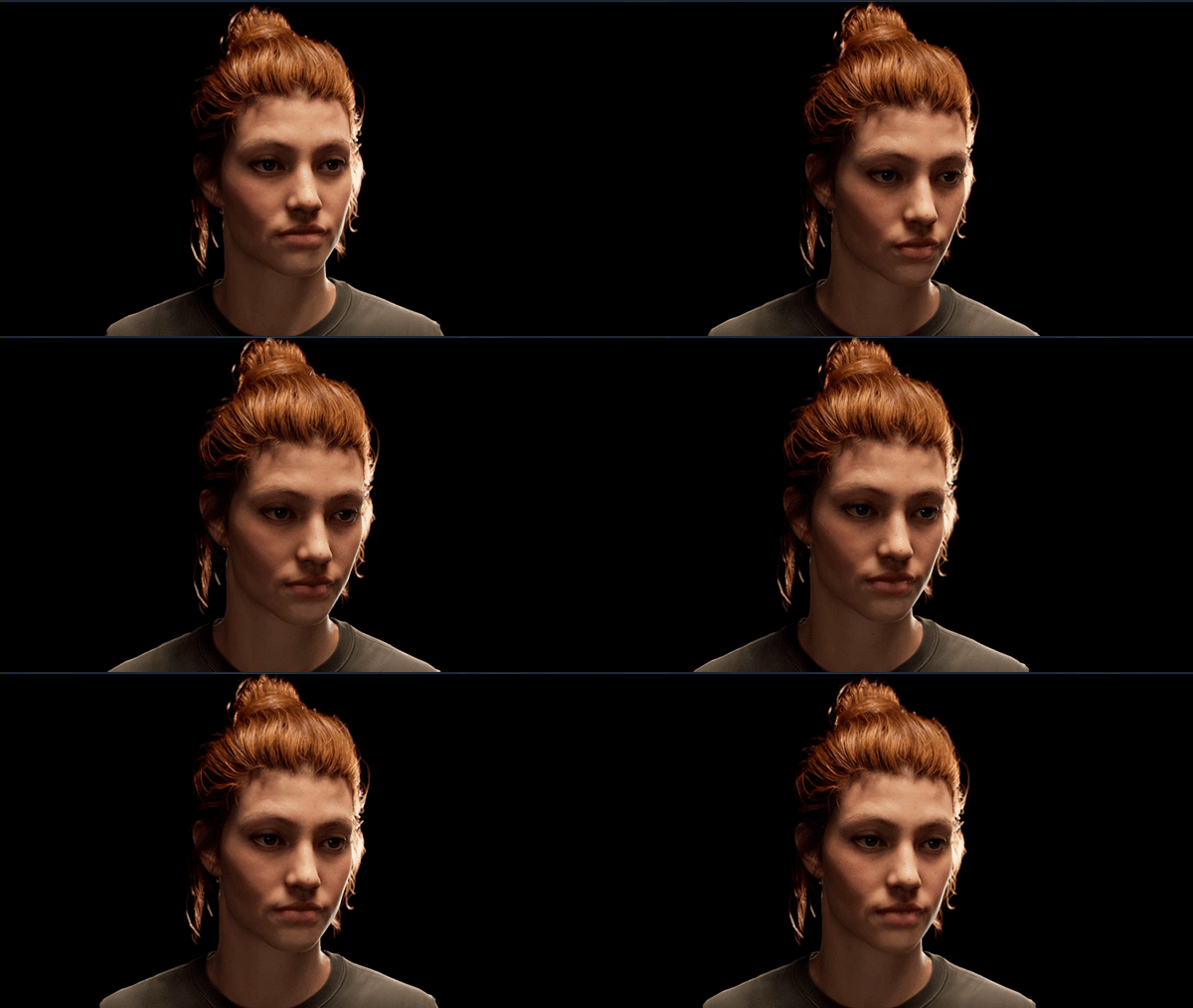
Last year’s Unreal Fest was about new tools to build bigger, more detailed worlds, as I saw firsthand with The Witcher 4’s reveal, but this year things look to be less about going big and more about tangible realism in how we interact with a game world through ‘living’ NPCS. This year, the focus seems to be on what’s in those worlds, on how characters behave, act, and react.
Krafton's PUBG Ally in PUBG: Battlegrounds is being held up as the type of experience that devs will now have more power to create, and while Krafton customised the underlying on-device inference engine (NVIGI) directly, in-house (the Agent/Chat/RAG APIs are convenience layers on top of NVIGI), it alludes to a future of more realistic NPCs that Epic and Nvidia believe ACE UE5 plugins could make a reality.
Nvidia's AI-driven companion system can listen, respond, interpret what’s happening in a match and act like it understands the flow of the moment rather than just firing off pre-written lines, so you can speak to it or type at it and it comes back with actions that work in the chaos of an actual live game, helping with navigation, combat support, even basic decision-making.
Underneath that is the more structural shift, the arrival of the Nvidia ACE (Game Agent SDK), sitting inside Unreal Engine 5 and giving developers a way to build what Nvidia calls ‘agentic characters’ directly into games, not as external services bolted on afterwards but as part of the engine itself, threaded through plugins and APIs that connect speech, language models and gameplay logic into a single loop that actually runs in real time.
Strip it down and you get three core parts working together, an Agent API handling behaviour and decisions, a Chat API managing conversational flow, and a retrieval layer that keeps responses grounded in the actual game state so the AI doesn’t drift into generic assistant mode, and together they allow a character to interpret what a player is doing and respond in context while still being held inside the boundaries of the game design. Nvidia and Epic go into more detail on the Nvidia Blog.
ACE is not just about talking to NPCs either, as I tried for myself previously, because the wider ACE toolkit brings in speech recognition, lightweight on-device language models and text-to-speech systems that are all designed to run locally, not off in the cloud somewhere, which matters more than it sounds, because latency changes everything, the difference between a response that feels present and one that feels slightly late and already disconnected from what you just did. Besides, if you’re fighting for your life in PUBG and your Ally buffers before replying, the mask will slip fast, which is perhaps why Krafton has chosen to implement its own NPC approach, but ACE plugins point to an easier future for many devs
That’s the broader implication here too, as it signals games moving away from traditionally authored interaction scripts towards systems where designers, writers and artists define personality, backgrounds, behaviour rules, and then let the AI fill in the space between those constraints. It will push game development a bit closer to systems design than to traditional scripting, but it also raises the same old tension about control, consistency, and whether authored narratives can survive when characters start improvising more freely.

For now, it’s all still early, feels experimental, but it’s not yet fully baked into mainstream production. Yet the direction is fairly clear: Unreal Engine 5 is steadily moving from a tool for building static characters into something closer to a way to unleash ‘thinking’ NPCs that can act and react in ways that bring those vast, detailed UE5 worlds to life in tangible ways.
Or NPCs could just explain what secondary fire does, because fully autonomous ‘allys’ are still a way off, but Epic is building the foundations for what it could become, and it will be interesting to see what creative, often indie, game devs can do with ACE in the future.
Discover more news from Unreal Fest 2026.