





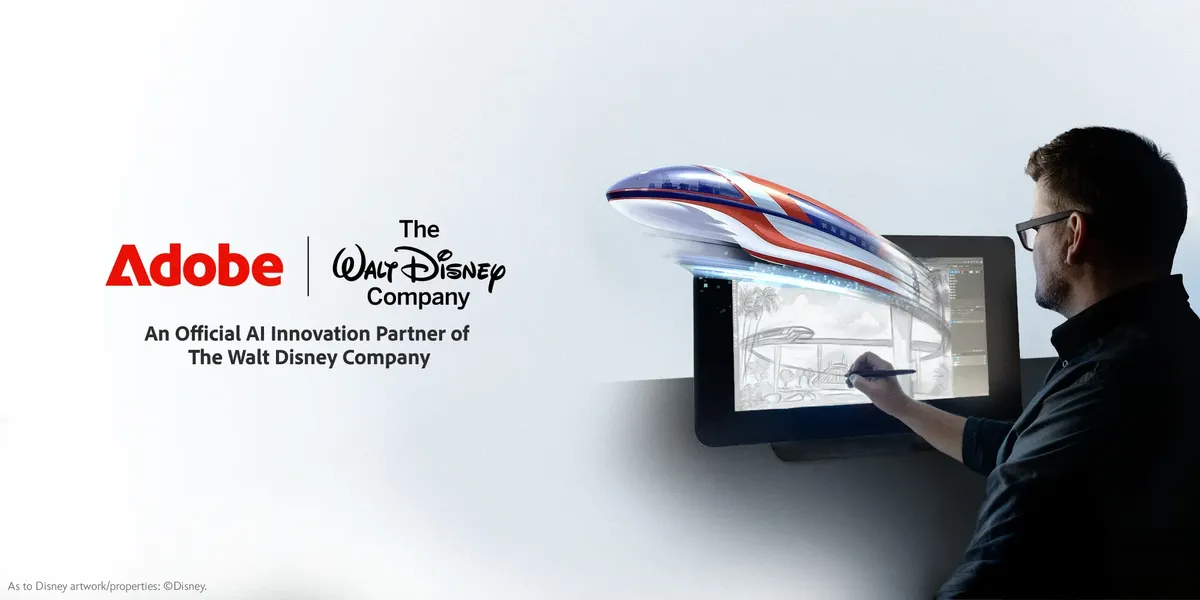
Just as Adobe MAX 2026 gets underway in Miami, the maker of Photoshop and Illustrator has announced an eye-catching deal that could change how the world sees it. It's now an Official AI Innovation Partner of The Walt Disney Company.
Under the terms of the deal, Adobe will work with Disney to develop custom-made AI models trained on its own intellectual property. These will be used to generate and explore concepts for Disney and ESPN productions as well as for theme parks. The move's raising eyebrows given that Adobe isn't an OpenAI, Google or Anthropic, but that could also be why the partnership makes sense for both parties.
Disney's attempts to bring AI into both internal pipelines and consumer-facing output haven't gone so smoothly so far. Some internal developments were ridiculed, and a deal with OpenAI collapsed after the ChatGPT maker pulled the plug on its Sora video generation model just three months in. The nearest replacement so far is an agreement to let TikTok creators use Disney IPs.
The Adobe deal focuses on internal pipelines rather than finished content. Adobe will provide access to tools like Firefly AI, Premiere for video editing and Photoshop for image editing (all available in Creative Cloud Pro). But it will also provide Firefly Foundry proprietary AI models and dedicated engineering and research resources to support production pipelines.
Disney will work directly with Adobe on the creation of new custom AI models trained on specific unique world knowledge like character attributes, environments and visual styles. These will be developed to meet the needs of StudioLAB (Walt Disney Studios’ collaborative innovation hub for prototyping) and ESPN Edge (something similar for sports broadcasting). Customer AI models will also be used by Walt Disney World Resort, Disneyland Resort and Disney Cruise Line.
The idea is that some development processes that previously took months could now be compressed into days or even hours. Hannah Elsakr, vice president for GenAI New Business Ventures at Adobe, describes the collaboration's approach to AI as "an accelerant for artistic vision, creativity and guest engagement” and that they'll allow artists to do more creative work as well as faster work.
As announced in June, Walt Disney Imagineering Research & Development is already using Firefly Foundry in its Theme Park Design Toolkit. A sketch-to-image model is being used to transform hand-drawn concepts into fully rendered 2D concept art, while a custom image model generates on-brand creative assets linked to Disney franchises.
The expansion of that arrangement will be concerning for concept artists. The Walt Disney Company has already made multiple waves of layoffs in 2026 under CEO Josh D’Amaro, and there are plans for a larger wave targeting up to 20% in annual cost savings across various divisions. In July, it was confirmed that one batch of cuts included job losses among Pixar artists. The fact that these cuts were announced first is unlikely to dispel suspicions that the Adobe deal is facilitating job losses by allowing fewer artists to work faster.
Some people have expressed surprise that Disney has chosen Adobe rather than one of the tech giants behind the frontier AI models, but that could make this the safest decision from risk management point of view. Rather than relying on general-purpose models trained on vast amounts of content, Disney and Adobe are building private models trained on Disney's own assets, which should help control brand consistency, provenance and ownership. Disney's IP will remain inside a private system instead of getting passed to an external foundation-model provider.
This builds on Adobe's commercial strengths. Firefly was never likely to win a race to build the world's biggest foundation model, but Adobe's found an opportunity to become the company that helps brands safely use AI with their own content.
Disney may be the most important proof-of-concept customer it could have hoped for for. If the arrangement works, it could provide a template for how other major entertainment companies could adopt AI. It would also signal Adobe's shift from creative software provider to an infrastructure partner comparable to Microsoft in enterprise office work, AWS in cloud computing, or Unreal Engine in gaming.