



What does it mean to design a laptop in an era when the very concept of a laptop may be obsolete within a decade? As artificial intelligence rewires the relationship between humans and their devices, the designers tasked with building tomorrow's hardware face a challenge unlike any before: creating objects for experiences that do not yet exist.
In a wide-ranging conversation, Brian Leonard, Vice President of Design at Lenovo, spoke candidly about the seismic shifts reshaping his field, from foldable screens and modular hardware to the quiet death of the purely software-driven interface.
From thin and light to... something entirely different
For years, the guiding ambition of laptop design was deceptively simple: make it thinner, lighter, and more affordable. That era, Brian suggests, is firmly behind us.
"If we look back a couple of years ago, we were focused on how do we make it thinner, how do we make it lighter," he says. "And now it's completely different, because we have the opportunity to change the way we use computers every day."
The shift, he argues, is not merely aesthetic. The arrival of capable AI has thrown open a door that hardware designers had not previously needed to consider: the possibility that the fundamental act of computing — strings of letters forming words, words forming sentences, manual inputs yielding predictable outputs — may itself be replaced.
"I think in the future, our relationship with the devices that we use can dramatically change. We can shift people from that manual process of being doers to now directing a process. Giving your intent. And AI helps understand who you are so that it delivers an outcome that's more personalised to you."
The hardware-software-AI triangle
Brian, who describes himself as a trained hardware designer responsible for somewhere between 700 and 800 notebook designs over the course of his career, is candid about how the scope of his work has expanded.
"When we look at what the future is, it's not just about hardware. It's about this relationship between hardware, software, and AI. So it's no longer just about what it looks like and what it did, but what are those possibilities?"
This triangular relationship, he says, is central to Lenovo's new AI strategy, which includes a personalisation platform called Qira. The goal is not to deliver generic AI responses, but to use control of hardware, software, and AI in combination to create something more tailored.
"It starts to become a more personalised experience versus a generic experience."
Foldables, rollables, and the expanding screen
One area where Brian's enthusiasm is unmistakable is in form factors that depart from the traditional clamshell design. Foldable and dual-screen devices, he argues, are not novelties but logical responses to where computing is heading.
"Foldables, rollables, dual displays... these types of things have a huge role in the future of computing, because even software flows are going to be different."
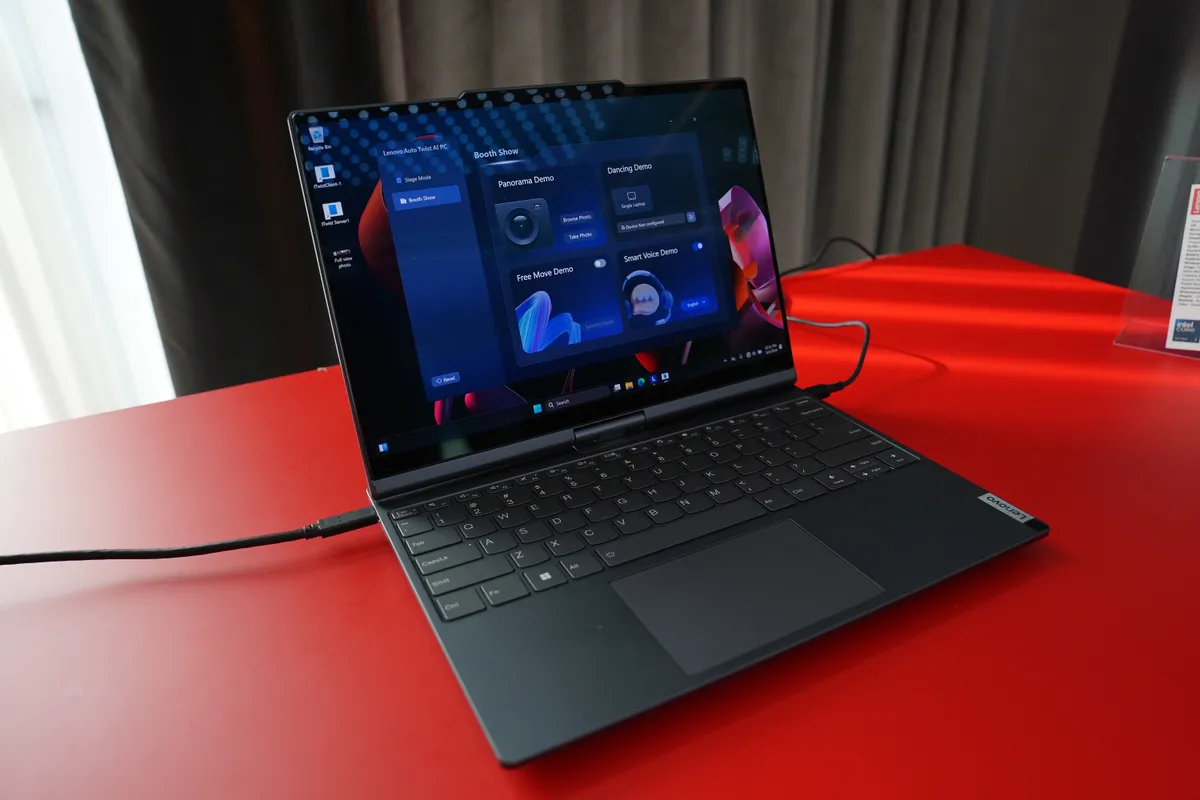
The Yoga Book, one of Lenovo's more experimental dual-screen products, was directly inspired by observational research; designers watching people in coffee shops arrive with notebooks, external keyboards, and stands, cobbling together makeshift workstations on café tables.
"That is actually what led into the original concept work for Yoga Book. We started building models with two displays; if you're going to do that and have an accessory keyboard in front, why wouldn't you have two displays?"
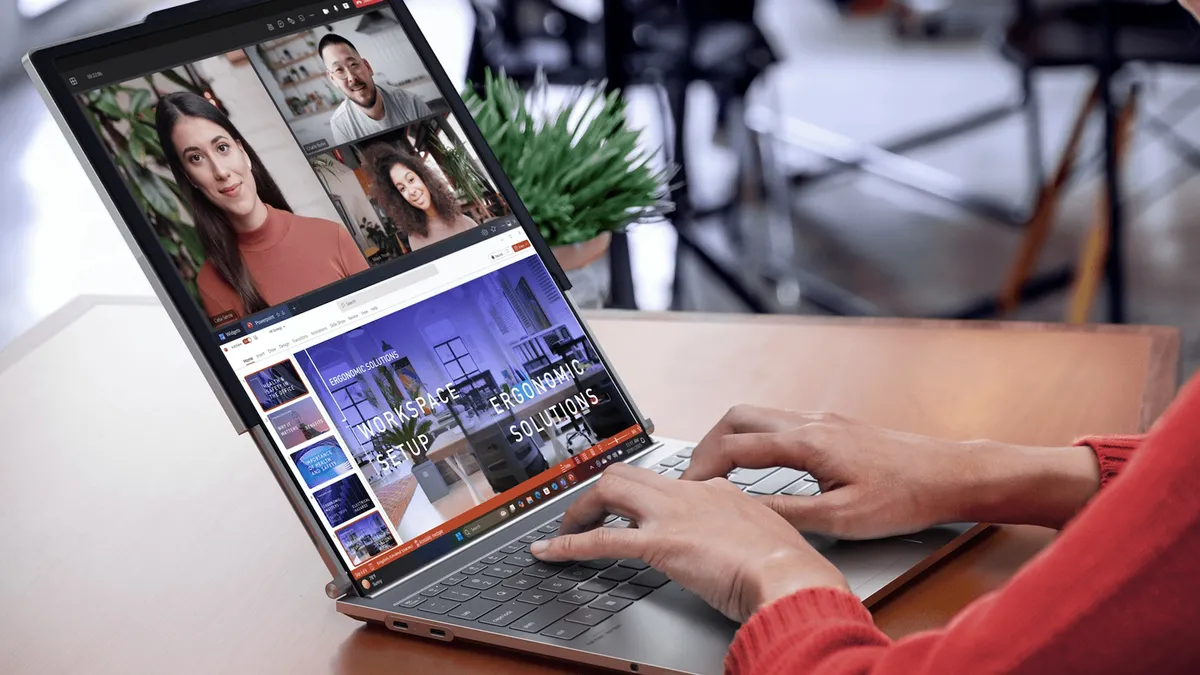
Brian sees these devices as challenging the primacy of the physical keyboard, not by eliminating it, but by making it optional, turning it into a modular element of the device.
"I can use a physical keyboard when I really have some intense writing to do, but I can also use a digital keyboard if it's just a little bit of editing. It starts to let me make the choice."
The ecosystem imperative
Individual devices, however innovative, are increasingly insufficient on their own. Brian describes a design philosophy centred on building products that function as part of a coherent system rather than isolated objects.
"We've been working on a piece of software called Smart Connect, which connects my phone, my tablet, and my PC together so I can use the value of each one of those devices independently. But the next step is: I need a picture, or I need to make a sketch on my tablet for the presentation I'm working on, and instantly I sketch it, and it's available to me."
The aspiration, he says, goes beyond visual consistency or shared branding. It is about genuine functional integration; designing so that the whole exceeds the sum of its parts.
"I don't want to take a picture and email it to myself and then open it up in email and offload it and then put it into a presentation. That should be seamless."
Modularity, repairability, and the return of the physical button
Our conversation also touched on a quieter but growing movement in consumer electronics: the demand for devices that can be repaired, upgraded, and personalised at a component level. Brands such as Framework and Fairphone have built followings around this principle, and Brian sees it as a natural direction for Lenovo too, one with deep roots in the company's own history.
"I can remember opening up the palm rest on a historical ThinkPad, and inside there are blue tabs to take out the hard drive, the optical drive, the memory. At that point, it was table stakes for how we designed computers. Somewhere along the way, the world focused on thin and light."
That focus, he suggests, came at a cost, and the industry is now correcting course.
"The world is now focused on different things: the responsibility of the products, which may be about sustainability, accessibility, as well as repairability. That's the true value of some of the modular things; making these things repairable so that it's easy to upgrade as well as get service parts."
On the broader question of tactility and physical controls, Brian is equally direct. Asked about design trends he is finished with, he pointed immediately at the wholesale migration of controls to touchscreens.
"I really hope we're done with: all we have to do is give you a screen, and you press and do things on the screen. I love the trend in automotive where they put the buttons back. I hope we get away from things being completely software-driven and bring back some of those natural, multimodal things. The tactility."
This, he notes, is not mere nostalgia. The haptic and physical quality of an interface communicates something about the value and craft of an object. He traces Lenovo's own keyboard heritage directly to the IBM Correcting Selectric typewriter, through the ThinkPad's acquisition from IBM, a lineage of considered physical design that stretches back decades.

Designing a dream workspace
Asked what he would build if freed from commercial constraints entirely, Brian's answer was refreshingly telling. Rather than describing a single device, he described an environment.
"I would really be interested in designing a workspace that encompassed an ecosystem of devices that were about my person, focused on it more like the cockpit of a car versus a desk and a chair. To get out of the scope of the devices and design an environment that supported the devices."
It is a vision that captures the broader direction of his thinking: away from the object, and towards the experience. Away from the isolated screen, and towards the connected, personalised, multimodal workspace of the near future.
What emerges from our conversation is a picture of a design discipline in genuine flux; not anxious about that flux, but energised by it. The questions that preoccupied hardware designers for the previous two decades (how thin, how light, how cheap) have given way to something far more open-ended: how should a device understand you, adapt to you, and work alongside all the other devices in your life?
Brian's answers suggest that the most interesting design decisions ahead are not about millimetres or materials, but about the intelligence woven into the relationship between human and machine. Whether through foldable screens, physical controls making a comeback, or AI that learns the contours of individual intent, the future of personal computing appears to be one that is, finally, genuinely personal.