Even just a few months ago the idea of making an entire feature-length movie using generative AI was fairly risible. If Coca-Cola couldn't achieve consistent visuals over a 60-second Christmas ad, how would anyone produce a 90-minute film?
But months are years in AI time, and this week we suddenly had headlines claiming that a 100% AI-generated movie had "premiered at the Cannes Film Festival": a 95-minute action-fantasy film called Hell Grind.
Hell Grind (trailer above) was produced entirely on the Higgsfield AI video platform by a 15-person team in Kazakhstan, purportedly in just 14 days.
To clarify, the AI movie didn't premiere at the Cannes Film Festival, despite even the Wall Street Journal suggesting it did. Rather it was presented at a side event held in the geographical vicinity of the festival.
That's a bit like a band hiring the back room of a pub in Glastonbury and then claiming to have played "at Glastonbury". It's cheeky, a bit sad and it makes it hard to know how much to believe anything else the band says.
Higgsfield says Hell Grind cost "about $500,000" to make, of which $400,000 was AI compute costs. It estimates that traditional movie production for a comparable film would cost about $50 million.
Judging from the trailer above, the movie is camper than a field of AI-generated tents, but the objective was to prove it could be done and that generative AI is ready for production. Hell Grind isn't intended to be a blockbuster but to promote the AI pipeline to Hollywood (in tandem, The Mask director Chuck Russell has announced two AI features, also to be made with Higgsfield).
Such a pipeline completely changes what it means to work on a movie. Instead of directing actors and other artists, the various directors of Hell Grind (a sizeable portion of that 15-strong team has director billing) prompted AI models. Instead of retakes, prompts were tweaked to get a closer result to what they wanted.
In the behind-the-scenes video below, Hell Grind's directors are very clear about what they see as the benefits of generative AI for making movies: no equipment, no physical exhaustion on set, no arguments over budget... and no people?
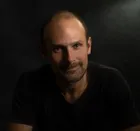
“The future is one person making a whole film,” Mikhail Kumarov says. “Like a writer, like a manga artist. Their stories, their fans: the only thing that matters is that a person has light inside; a story they can tell the world.”
The big challenge for making movies with AI video has been achieving consistency in characters' appearances and in world physics over anything longer than a short clip. Higgsfield is an orchestration platform hosting AI video models from various developers, including Google’s Veo 3, but it adds tools intended to help make output more controlled and consistent across multiple shots.
In its pipeline for the Hell Grind, each prompt generated about 15 seconds of footage. The first 25-minutes of what was originally intended to be a series required 16,181 video generations to produce 253 final shots
To get usable footage, prompts had to very specific in terms of detail and were often around 3,000 words long. Prefixes were used to define a shot's style, the type of camera and lens and the lighting, the later reportedly being the key to avoiding the AI slop look. Prompts also had to specify that the output should respect natural laws like gravity and inertia – even to the point of using phrases like “no floating props”, according to the Wall Street Journal.


Another director, Adilet Abish, talks of being surprised to find himself moved to tears even though Hell Grind's characters are AI-generated.
Aitore Zholdaskali, another of the directors, previously made movies the traditional way, including a 2025 movie called Sicko. In a press release, he's quoted as saying: “It took me ten years to get my first traditional feature made. Most people who started with me never made it to directing movies. I started out shooting weddings and music videos, slowly building trust until someone gave me a TV series.
“Making a movie today feels like making an album twenty years ago: you need investors and big studios. But then the laptop changed music forever and gave us Billie Eilish. That’s what Higgsfield is doing for filmmakers. The next generation won't have to wait ten years.”
Let me know what you think in the comments below. This vision of solo filmmakers making entire movies on their own may sound alarming to many who have fears about the impact of generative AI on jobs.
Just ahead of Cannes, the artist Alma Haser launched Empty Red Carpet, a series of photos intended to highlight what she sees as the "creative theft" posed by generative AI. The work was created for Human Made Mark, an initiative that proposes a certification programme for movies that have real people both in front of and behind the camera.
In the US, the Academy of Motion Picture Arts and Sciences recently updated the rules for the Oscars to clarify that generative AI cannot win acting or script writing awards.
This article originally appeared in ImagineFX. Subscribe to ImagineFX to never miss an issue. Print and digital subscriptions are available.
Creative Bloq is now easier to access than ever before with our on-the-go app, which brings you all the content you know and love from our website, but in a super-streamlined design.
Download the Creative Bloq app for iOS
Download the Creative Bloq app for Android