




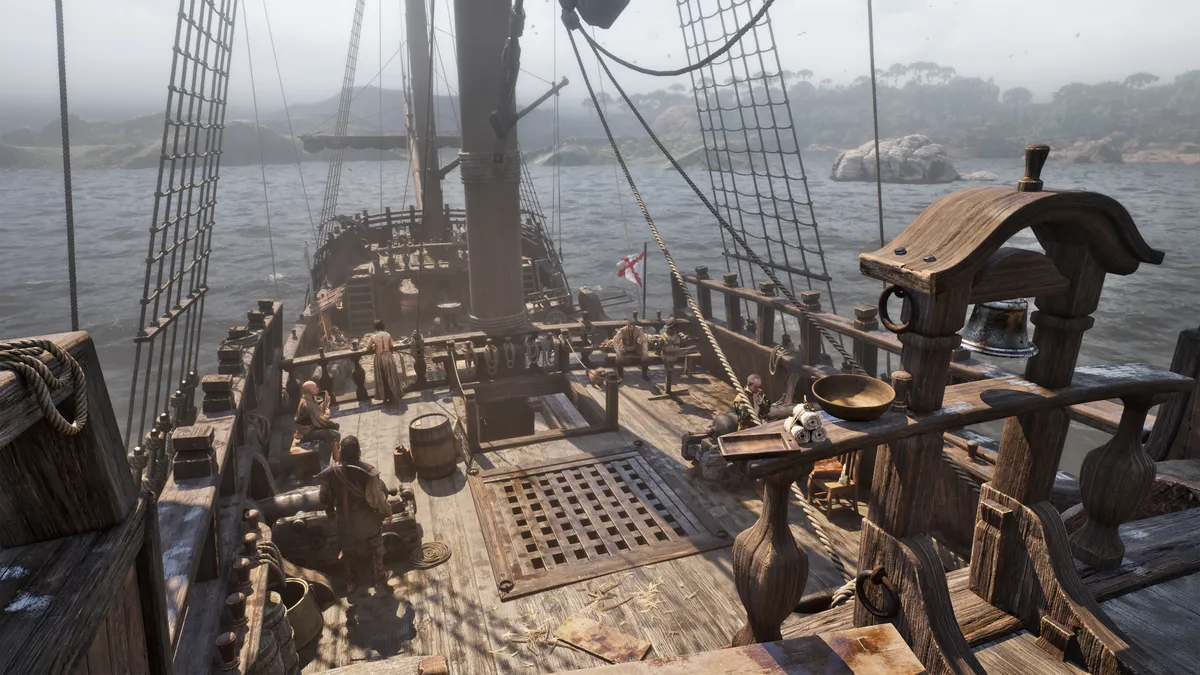
Even before The Mound: Omen of Cthulhu properly begins, it has already committed to its most important design decision: atmosphere, thick, heavy, humid atmosphere. Even before I put a foot on the island, the ship – our temporary base to launch treasure hunts from – is caked in fog; its wooden planks and beams drip with condensation. It creaks and smoothly tilts, lamps light its corners drawing the eye to its weapon lockers, loadouts, cooks for turning hunted meat into something more potent – all the things you find in a co-op extraction loot ‘shooter’, but here absolutely loaded with storytelling and mood.
This art direction lends The Mound an identity before anything has even happened, and as someone who loves a bit of Cthulhu tension, it appeals to me. Even the functional elements of the co-op extraction loop, such as the weapon lockers, loadout stations, and cooking stations for turning hunted meat into upgrades, are not clean UI spaces dressed as props but dimly lit corners of the ship. They’re embedded into the ship’s lived-in decay, and it feels solid and grounded.
Before leaving for the island, there’s a short, almost deceptive calm. I pick up a flintlock rifle and take time to examine its beautifully modelled period details, bronze decorations, and weight. It sits in the hand with a reassuring heft that suggests control and precision, even a sense of comfort, a modern-ish weapon in a world of zombies and creaking sails. Then comes the quiet correction from the developer who’s guiding my party: “gunpowder gets wet and doesn’t work in the rain”. It’s pouring down. That comfort I just felt is already being dismantled, and I’d love to reach for a bow and arrow, but my team is one step ahead, and the cupboards are bare.
The Mound isn’t interested in reliable tools or stable expectations; it wants you to feel anxious and question everything, and I get that sense even before we’ve left for the uncharted island where all the weirdness takes place.
Shore shank
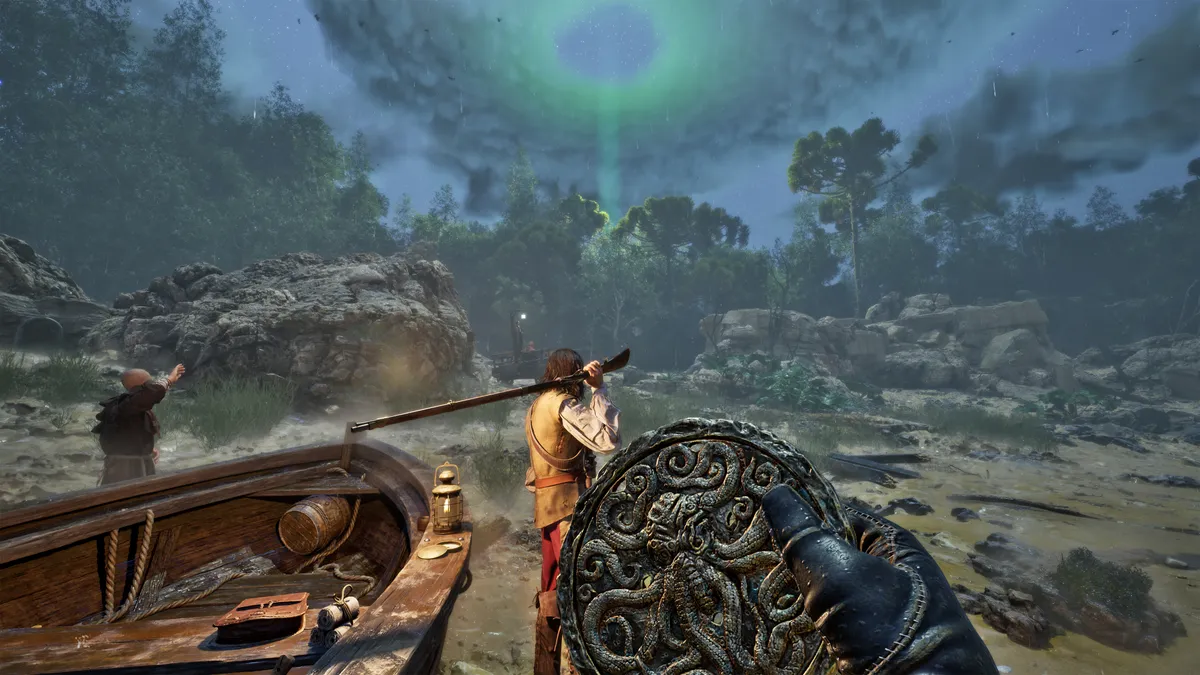
On shore, the objective is almost aggressively simple – collect treasure to the value the captain has requested (done by dropping them into a cart that follows yoy everywhere, even when all manner of spectres loose). Bring back meat, water, and resources if you can. It’s a clean extraction loop, stripped of ambiguity that simply demands we find valuables and return to the boat. That clarity, however, is a little misleading, as once we begin exploring, first the shoreline and beach, before heading into the jungle, things get weird and survival becomes a bigger concern than loot.
The Mound’s jungle feels genuinely alive, and it's listening. There’s the ambience of animal cries, the crunch of leaves underfoot and that ramshackle shake of tins and wood you always get in games, but here the island reacts. The more noise we make, the more the island comes alive. Hacking through the jungle undergrowth, running, talking too much and, of course, shooting, spawns threats; the undead stumble in the fog, more drift in and out of view, in the corner of my eye. Made using Unreal Engine 5, it feels dense and complex, just the kind of space where things can happen.
The mood of the environment changes, first subtly but then physically. The fog thickens around us, mist coils through ruined structures left by earlier expeditions, swallowing sightlines that were just clear moments before. The ground and its roots take on an unnatural, pulsing redness. I look up, and the moon is turning red; the jungle is about to truly come alive, and when that happens, nothing can be trusted.
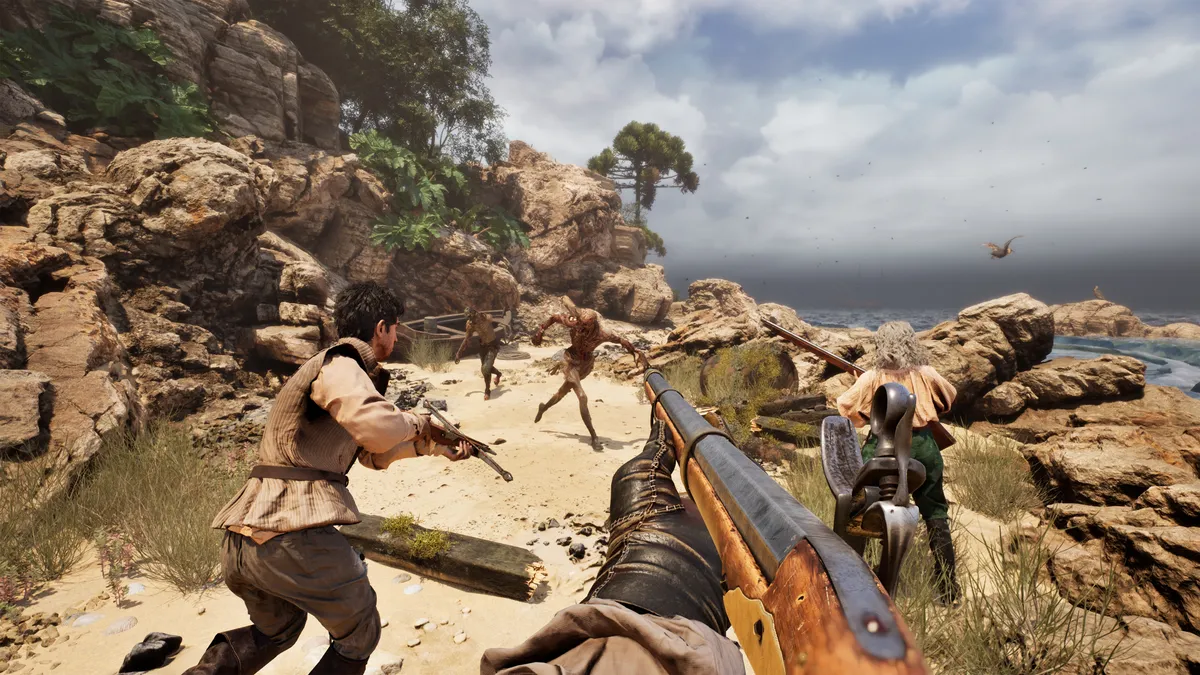
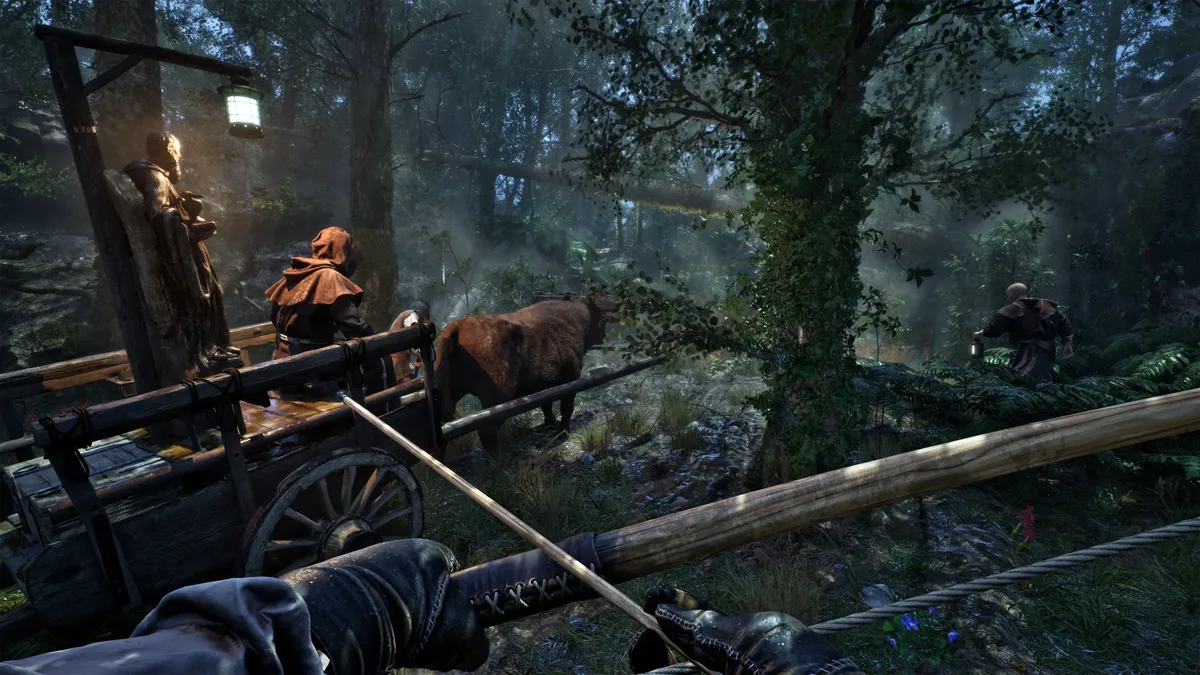
Combat is solid enough, and the 16th-century weapons mean there’s a slow, methodical pace to confrontations. I’m able to get off a shot with the rifle before the rain sweeps back in and the powder runs dry; the thick smoke from my shot hangs in the air dramatically. Bow and arrows are slower to fire, faster to reload, but deadly when you take time to aim. Working my way down the arsenal as more undead shamble from the fog, I go to my knife and then run.
This is where the game’s psychological layers begin to assert themselves, and where its art direction stops being aesthetic and starts becoming a mechanic. World design becomes a tool in the ACE Team’s arsenal to toy with players, because not everything you see on the island can be trusted.
By running for it, I lose my team, and in a horror co-op game that alone can feel like dislocation, but losing my team in fog is when The Mound really starts to get playful. Stumbling through the low-visibility jungle, I come across silhouettes resolving into familiar shapes–my team. The default character designs feel familiar and safe. Then the problem: they’re not familiar at all. A shout cuts in over my earphones –“Run!”–followed by another voice insisting, “That’s not us!” What I’m seeing and what I’m reacting to no longer align, and The Mound just got very weird.
The Mound avoids photorealism in favour of a painterly, interpretive style, one that uses strong silhouettes that hold their shape in low visibility, as well as high-contrast lighting that prioritises drama and deliberate colour grading that pushes environments towards decay and humidity. This means that when the island comes alive and begins playing with expectations, it doesn’t feel like a gimmick; instead, it works because the game’s visual language has been designed for ambiguity, and its Sanity system is designed to be visualised not as a metre that fills and ticks away in the corner of the screen.
Everything feels designed around a sense of risk and reward, of trying to prevent the island coming alive and everything going nuts. You want loot; then a medallion that can be struck will lead the way to treasures made from Tulu metal, but it resounds with a deafening 'clank' when hit, so take the risk, get a reward.
My initial expectation going into playing The Mound was straightforward enough: a co-op extraction shooter wrapped in Lovecraftian dressing. But ACE Team’s approach pushes far beyond that framing. The visual identity is rooted in 16th-century conquistador expeditions through South American-inspired landscapes, and it commits to that aesthetic while, when needed, thoroughly subverting it. That’s the real identity of The Mound, not as an extraction shooter, not co-op survival, not even psychological horror in the conventional sense; it’s a game that uses art direction as an active system of deception.
ACE Team uses all its levers not just to entertain but to build trust, and then dismantles that trust through a controlled visual breakdown. What began as a simple, grounded loot-driven expedition became something more incredible and unsettling, a place where you literally can’t believe your eyes. Well played, Ace Team.
The Mound: Omen of Cthulhu releases 15 July for PlayStation 5, Microsoft Windows, Xbox Series X/S.