





"Nothing says polished retro graphics like nice crisp pixels being blasted across the screen at an accelerated pace." That's how Mark Chambers, Lead Artist at Auroch Digital, sums up the appeal of Warhammer 40,000: Boltgun 2, and it's hard to argue once you see the game in motion.
This sequel picks up directly where the original Boltgun left off. This time you can play as Ultramarine Sternguard Veteran Malum Caedo or the swifter, flame-wielding Sister of Battle Nyra Veyrath, fighting through a branching campaign that stretches from the towering heights of a hive city to the dense mangrove swamps of a jungle world. Expect new weapons, new locations and new foes, including the bloodthirsty Bloodletters and their daemonic Juggernauts.
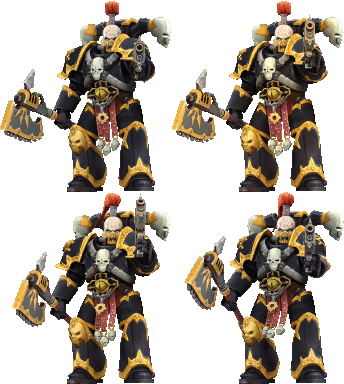
For artists, the real draw is how it all looks. Boltgun 2 is a 'boomer shooter', but its sprites are far from hand-placed relics of the 1990s. Characters begin life as 3D models, are captured from eight camera directions, and are then converted into sprite sheets packed with normal, ambient occlusion and emission data, before being projected onto billboarded planes in the game world.
It's a clever balancing act: crisp, chunky pixels on the surface, modern rendering underneath, and the sprawling detail of the Warhammer 40,000 universe squeezed into silhouettes that read instantly at speed. I spoke to Chambers about how the team pulled it off, and where retro game art limitations end and modern polish begins.
Warhammer 40,000: Boltgun 2 is out now for PC, PlayStation 5 and Xbox Series X|S (with a Nintendo Switch 2 version still to come).

Creative Bloq: How do you make pixel art feel authentically retro without being constrained by the technology of the past?
Mark Chambers: Pixel art at its best does a lot with very little, which was certainly the case in the times of boomer shooters. Working within those confines resulted in a unique art style, and we captured that look by using crisp, uniformly spaced pixels, showing an authentic, unfiltered version of our sprites but with the added bonus of a bit of modern sharpening and polish.

CB: Where do you draw the line between retro limitations and modern visual detail?
MC: Considering that shader technology has developed vastly from what it once was, we had to be very careful with how we applied modern techniques. Things like reflection, liquid and transparency are used sparingly so as not to lose the retro feel.
CB: How do you translate Warhammer’s incredibly detailed characters, weapons and environments into readable pixel art?
MC: Warhammer 40k features characters with considerable amounts of detail. One of the challenges we faced when creating enemies for Boltgun 2 was converting things down into a pixel art format while still making them recognisable at lower resolutions.
Step one is sourcing good references. We're in the unique situation of working with an IP that has countless amazing examples of concept art and established designs, so we're able to pick and choose candidates from a wide selection. We look for things like recognisable shapes and strong silhouettes that would read well to players in-game.
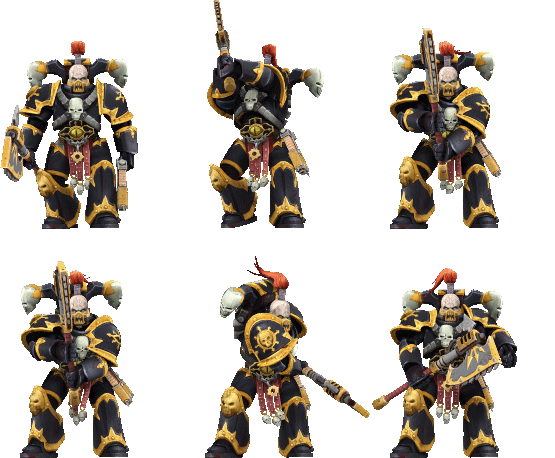
Our animation style uses the same ideas of style over realism, and poses and gestures are often exaggerated to sell strong, recognisable silhouettes. We also purposely reduce the number of frames to include only the most important angles, which is also a nice callback to how characters were animated back in the day.

CB: Do you start with detailed 3D models or concepts and reduce them down, or build the pixel art from scratch?
MC: We begin by building 3D models and then the process of pixelisation occurs. We use a custom rendering setup that captures assets from 8 x camera directions, and a script converts the output to a compressed 2d sprite sheet composed of several different materials (spread across a number of channels).
As a final step, our rendered character gets projected onto a billboarding plane for players to marvel and blast away at.

CB: How do you decide which details survive the journey from a full-resolution design to pixels?
MC: We use a fairly similar workflow to conventional game art pipelines, and we try to emphasise parts like weaponry, armour detail and skin patterns. Anything that's too high in detail is converted into an impression of the object rather than an accurate portrayal (stuff like chainmail, hair, etc.), which would end up looking too noisy.
Specific resolution settings enable us to find the right balance of pixels, and enemies often have custom settings that capture exactly the right amount of detail.

CB: What role do modern lighting, particles and visual effects play in maintaining the retro look?
MC: We use Normal and AO maps to reflect surface detail and essentially 'fake' the look of 3d onto 2d sprites (a key component in the look of our game). Glowing emission and reflection masks are available too, and we even have something called an SDF layer that enables cool status effects and overlays where needed.
CB: How do you use chunky pixels alongside modern rendering without the two styles fighting each other?
MC: We use a 'hand-painted' technique to artificially bump values like shadows and lighting (also known as Ambient Occlusion), which helps with the readability of assets in-game.
A favourite technique is applying edge highlights to really make models 'pop'. Our painting style probably shares a lot in common with how real-world Warhammer 40,000 models are painted (with the added benefit of CTRL Z)
CB: What makes pixel art still work for modern players beyond the nostalgia factor?
MC: Pixel art is an impressive medium which requires a lot of effort and skill. Nothing says polished retro graphics like nice, crisp pixels being blasted across the screen at an accelerated pace, and there's an appeal to games that lean more into strong visual styles over realism. A world of '3d pixels' gives us that aesthetic, and the concept can be applied to great effect.
CB: Has working in pixel art changed the way you design characters, environments or effects for Boltgun 2?
MC: We've worked hard to develop a pipeline that captures the idea of a 'polished retro' boomer shooter, especially for characters. There were many challenges involved in the process, from exploring how best to use pixel art in a 3D setting to balancing performance, translating high levels of Warhammer 40,000 detail, and ensuring a consistent look across all areas of the game.

CB: What can you do with pixel art today that simply wasn’t possible when the games that inspired Boltgun 2 were made?
MC: Modern Render engines give us the flexibility to quickly experiment with different pixel resolutions in order to find that sweet spot of consistency, while still looking retro. Back in the day, artists had to ‘bake’ pixels in by hand, ensure everything was balanced, and manually make changes if needed. There's also the massive benefit of being able to capture sprites from 3D models now.
Consoles to play Warhammer 40,000: Boltgun 2 on: