The Oscars season is in full swing. And while the Academy Award for Best Animated Feature is looking like a battle of KPop Demon Hunters vs Zootopia, it's in the Best Animated Short category that we can find inspirational gems.
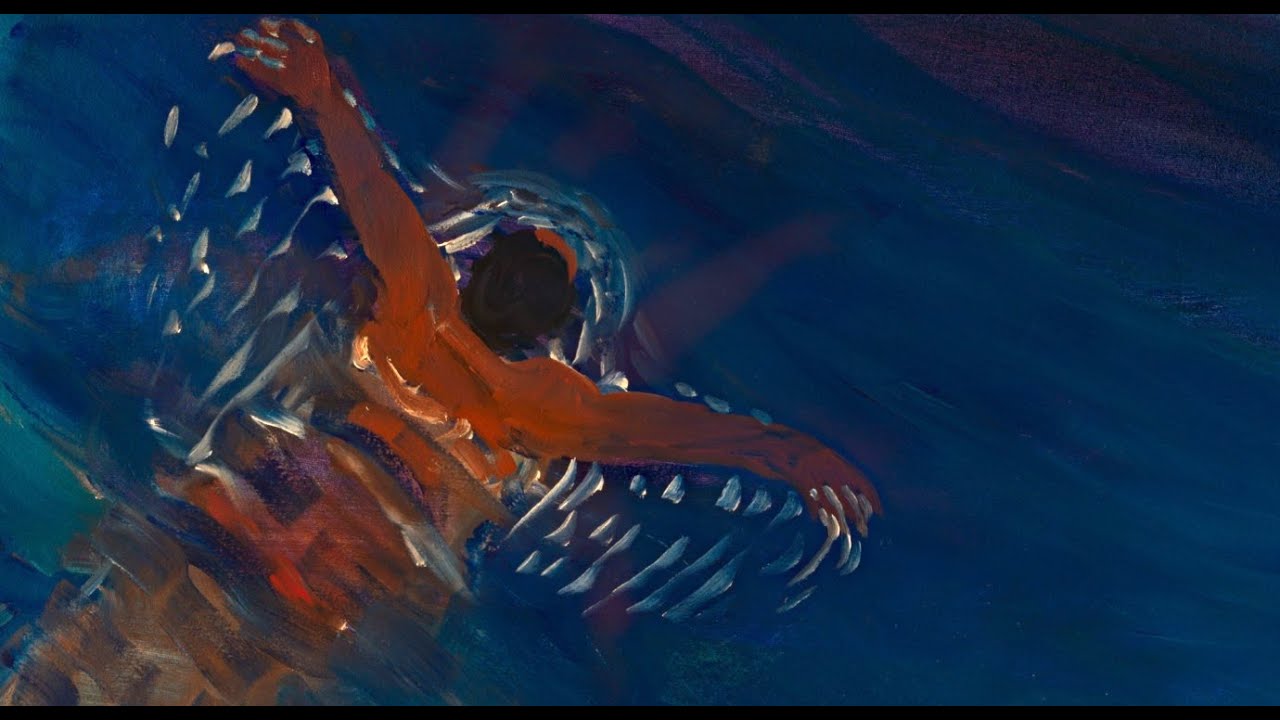
A strong contender this year is French animator Florence Miailhe's Papillon, or Butterfly. The striking, painterly and impressionistic film condenses the life story of Olympic swimmer Alfred Nakache into 15 minutes of beautiful, and at times harrowing, animation.
Turning 70 this year, Florence has honed a distinctive 'film-painting' style using oil, pastel and sand directly under the camera. Butterfly began life back when she was struggling to find funding for her 2021 feature film The Crossing. She started thinking about another project, and a memory from her childhood resurfaced.
Florence had met Alfred when she was young because she happened to take swimming lessons with his brother William. It was only later that she discovered Alfred's history.
He had been a member of the French team at the 1936 Berlin Summer Olympic Games, but was then deported and imprisoned at Auschwitz. He would survive the Holocaust and go on to compete again in first post-war Summer Olympics in London in 1948. He died in 1983 swimming near a place where Florence herself swam as a child.
I caught up with Florence to learn more about why she decided to tell this story now, how her animation style provided the perfect medium to tell it, and how she overcame technical challenges on the way.
Why tell Alfred's story now?
I felt a deep need to tell his life story through that final swim, as a plunge into memory. This film invites us to reflect on issues that are still very present today, such as antisemitism, racism and fear of others. It shows how these dangerous tendencies can weaken our societies, and by recalling the tragedies of the Second World War, it underscores the importance of remembrance.
It also highlights the revocation of citizenship, an aspect that is far from insignificant. This question strongly resonates with contemporary debates, particularly around migration policies. It is crucial to remind ourselves how unjust and life-altering such measures can be.

What are the pros and cons of your painterly approach to animation?
This technique gives me great freedom. The texture of the paint, the grain of the canvas, the visible brushstrokes bring a very particular warmth and depth.
Above all, painting makes transitions easier: I can transform a face, move Alfred from one age to another, or shift him from a memory into the present with great fluidity. Underwater, bodies become more abstract; at the surface, they are more defined. I prioritise movement and sensation over precise drawing.
However, it is a long and demanding process. Each shot is complex to create, especially when depicting water — the sea, a swimming pool, or a river each require different approaches. The slower the movement, the more difficult it is to animate.
How long did it take to make Butterfly?
The preparation was quick. I very soon knew how I wanted to tell this story and make the film. The actual production required two months for the sets and 100 days of animation.
Three of us worked on the animation, followed of course by post-production. We completed the film in one year.


Water is such a big part of the film. How did you achieve its different looks?
Water is truly at the heart of Butterfly, and representing it was one of the film’s greatest challenges. I wanted every key moment of Alfred’s life – whether joy, achievement, or pain – to be connected to water, like a thread running through his entire story.
To achieve this, I used a slightly different technique from the one in my feature The Crossing: the backgrounds are painted on canvas, which gives a richness and density of texture that glass alone would not provide, while the water itself is animated either on glass to achieve transparency and fluidity, or directly on canvas to benefit from colour blending.
I always animate directly under the camera, which allows me to gradually transform the paintings, let movement emerge progressively, and create images from the materials as they appear during the process. Some shots were particularly difficult because each type of water has its own nature: the sea, swimming pools, rivers, or basins.
Each 'water' has its own personality and requires a different approach to keep the movement both credible and poetic: the clear, luminous waters of childhood in rivers and waterfalls; the murky, muddy waters of the camps, almost nightmarish; the sea and pools in the love scenes, more sensual and enveloping.
I worked with two animators who had already collaborated with me on The Crossing. Their experience was invaluable in handling the complexity of these transformations.
For me, painting water directly under the camera was an obvious choice. It allows me not only to make movement and texture visible, but also to convey all the symbolism and fluidity of Alfred’s life: memory, emotions, transitions between ages and recollections.
Water thus becomes a character in its own right — a narrative and emotional force accompanying every stage of his journey.
How did you choose the film's colour palettes?
Colour was central to my approach. With my production designer, Margaux Duseigneur, we created a specific palette for each period of Alfred’s life, almost like an emotional colour chart.
For example, a sky blue for childhood, turquoise blue for adolescence, navy blue for maturity, and a violet-tinged blue for his final dive. The Auschwitz scenes are rendered in dull, muddy, greenish, almost dirty tones.
Each colour corresponds to a memory, a specific moment, and works on the viewer at an unconscious level. It was a deliberate choice to support the story and emotions in a subtle and coherent way.

What was the most difficult part of making Butterfly?
The most difficult scene to create was the arrival at the concentration camp and Nakache’s separation from his wife and daughter, because I didn't know how to represent it. It's extremely difficult to depict such traumatic events without falling into voyeurism.
As I mentioned earlier, very slow movements are also challenging to animate. The dive into the Auschwitz basins to retrieve the bread thrown to him, as well as the shot where he sinks into the water, required a great deal of work and patience from the animator who created them.
Finally, how do you see the health of animation as a genre?
I can mainly speak about French animation, which I know well. There are more and more films of very high quality, both features and shorts. When I started, there were very few animation schools in France. Now there are programmes all across the country. The young directors coming up today are extremely talented.
However, the animation sector is quite concerned about the rise of artificial intelligence. I believe it is important to continue producing inventive films that move beyond traditional techniques and affirm the importance of artistic craftsmanship.
For more inspiration see the winners of the Concept Art Awards and the VES Awards 2026.