Our Verdict
The Noble Vanguard is the sound of something that's been sitting out in the sun for too long. The audio version of a desiccated foodstuff, I feel it trying to suck out the moisture from my ears, such is its crispy tuning. Can audio sound fried?! Apparently so. This is a poorly tuned IEM with a poorly designed faceplate, and it costs $325. Save your ears, save your money, buy something else.
For
- +Good cable (but not modular)
- +Comes with USB-C adapter
Against
- -It doesn't sound good
- -It doesn't look good
- -It doesn't fit good
Why you can trust Creative Bloq Our expert reviewers spend hours testing and comparing products and services so you can choose the best for you. Find out more about how we test.
Best known for making the excellent $5,000 IEM Kronos, the superb wireless earphone Osprey, and the fantastic FoKus Artemis ANC headphone, Noble is a US/Taiwanese company that makes beautiful-sounding, beautiful-looking audio products, many of which I've tried and enjoyed.
Then there's the Vanguard.
It's tricky when you get an absolute stinker in to review. After all, I don't want to make enemies in the small audiophile world. But the Vanguard is straight up a terrible IEM.
Price: $325/£299
Release: July 2026
3 drivers: 1x 10mm PEK dynamic driver; 2x custom balanced armatures
Materials: CNC-machined aluminium alloy faceplates, DLP 3D-printed resin shells
Cable: 1.2 m
Impedance: 23 Ω
Sensitivity: 112 dB SPL/mW
Weight: 7.5 g each
Of course, there will be people out there who'll like its obtuse tuning and unclear design. But at $325 I can't shake the feeling that it's a result of a series of mistakes rather than clear intent.
For context, every single IEM on my list of the best budget IEMs sounds and looks better than the Vanguard – some providing a modular cable too, despite costing a fraction of the Vanguard's price.
Let's dig into what went wrong.
Sound profile

Overall, the Vanguard's great sin is its imbalance. This is not a case of it not hitting my preferred tuning characteristics. I like all sorts of tunings, and I'll give a glowing review to an IEM that is well-balanced, even if its style of tuning isn't my bag (as with the Juzear Light Shuttle). Even a ridiculously coloured basshead set can be excellent, if balanced (Kiwi Ears x HBB Punch review in progress!).
But I believe that whoever tuned the Vanguard had an off day. The bass, midrange and treble all sing from completely different hymn sheets, and taken as a whole, it sounds boxy, bright, lean, dry, crispy, sharp and piercing.
The timbre is not what you would call realistic.
Bass: The first track that I play when reviewing an IEM is always the same: Erykah Badu's Other Side of the Game. It opens with a big fat bass note, swiftly followed by the thwack of a snare drum. It's a great way to know where you are with a set.
When played through the Vanguard, the bass note sounded like a trumpet, and the snare like a plate of wet jelly being thrown at a wall. I genuinely laughed out loud.
Now, I've not seen any graphs, but I don't think the problem is a lack of bass. There is some bass to be found here, it's just that in the context of the rest of the frequency response, that bass is being strangled of all its life. It lacks weight and body. It is weak sauce.
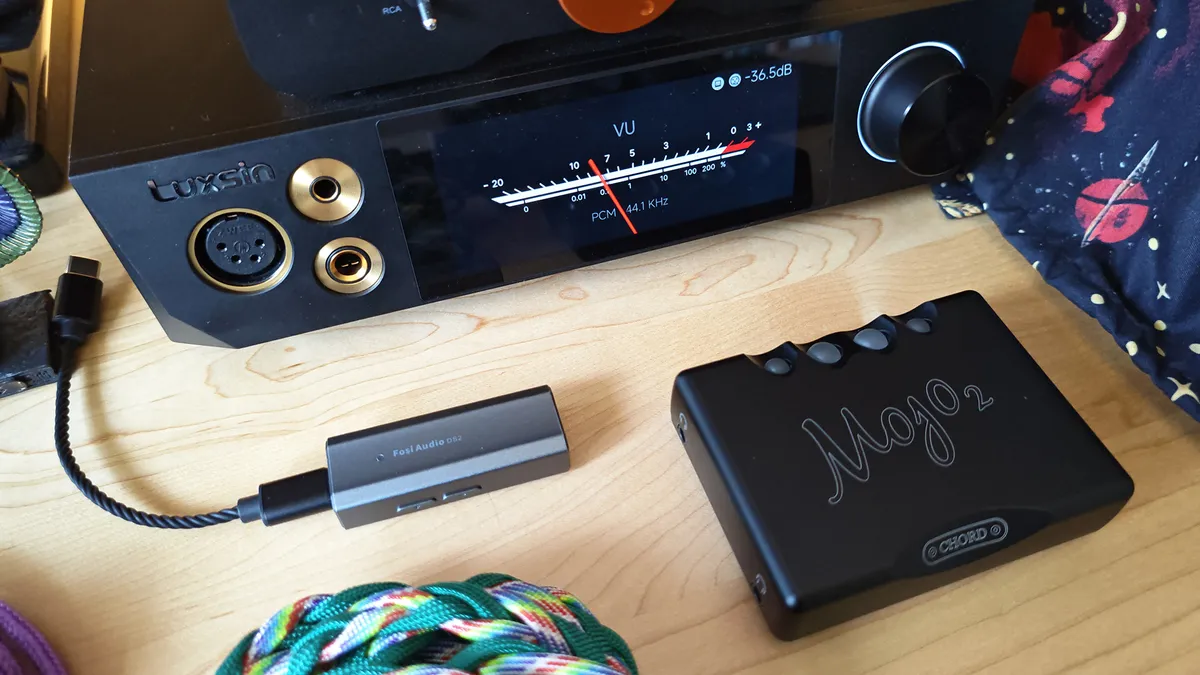
For all my headphone and IEM reviews I play them with my Luxsin X8, Chord Mojo 2, and Fosi DS2 DAC/Amps, as well as straight from my MacBook Air (M4) and Denon RCD-M41DAB player. They all provide a transparent source for a clean, detailed signal. My music sources are Spotify Lossless and CDs.
Midrange: This is the culprit!
Using a tonal sweep, there's a dip in 300-800Hz, followed by a peak around 2-4kHz – there's usually a mound, but this is a mountain. That translates into a thin lower midrange that makes vocals and instruments sound hollow, then a very pronounced upper midrange that brings a sharp, thin edge to everything.
If I'm being generous, I'd describe this approach as having attack and clarity.
I've come back to the Vanguard several times, each time wanting to 'get it'. Although negative reviews are fun to write, I know this IEM is the result of a team of people working hard, and I want to be fair. But after each session, I walked away thinking the same thing: this tuning is fundamentally misjudged.
To give Noble credit, this is an IEM that tries something new, which is to be applauded. But I cannot recommend the results.

Treble: Taken by itself, I can't find any problematic, sharp peaks here. But due to the shy bass and insane upper midrange, a little treble goes a long way.
With a balanced set, it's fairly easy to pinpoint what's going on in each area of the frequency response, but because the upper midrange looms so large, everything is in its shadow.
My treble-forward test tracks come across as piercing. The brightly mixed Lucinda Williams Sweet Old World is close to unlistenable – the tambourine, snare and cymbal crashes are too sharp to enjoy. But is this because of an excess of treble, or the sharp context that the upper midrange frames a modest treble? I can't be sure.
I don't think there's a shortage of air, but where that would usually add a dimension to the lower frequencies, with the already over-baked upper midrange, it aims a spotlight at the sun.
Price & value

The Noble Vanguard is $325, which is an incredibly competitive price point. If we put a pin in the tuning for now, and judge the Vanguard on its build, comfort, drivers and accessories, the Vanguard does OK.
This is a deep, long-style of IEM, and I personally don't find that style very comfortable, but I know that some people do, so we'll leave that in the 'too subjective to talk too much about' pile for now.
If driver configs are important to you, the Vanguard's three-driver setup is a slightly lower count than many competitors, but the individual transducer quality and component materials are good.
I personally don't worry too much about drivers, as it can quickly become a numbers game, and I'm unconvinced that more = better.
However, the aluminium and 3D resin build of the Vanguard is good, and the cable is also a nice thin, black number that doesn't tangle. It isn't modular, however, and it really should be, so that's definitely a point taken off for that.
Competition
When evaluating the Vanguard's value based on its tuning, it doesn't perform well. If you want a bright-leaning IEM around the same price, you can get the ZiiGaat Horizon ($330) or the Binary EP321 ($310), which are both excellent. If you want that slightly peaked pinna ear region, the Moondrop Blessing 3 ($360) is a great option (because it balances that peak with more bass!).
But for my main comparison, I'm not going with any of these sets. I think I can make my point comparing it to a $35 IEM instead...
Noble Vanguard vs Ooopus Op.22

You may think I'm being provocative by comparing the $325 Noble Vanguard with the $35 Op.22, but I'm really not. The truth is, the absurdly-named Ooopus Op.22 is a better-sounding IEM than the Vanguard, in both its sound settings (though admittedly, when it comes to build quality it's not in the same league).
That's right, the cheap IEM has two sound profiles: a neutral tuning, with a slight upper midrange elevation, and a bass-boosted setting. And I think the Op.22's upper-midrange-elevated tuning is a better version of the Vanguard.
That's because the Op.22's standard profile balances out a slightly elevated pinna region with a fuller, more linear bass-to-midrange. There's no dip in the lower midrange to reduce a sense of body, as with the Vanguard. The bass response is also well extended with the Op.22, and though subtle, like the Vanguard, it actually registers.
Bottom line: The Op.22 is just more balanced than the Vanguard.
And when you flick the bass boost on the Op.22, you get an unholy amount of bass that's really fun. As it's a different tuning approach, it doesn't make much sense to compare it to the Vanguard, so let's move on...
Should you buy it?

There are a couple of positive reviews of the Noble Vanguard online, so it's definitely worth having a listen for yourself to see who you agree with. Personally, I believe the team at Noble have made an uncharacteristic blunder here.
The build is good, but the cable isn't modular. There's a good number of ear tips, but the faceplate design of a cool-ass medieval sword-wielding warrior is basically unreadable. For every positive I can think of, there's an equal or greater negative. And that's before you get to the tuning.
If you have a hankering for a skyscraper peak in the pinna gain region (no shame, feel yourself), then give it a go. But be warned: a weak-ass bass and a troublesome treble accompany that absolute wad of upper midrange.
I find the Noble Vanguard impossible to recommend.
out of 10
The Noble Vanguard is the sound of something that's been sitting out in the sun for too long. The audio version of a desiccated foodstuff, I feel it trying to suck out the moisture from my ears, such is its crispy tuning. Can audio sound fried?! Apparently so. This is a poorly tuned IEM with a poorly designed faceplate, and it costs $325. Save your ears, save your money, buy something else.