Our Verdict
Since its 2025 release, the Truthear Pure has been the best warm-tilted neutral-tuned IEM you can buy for $90 – and quite a bit more than that! That warmth, and mid-bass with grip, back up a delightfully balanced midrange and a smooth treble. It's not the most comfortable, though I didn't have the issues some people have reported. I like that visually the Pure stands out from my other smooth-edged IEMs, and it also comes with one of the simplest, coolest carrying bags, and a range of ear tips usually found with pricier sets. Ultimately, it's one of the best IEMs I've heard under $300.
For
- +Leading neutral-warm tuning
- +Bass with grip
- +Supreme midrange
- +I love the angular look
Against
- -Couple of bumps in the treble
- -Could be more comfortable
Why you can trust Creative Bloq Our expert reviewers spend hours testing and comparing products and services so you can choose the best for you. Find out more about how we test.
The Truthear Pure represents two of the main reasons I love personal audio so much. The first is, obviously, that it sounds great. But a close second is that at $90, the Truthear Pure is a really bloody good deal. I can't think of any other hobby where price and performance aren't actually that correlated – where you can spend under $100 to get the kind of sound quality that many more expensive IEMs fail to achieve.
The Truthear Pure is my top pick of the best budget IEMs as well as being on my list of the best IEMs under $500 for these reasons.
Price: $89.99/£79.99
Release: July 2025
4 drivers: 1 x 10mm dynamic driver; 3 x balanced armatures
Materials: DLP 3D-printed translucent resin cavity, matte metal faceplate
Cable: 1.2 m
Impedance: 13.8 Ω
Sensitivity: 124 dB/Vrms @ 1kHz
Weight: 4.5 g each
It's hard to fault the Pure's balanced, warm-neutral tuning (though I do my best below) and impossible to criticise its exceptional value for money. The only real negative is that it's not the most comfortable IEM in the world – though that's the price you pay for a cool, angular design. It generally fits fine in my ears, yet some find it awkward. It's definitely worth noting if you're thinking of buying a pair.
Yet, if you're an audio fan with $90 to spend, buy a pair you should. Due to its excellent tuning and its excellent value, the Truthear Pure is the easiest IEM recommendation I've made.
Let's dig into why...
Sound profile


Overall: The Pure is exceptionally well balanced, and even though it does have warmth, it is also distinctly neutral, so don't expect the warm glow of something like, say, the Xenns Tea Pro. This is not an IEM that's concerned with contrast (elevated bass and elevated treble duking it out, for example), but its bass is strong and there's just the right amount of treble to offer good detail. Plus I hear an added bite at 3.4kHz that isn't commonly captured on the graphs. There's no shout, no sibilance, and though it's not a vocal-forward set, you get a smooth, correct-sounding timbre. If you want a detail monster, this is not it.
Bass: Though 'warm' can often mean bloated, muddy or congested, the Pure pulls off a warm sub- and mid-bass without hitting any of those bum notes. Unlike the CrinEar Reference – the current neutral benchmark IEM – whose slight 200Hz dip accentuates the mid-bass by making a clear cut between upper-bass and lower mids, the Pure just steadily slopes. From 20Hz to 900Hz, the Pure's frequency response is on a gradual downward trajectory, which gives it an impressively thick, warm, bassy sound, without making the lower mids sound lean.
I'll admit, after listening to the Pure for a few weeks and finally looking at the frequency response graph, I was shocked at that steady downward line. There's usually more curves and bumps to accentuate parts of the lower frequencies. Yet I think the Pure sounds more sophisticated than its sloping graph would have us believe. And that's thanks to the balance with the rest of the frequencies.
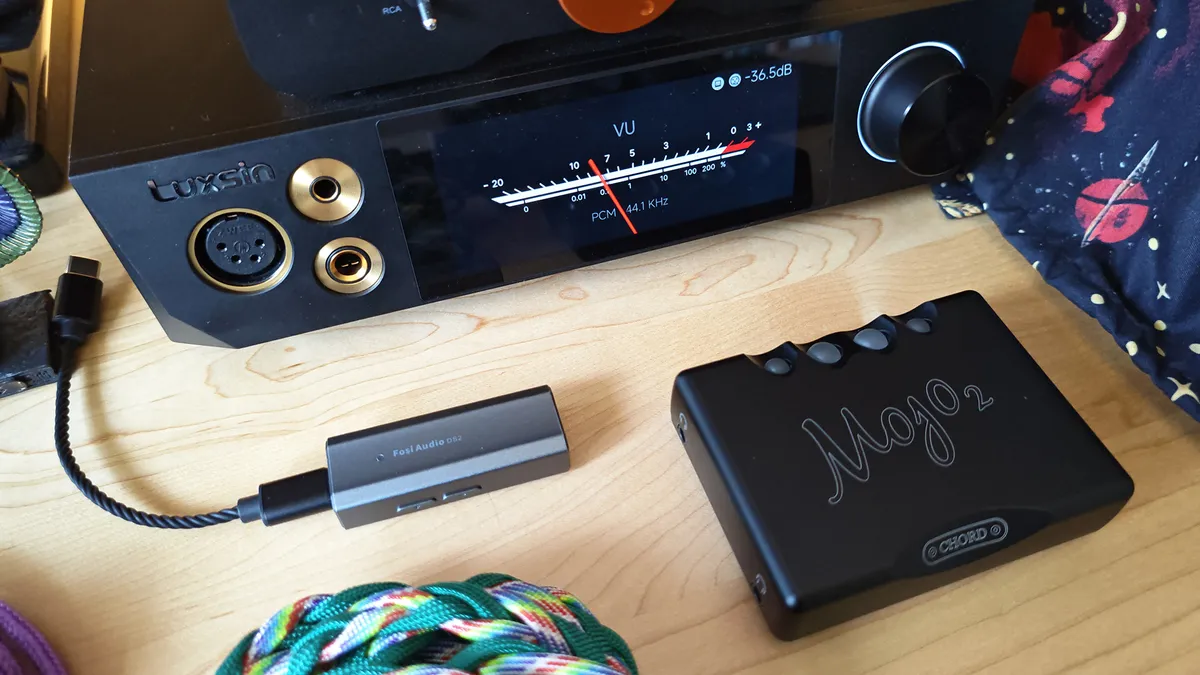
For all my headphone and IEM reviews I play them with my Luxsin X8, Chord Mojo 2, and Fosi DS2 DAC/Amps, as well as straight from my MacBook Air (M4) and Denon RCD-M41DAB player. They all provide a transparent source for a clean, detailed signal. My music sources are Spotify Lossless and CDs.
Midrange: Another surprise was the Pure's midrange. The lower mids are spot on neutral, and go far to explain the natural timbre that the Pure boasts. They're full and warm, and even though there's a wee dip at the foothills of the pinna region, instead of coming across as thin, they remain smooth and rich.
It's the upper mids where the first surprise resides. I hear an added kick around the 3.4kHz area, though that's not present on any of the graphs I've subsequently seen. I perceive the laid-back pinna region, which I'm a fan of, and although that means this isn't a vocal-forward set, that 3.4kHz peak makes sure the Pure isn't dull or blunted for me. Instead, I seem to get the best of both worlds with the upper mids – smooth with a bit of bite.

Treble: The lower treble is smooth sailing, and things cling fairly well to the JM-1 target until we get to 6.4kHz and 7kHz. Here I encounter a couple of peaks, and although that may seem a beat too early compared to most of the graphs online, it's definitely there for me... and I don't mind it at all.
For me, these elevations offer a counterpoint to all the warmth lower down, giving a sense of dimension to the thick note weight of instruments. Although many will see the midrange as the highlight of the Pure (and for good reason), I think its treble needs a shout-out too. That's mainly for not succumbing to what 99% of IEMs do: playing the technicalities game by ramping the treble up. More treble often translates into a sense of crisp detail and clear imaging, but the Pure doesn't chase those shiny goals.
Instead it aims to be as neutral as possible, and it largely nails it, just with that bit of added warmth. The result is a pleasure to listen to.
Price, value, build

When it comes to its tuning, the $90 Truthear Pure competes with IEMs that cost several times its price. It offers exceptionally good value for money, and on this criterion alone, just go out and buy it!
But we have to also consider the build quality of the Pure, and its driver configuration. Its 3D-printed resin body with corrugated metal top shell is striking visually, but will always lag in value proposition when compared to an all metal shell, like the $80 Simgot EW300.
I personally couldn't care less whether an IEM is metal or resin, as I find them both to be durable – comfort is more important to me, and as I've said, I find the Pure to be fine in that department. As you'll find in the Upgrade/Downgrade section, there are IEMs around the price point that are more comfortable than the Pure, but it's just not an issue for me.
Then there are the drivers. The Pure offers a 1DD and 3BA hybrid design, which is impressive for under $100, and is more raw driver tech per dollar than the competing Simgot EW300, $80 Dunu Titan S2 or the $99 NiceHCK F1 Pro.
However, I think the Pure dunks on those IEMs, and I want to up the price point a little to find other not-good-but-great IEMs to compare it to...
Competition: Aful Explorer

- Another value monster at $110
- More detailed yet more relaxed, softer
- More comfortable
The Aful Explorer is another excellent IEM at around the $100 mark – $110 from Amazon to be exact. I think you get more of an exciting tuning than with the Pure, but not exciting like the Juzear Defiant (see below) – we're not talking V-shaped contrast here. The Explorer is exciting due to its bold approach to dampening its upper midrange.
It brings a more traditional bass boost than the Pure, though I enjoy them equally. Then instead of the normal ear gain mountain that you'll find in 90% of IEMs, the Explorer makes a plateau from around 2-4.5kHz. The only other IEM where I've seen this implemented well is the $370 Aful Performer 8s.
The Explorer is not trying to be neutral. It's smooth, warm, rich, relaxed in its upper midrange. Yet even with this reduction in the upper mids, the Explorer is a great IEM for the midrange. With its fuller upper treble compared to the Pure, it brings more of a sense of detail to its relaxed midrange, while retaining the smooth. It's an impressive tuning, and another $100-ish IEM that sounds a hell of a lot better than many IEMs several times its price.
So which would I get? Both! I think they offer two different-enough tunings to take on any library of music. If I had to choose one, it would be the Pure... but it's close.
One important note is that the Explorer is way more comfortable than the Pure. That's not completely fair, as the Explorer is one of the most comfortable IEMs I've ever used – its small-medium shell fits my ear without any fuss. Both the Explorer and the Pure have set cable terminations, unlike the next competition...
Competition: Juzear Defiant

- Exciting V-shape tuning
- Modular cable for the win!
- Ineffective vents cause discomfort
The Juzear Defiant (either the OG or the newer Gamefidelity Edition – they're basically the same IEM), is another value monster, and another fantastically-tuned IEM at bang on $100.
I'm looking at the Defiant as an alternative to the Pure because they have totally different tuning philosophies. If you don't want the mature warm-neutral of the Pure, the Defiant offers an exciting V-shape that, again is executed better than many other contrasty IEMs with higher price tags.
And it's not as if there's a shortage of V-shape sound signatures out there – it's the go-to tuning of 99.99% of commercial headphones for a reason. Starting with a solid sub-focussed bass boost, the Defiant dips between around 300-700Hz (compared to the other two), making the bass and higher frequencies pop in comparison. The downside to this, when combined with a more forward upper midrange, is that things can sound a little lean. Vocals are forward and treble is extended, so you get an exciting, detailed sound, with good separation of instruments – better than Pure.
A negative to this fun V-shape sound signature is that the timbre of the Defiant isn't in the same class as the Pure. There's a naturalness to the Pure that the Defiant doesn't (want to) replicate. When listening to the clarinet, guitar, bass, and drum intro on 'Before I Saw the Sea' by Me and My Friends, things just have that natural, 'correct' sound to them with the Pure. Things sound clear, natural with a touch of warmth. The Defiant sounds bassy, bright and lacks that body of the Pure.
I enjoy both of these IEMs, but if I had to choose one, I'd go with the Pure, as it has that punchy bass without losing the body weight of the lower mids. Again, if I could afford it, I'd get them both, as they offer different, excellent tunings.
One thing the Defiant has over the Pure is that its cable is in another class. It's a better quality, and also is modular, so you can swap between 3.5mm, 4.4mm and USB-C terminations. On the down side, I find pressure can build up more with the Defiant, as its air holes are not as effective as the Pure's.
Should you buy it?

I think everyone who loves audio and wants the best version of different sound signatures should buy the Truthear Pure. In this case, that tuning is warm-neutral, so don't expect excitement, contrast and loads of detail.
I've heard the Pure be described as the Sennheiser HD 650 to the slightly cleaner, colder Truthear Hexa's HD 600. I get that comparison – but the Pure has smoother treble than the HD 650, a better bass extension, and not as much openness to its presentation. Still, it gives you a good idea of what the Pure is about, of what it's aiming for.
The Pure is exceptionally balanced – more measured, mature and magnificent than many IEMs several times its price. It's the perfect IEM for someone just getting into audio, and should be in every audiophile's collection.
out of 10
Since its 2025 release, the Truthear Pure has been the best warm-tilted neutral-tuned IEM you can buy for $90 – and quite a bit more than that! That warmth, and mid-bass with grip, back up a delightfully balanced midrange and a smooth treble. It's not the most comfortable, though I didn't have the issues some people have reported. I like that visually the Pure stands out from my other smooth-edged IEMs, and it also comes with one of the simplest, coolest carrying bags, and a range of ear tips usually found with pricier sets. Ultimately, it's one of the best IEMs I've heard under $300.