The fireball kills the player almost instantly. On his second go, he presses the cabinet's button, expecting it to fire, because in arcades, buttons meant shoot, not jump. His on-screen little man falls down a hole, and the player walks away.
Back in 1983, the game's creator Peter Robinson watched it all from behind the cabinet. His company, Century Electronics, had spent six months on Hunchback, and a stranger had given it one go and left. The team went back and simplified the opening until the first screen was virtually a single hazard, then introduced each new obstacle gently. "Very gently bring in the next. Very gently bring in the next," Peter Drury says, recounting his time with Robinson.
This is the kind of story that fills Peter Drury's new book, The Arcade 1971-1999: The Stories Behind Classic Coin-Ops, Told by Their Creators, published by Bitmap Books. The 408-page hardback covers 120 retro games, from Pong and Space Invaders to Mortal Kombat, with contributions from more than 90 programmers, designers, artists and musicians. Nolan Bushnell, co-founder of Atari, wrote the foreword, and Eugene Jarvis, creator of Defender and Robotron, wrote the afterword. Drury describes the response as "an embarrassment of riches": he wasn't sure either would say yes.
(Like the sound of it, read our guide to the best retro game consoles.)
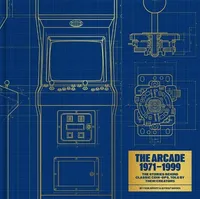
Drury is a Senior Lecturer at Nottingham Trent University and a regular contributor to Retro Gamer since its 2004 launch. He was born in 1970 and grew up alongside the machines. He remembers first meeting his first arcade cabinet, Boot Hill, at the age of eight, after a swimming lesson at his local leisure centre. "They just sort of arrived," he tells me, adding: "This sounds weird, but you couldn't really believe that people had made them."
After two decades of talking to the people who did, he says the biggest surprise was how little planning went into making games we now remember so sentimentally. The thing he's learned from his many interviews for the book is, "These were made by human beings who were fallible… They didn't plan things out meticulously first, and were working out as they went along."

Code bugs as raw material
Some of the best-loved games began as faults. Andy Walker, who made The Pit alongside Tony Gibson at AW Electronics in Bridlington, told Drury it "started with a bug"; they were originally making a space game whose ship was meant to leave nothing behind as it flew across the screen, but left a trail that only cleared if you doubled back over it. "He's like, 'whoa, maybe there's a game in that'," Drury recalls, and the Dig Dug-like The Pit was born.
Drury recounts how Gotcha, made in 1973 and considered the first maze game, has a similar origin. A display fault on a Pong chip stopped the numbers from forming properly and produced something like a maze. Al Alcorn, Ron Milner, Steve Mayer and the team saw an opportunity rather than a defect and began creating a game around the flaw. "The number of times that I talk to people," Drury says, "it's the same story."
In addition to shedding light on developers' stories, the book also corrects some legends. The best-known is that Pong's first night in a Sunnyvale bar was so successful that the coin box filled and the machine broke. "So that's not true," Drury says dryly. The story comes from an early-80s book, whose account was so detailed it "should have been an indication that it can't have been a fly on the wall".
Drury asked Alcorn and Bushnell, who were actually there, and they recalled putting the machine down, going for a beer, and waiting. Eventually two players tried it and instantly understood it: "Oh, it's tennis. Job done." Then no one played it again that night. The bar owner called a week or so later to say the coin box was full and, as Drury tells it, mentioned people turning up in the morning, annoyed that it wasn't working. "Normally the only people that go to a bar in the morning are alcoholics," he says. "Now these were people who genuinely had wanted to go and play this game."
Bushnell knew they were onto something. "Let's not exaggerate," Drury adds, "but it was true."

Donkey Kong is another case. "Everyone associates that game with Shigeru Miyamoto, who is unquestionably a genius," Drury says. But the book includes an interview, translated by Kate Willart, with programmer Hirohisa Komanomi, whose team at the contract developer Ikegami Tsushinki built the game for Nintendo. Miyamoto wanted a big gorilla and sketched one screen with a hint of the rest. His hero, still nameless, couldn't jump. The programmers argued that it made for a defensive game, with the player constantly on the run. Add a jump, and suddenly you could take on the barrels.
"They put the jump in, and they designed the other screens," Drury says. "The game that people are still playing and still pushing up the high score… the people that really made it are not known, and I hope this book in a tiny way helps."
The same applies to the hardware. Drury's boxout features that hang in the book's pages detail the unsung roles of these classic games, including engineer Dave Sherman, who built the elliptical-tunnel hardware that gave some Atari games a 3D look. "Do you think the people that made the hardware get the same credit?" Drury asked him. "No, no, we don't."

Lurking on players
Like Peter Robinson, the game designers who got it right often stood back and watched. Ed Logg, creator of Asteroids and Gauntlet, once watched a player lose all three lives in a minute, swear at the machine, and immediately put in another quarter.
"He thought that was his fault, and that he could get better," Drury says. "That's the consistent message that came through [interviewing these game designers]: you've got to catch the player quick, it's got to be quickly understandable, and if they die, they've got to feel like it's their fault."
Logg's flying saucers in Asteroids – enemies that periodically cross the screen to shoot at the player's ship – nearly went the other way. Early on, their firing timer carried on after you shot one, so the next saucer arrived almost ready to fire. Players complained it was unfair. Logg reset it each time, and that tweak opened up "lurking": leaving one rock on screen, flying fast up and down, and picking off the saucers as they appeared. Players could stay alive for hours on one coin. Logg's first instinct was that he had broken the game, and he even produced a fix ROM for operators.
He decided to leave it, and those marathon sessions on Asteroids became priceless publicity. "Most people can't do it," Drury says, "but they want to emulate the one kid that can."

The coins count
These days we view retro games with a kind of reverence. Drury laughs and asks me quizzically, "Really?" when I suggest games back then were made for noble reasons – creative game design, new ideas, visual invention. As Drury's book reveals, none of this was romantic to the people involved. Games were sold to distributors, and the distributors made their money back a coin at a time.
"I was approaching them as, you know, works of art. I know that sounds pretentious," Drury admits. "And I was often reminded it's a commercial business." He describes one designer likening a poor cash-box result to being told your baby is ugly. Bushnell told him the arcade's advantage was instant feedback: put a game out, come back a week later, and count the quarters. "You can't argue," Drury says. It was an era of brutal honesty.
That cash-box logic ran through a game's core design. Drury points to the later gun game CarnEvil released in 1998, whose designer Jack Haeger admitted that one punishing boss was "a money sink". There was a cultural split too, as in Japan, Drury says, there is "far more emphasis on one coin, one play", while Western players were "softer, or we like winning" and happy to feed in more coins to carry on.
That pressure shaped games, including Crystal Castles, when designer Franz Lanzinger was recruited by Atari because he was a brilliant player and not an established developer. He wanted his game to have an ending, arguing that games aspiring to be like films should finish like them. In a business that depended on players coming back, he had to fight for it. Producer John Ray wrote management a diplomatic letter asking them to listen to Lanzinger. "It's the most diplomatic letter," Drury says. Management relented, and Drury's book reproduces the letter, so we can see a bit of history from when 'narrative' games emerged.

Drury says the people he interviewed were strikingly free of ego, "including Nolan and Eugene, to be honest, who really are superstars". Programming asked for a certain mindset, he says, and "being a good programmer is about your ability to code, not your ability to communicate or do a good interview". Drury offers an abstract example: if asked why a game designer back then would put a barrier on level three, they'd reply, "It was six weeks of my life, and it was a job, and I had a wife to go home to."
There was pressure of another kind. Brian Colin, who worked at Midway on the 1986 game Rampage, told Drury that deadlines mattered because people on the cabinet production line were waiting for a game to be made. At Midway, the game designers' offices sat in the factory corner. "You could look there and go; if I don't produce something, those lads aren't feeding their families."
Of the book's 120 games, 65 are Western, 55 are Japanese, and only three are British, despite the country's home-computer boom in the 1980s and 1990s. Drury asked The Pit's Andy Walker why. "We were great at making games; we weren't good at business," was the answer, and an arcade machine needs a manufacturing plant, whereas a Commodore 64 game could be duplicated "in his kitchen on a tape machine".

When arcades had to reinvent
By the '90s, the balance had shifted. "Arcade perfect" had once been the home console's impossible dream; once the Saturn and PlayStation arrived, home machines were "as good, sometimes better". The arcades answered by offering what the living room couldn't: communal experiences, from driving cabinets and 360-degree spinning seats, to light guns to the dance mat. Drury interviewed the designer behind Dancing Stage, who described a mode called "Come Dance with Me", in which a weaker player is carried by a stronger one, so long as one of them survives, they could keep playing forever. "It encourages strangers to play, to learn from each other, and it encourages the spectators to watch."
The book's final entry, from 1999, is Silent Scope, with its tiny LCD scope you looked down to snipe enemies, "and you can't get that at home".
Community mattered in Japan, too, which led to a particularly unique in-real-life trend. Drury cites the 1984 game Tower of Druaga, a 'fantasy Pac-Man with puzzles and combat', which never officially left Japan and was so full of secrets that players left notebooks behind the cabinets with tips like "level five, you need to deflect the fireball three times… That's the internet, or a bulletin board, a paper version of it," he says.
Drury also refuses to romanticise the venues themselves when I bring up arcades I went to as a kid – dark, smoky places with ancient machines heating up corners of the room with vector lines, and the pulsing glow of pixels. "We absolutely romanticise them," he says. British arcades grew out of travelling showmen storing their gadgets in seaside towns over winter, so video games slotted into an existing culture – one where "we let children gamble", with fruit machines beside Defender. "It wasn't all dark and smoky."

The Arcade reads as design archive
The book is as much a design archive as an oral history, and it includes personal photos, design sketches, and coding notes, plus concept art licensed from The Strong National Museum of Play in Rochester, New York, showing early plans for Star Wars, Paperboy, and Gauntlet. The Star Wars storyboard by Dave Ralston even contains a small slip, Drury notes with relish: "You will fly Luke Skywalker's Millennium Falcon". Drury says he thought, "There's no Lucasfilm geeks there."
Contributors dug deeper still. Krull designer Matt Householder and artist Jeff Lee sent original pixel sketches on graph paper, and Householder kept a list of levels he planned, only five of which made the game. Another entry on the list simply reads "firemaze", notes Drury. "I'm like, what would that have been? He went, 'I don't know, maybe like Joust, but on fire.' That sounds pretty good." Howell Ivy, designer of Circus, supplied the paper on which he worked out the seesaw's trajectories pixel by pixel. And Scott Tsumura, one of the industry's first producers, sent a photo of himself at a whiteboard, mid-pitch, with sales forecasts scribbled behind him.
"It was almost as if someone had gone back in time and said, 'One day someone's going to ask you about that whiteboard,'" Drury says lauging. "What a wonderful little bit of period detail."

The lessons to learn from gaming's golden age
Drury is delighted by the indie game boom, which he wouldn't have predicted 15 years ago, when "it was all going towards AAA titles". But he is wary of its retro instincts. "I think people sometimes focus far too much on the visuals: 'I'll make it pixels, and therefore it will be retro.' Remember, they weren't simplistic back then. That was cutting edge."
What he thinks is worth borrowing is the discipline of games that were "easy to learn but difficult to master", a phrase he says Bushnell and Atari repeated like a mantra, and the joy of a control scheme you have to learn. He recently enjoyed Paddle Paddle Paddle, an indie two-player rowing game. "It can test the marriage," he says. And he admits, only half-joking, that modern conveniences like rewind are tempting: "I wish back in the day when I was playing Donkey Kong I could rewind that five seconds. I would not go up that ladder."
Not that he wants to abandon the old ways or the new. He has played The Last of Us once, and Heavy Rain once – "I made my choices, I'm sticking with them" – but will happily replay Robotron or Galaxians hundreds of times, and points to a game cabinet sitting comfortably in his living room. "That's five minutes of pleasure right there. There's definitely a place for both."
He is also concerned about what gets lost as the people who made these machines age. Circus designer Howell Ivy died this year. "Everyone's obsessed with preserving the machines, which is good, and the ROMs, which is important," Drury says, and adds: "But preserving the stories is just as important."
The Arcade 1971–1999 is published by Bitmap Books, priced at £34.99.