






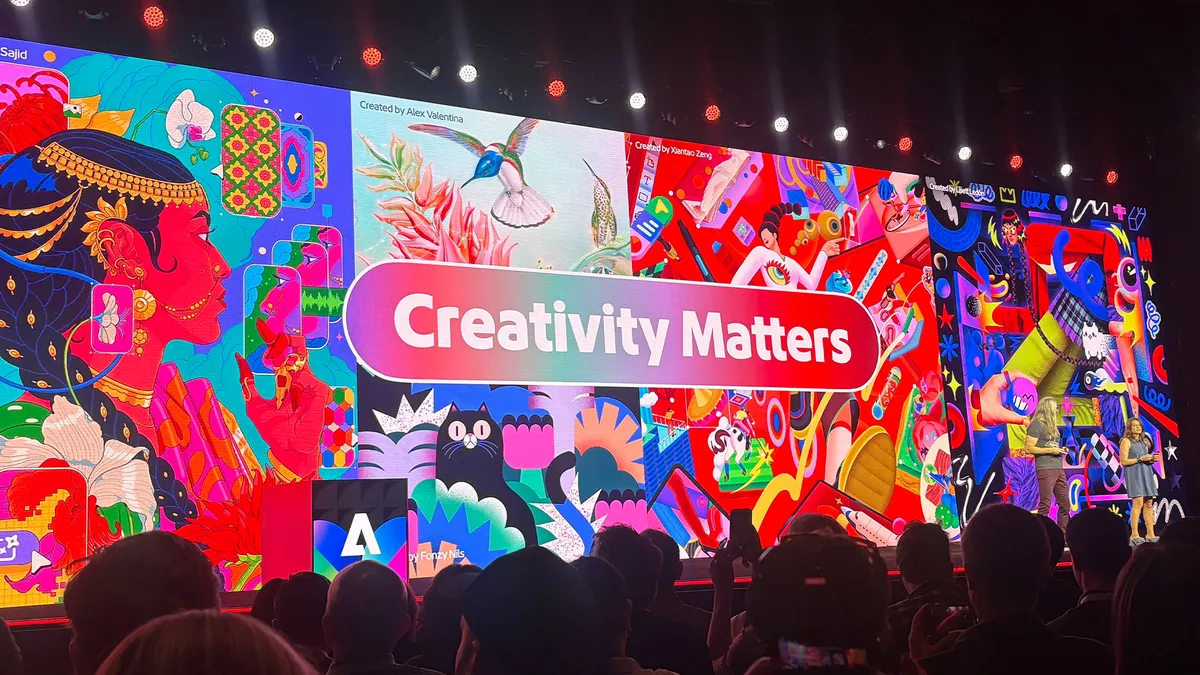
I recently had the privilege of attending this year's Adobe MAX, and amidst the flurry of excitement and innovations, what surprised me was the sense of community.
The phrase "finding your tribe" was thrown around profusely during the conference, and while I find the term mildly ickworthy, it bears truth. MAX is a space to connect, network, rant about the state of the creative industry, and, most importantly, a place to show up for your community.
It's no secret the creative industry was, and at times still is, a place of inequality. Be it race, gender, disability or age, while we have made strides to improve things, there are still gaps to be filled – something that Adobe is trying to address.
To learn more, I caught up with Karen Robinson, Vice President, Associate General Counsel, Litigation & Intellectual Property and leader of Adobe’s Black Employee Network, to discuss how Adobe is enacting change with purpose.
Tell me more about Adobe's Black Employee Network
I've been at the company for about 14 years. BEN (Black Employee Network) started in the US, and I'm a founding member. Initially, it was an effort to build community, so we slowly started expanding. We had chapters in San Jose, San Francisco, Utah and Seattle, but then we started expanding internationally. Our largest community of Black Adobe employees is actually outside of the US, in the UK – BEN UK is a really strong presence.
I've been the executive sponsor for BEN for probably seven or eight years now, and it continues to be a focused effort that I'm really proud of. What's really interesting about BEN in particular is the allies. It's not just our Black employees – I love that there are so many people who get involved even when it's not necessarily part of their specific community.
It's about intersectionality. So, we have Women at Adobe, MENA, (Middle Eastern and North African), Veterans at Adobe, Pride at Adobe. That's a really lovely thing about our employee resource groups in general, but I'm so proud of BEN. It's something that we put a lot of heart and effort into, and it sustains a lot of us.
How does Adobe avoid it's efforts feeling like ticking an inclusivity box?
We've always looked at inclusivity as something wildly important.
I'm responsible for some of our AI ethics and innovation, and as part of that, we made sure inclusivity is part of it. Looking at AI, how it can be used and what it's being trained on, if you're not focused on issues of inclusivity, you're missing out on large communities. That means the tools you're creating aren't serving those communities, so they're not the best tools you can create.
Our employee resource groups all developed out of a community's desire to be represented – to reflect their culture and the things they found to be important – and reflect them in the Adobe culture. The company really leans into it. It's not just ticking a box, or even just about minority groups getting together to have a sense of community. It's a way to make sure that we're offering the best products that reflect the communities we're serving. It's about empowering creativity for everyone. How do you do that if you're not including everyone?
Do you still think there's an inclusivity gap in the industry?
Sure. You can look at the numbers. I'm not saying anything that's shocking or outrageous. There is still opportunity for more inclusivity within the broader sort of industry.
Something I didn't realise was how much representation mattered. It wasn't until I got to a point where I had people coming up to me and saying, "Hey, I, I didn't even realise that someone like you could exist at a tech company, it makes me think that there's room and opportunity and growth for me."
For a long time minority communities were being told, "You need to be in science or technology." The reality is, you don't. There are entire swaths of the industry you can be involved in and not have a science or math background, but they needed to hear that and see that. I don't have a technical degree, and yet here I am – the first Black SVP at Adobe.
I look at the numbers, and we're growing. Success breeds success, and representation is a huge part of that.