



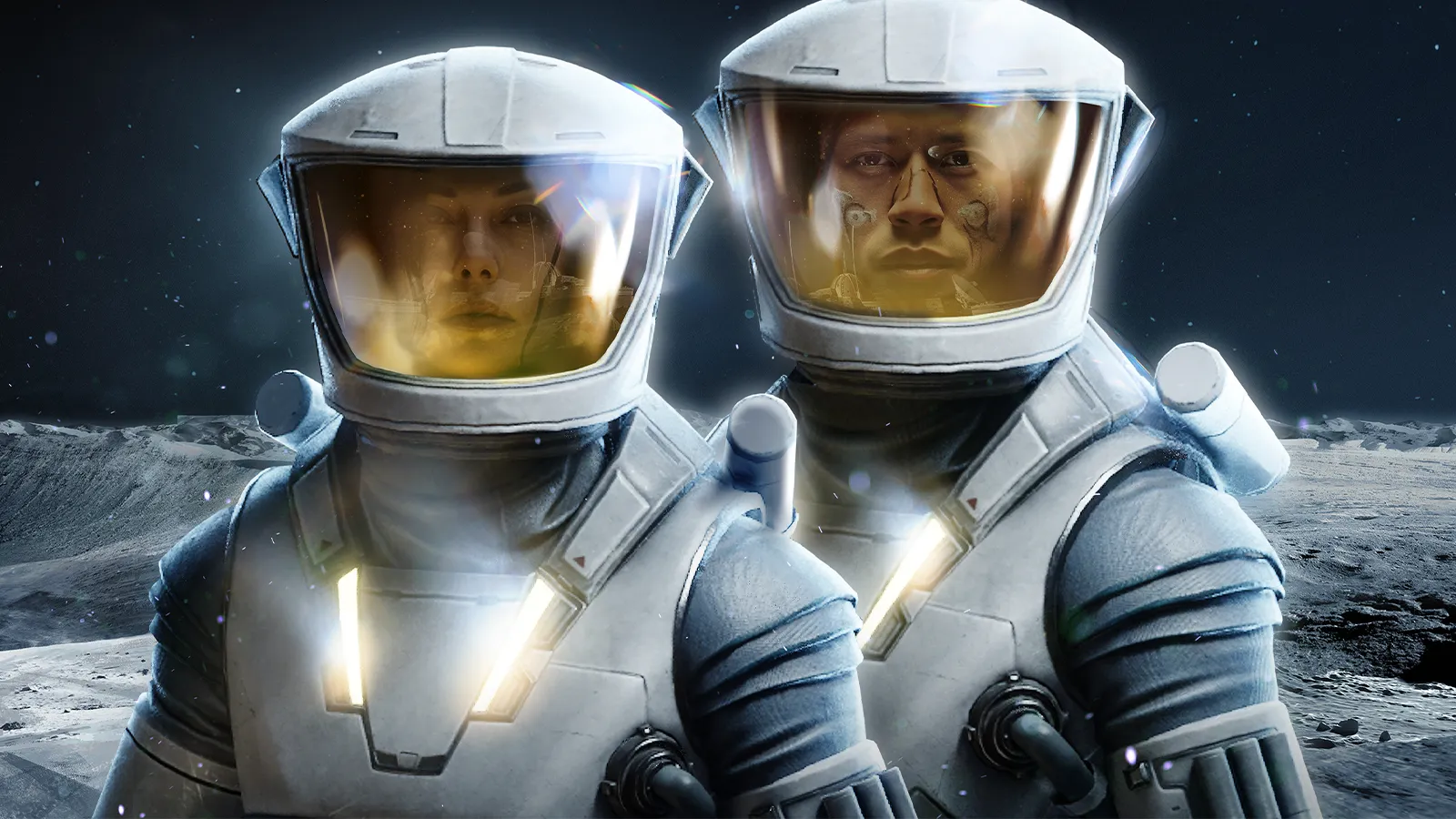
Cognition’s creative director Brian Pope doesn’t lead with worldbuilding or even technology, whether that's the use of Unreal Engine 5 or photogrammetry. He starts with preservation, or as he puts it, “Lunar Strike was actually originally developed as the idea of a game being used to tell both the story and the purpose behind archiving endangered heritage.”
That idea of archiving doesn’t stay abstract for long; instead, it starts to dictate how everything else is framed in the game. Set a century from now, Earth is ravaged by climate change, wars and ambitious future-forward thinking has ground to a halt. Against this backdrop, the Moon – Shackleton Station, at the lunar south pole, to be precise – becomes a storage site, a place of residue for data, debris, human traces - some deliberate, others left behind without ceremony, scattered across the lunar surface.
In Pope’s framing, even the Moon isn’t neutral, and it already carries weight; as Pope explains, "we're really littering the moon already… we turned it into a bit of a dump site”. Then he pushes the thought further, adding: “At what point does one person's garbage become another person's space history and heritage?”
It’s a passing remark in our conversation, but it carries some weight, not simply because Lunar Strike's commitment to realism drives the game's systems and builds its world, but because preservation and the use of photogrammetry to record our world are close to Pope's heart and central to the game. The Moon, in Lunar Strike, is being remade as an archive assembled from lost-and-found fragments, not simply an invented setting for a game.
Science fiction as a way of thinking
Pope doesn’t treat science fiction as decoration or mood; rather, he frames it as a way of thinking about what comes next, calling it “my great love” and “probably the most noble form of all literature, because it tells us who we might become.” That perspective becomes the philosophical backbone of Lunar Strike, shifting it away from speculative fiction as surface aesthetic and towards something closer to a working hypothesis about humanity under pressure and constraint – distance, isolation, time – and how all of that boils over at the worst time.
He extends that line of thought into more uncomfortable territory: “what it is to be human, and in a game such as Lunar Strike, we even ask the question, what it might be to become more than human, better than human.” From there, the game’s central tension sharpens into something playable: it questions what kind of species would decide to build a base there in the first place, and what gets preserved in the process, even when survival is on the line.
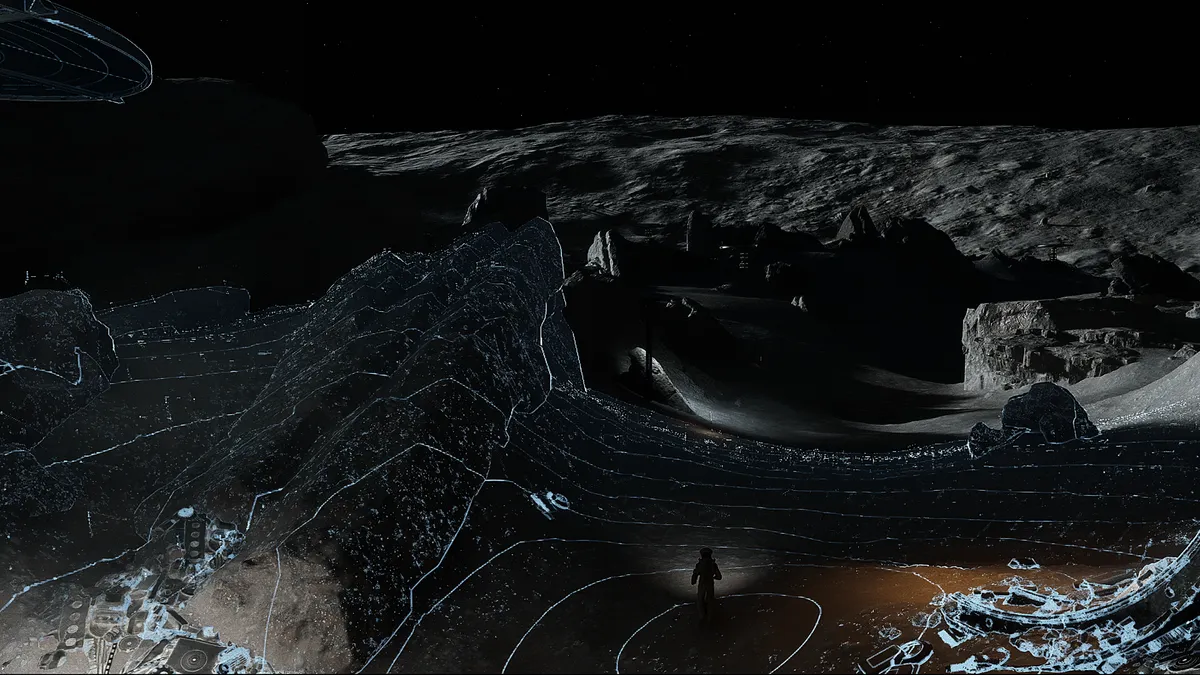
For a project built on such large ideas, the visual design has to carry weight to keep up. Lunar Strike’s technical backbone is photogrammetry, but it's not here simply to make the game look and feel real; Pope hopes to educate players on how and why the tech can be used. He explains that “the player walks away with a little bit of a skill set of how to do photogrammetry and LiDAR scanning, but more importantly, why it's important.”
That emphasis on 'why' becomes the pivot point as scanning lost and found items becomes central to the game's narrative, and that narrative becomes instruction on how photogrammetry can be used now: a framework for preserving humanity’s legacy by capturing scientific, cultural, and personal artefacts before they’re lost, both in game and in our lives.
The push for realism isn’t about simulation purity, then; it's about trust and engagement. As Pope puts it: “By having and making ourselves stick to, as often as we could, a high degree of realism, we really increase engagement, so that that way when we do step outside the bounds of science and physical possibilities, I think we've earned that trust.” Realism, then, isn’t a constraint; it’s the building blocks, the framework, giving the game's fiction room to exist and develop, and push the big ideas Pope loves science fiction for.
Building the Moon from Earth
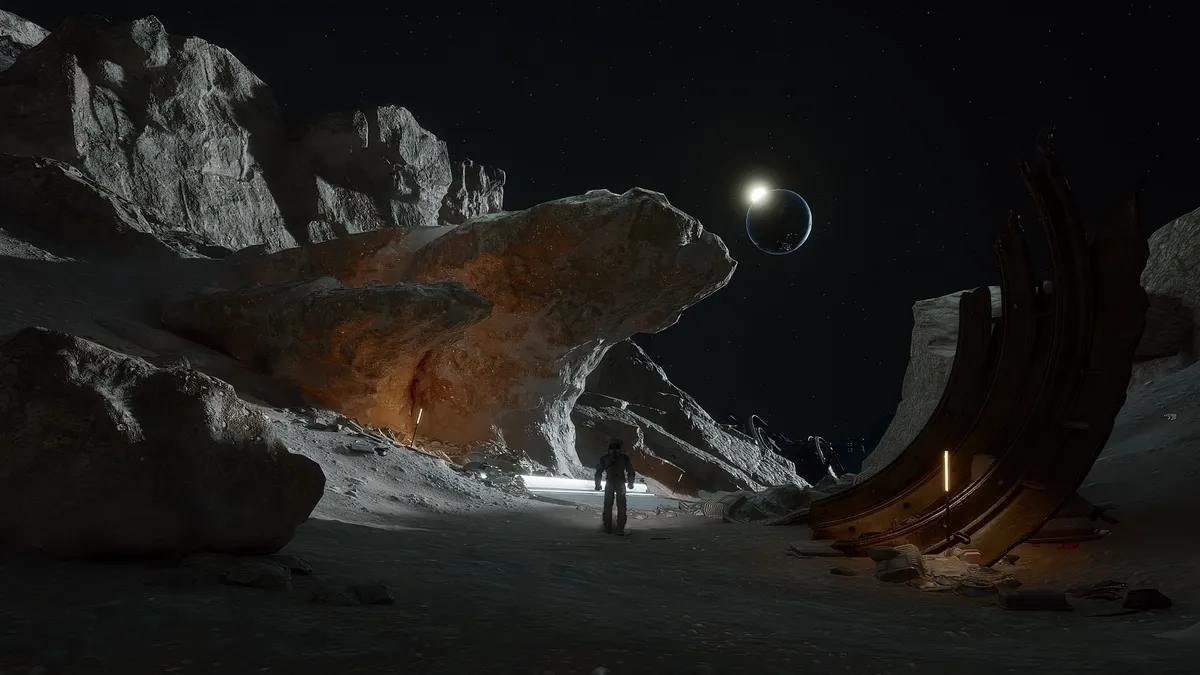
To build Lunar Strike's realistic moon and base, the team used as much real information as possible, starting with NASA geological data as a base layer, particularly around the South Pole, where lighting and terrain behaviour are grounded in mission data rather than imagined conditions. Earth environments such as California's beaches and Iceland's cliffs were scanned and repurposed as raw material for lunar surfaces, recontextualised rather than recreated.
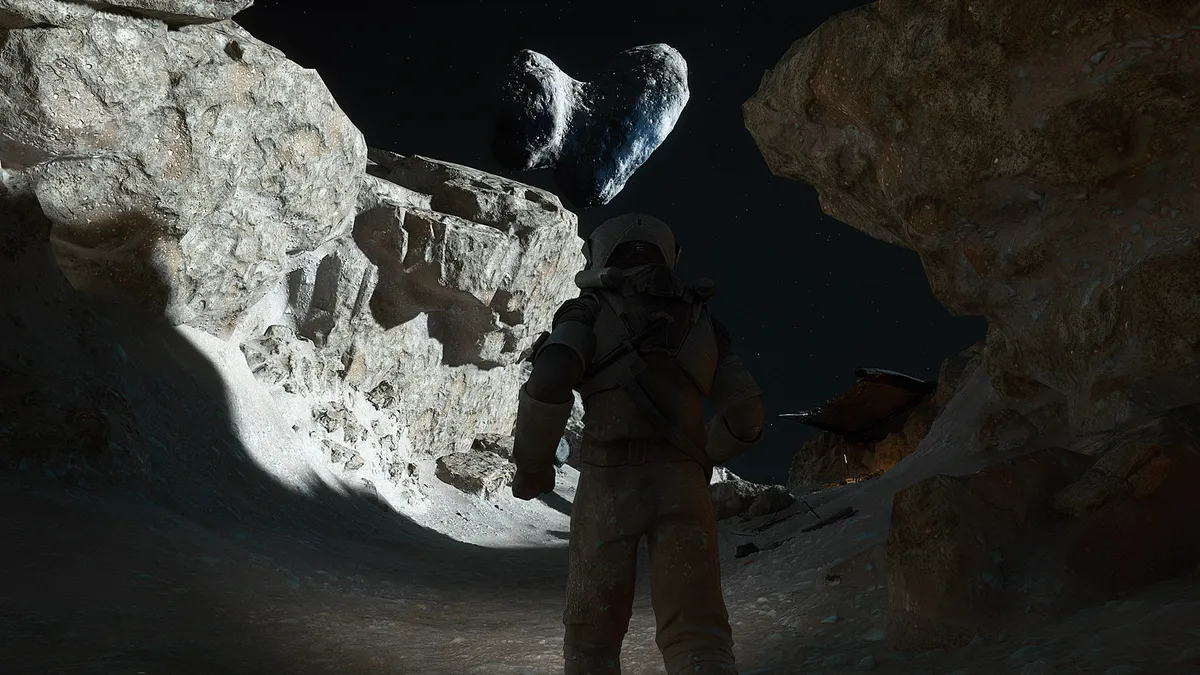
From there, the scope broadened to include spaceborne observation data. Pope notes that “we harvested several thousand photographs [from] the European Space Agency public site,” including imagery from the Rosetta mission, which the team used to reconstruct Comet 67P through photogrammetry. The real scientific data served as a reference for creating the in-game Comet 67P model, blurring the line between research material and the final visual language. The effect is a Moon that feels oddly credible before gameplay is added, and a threat so real because, well… Comet 67P is real.
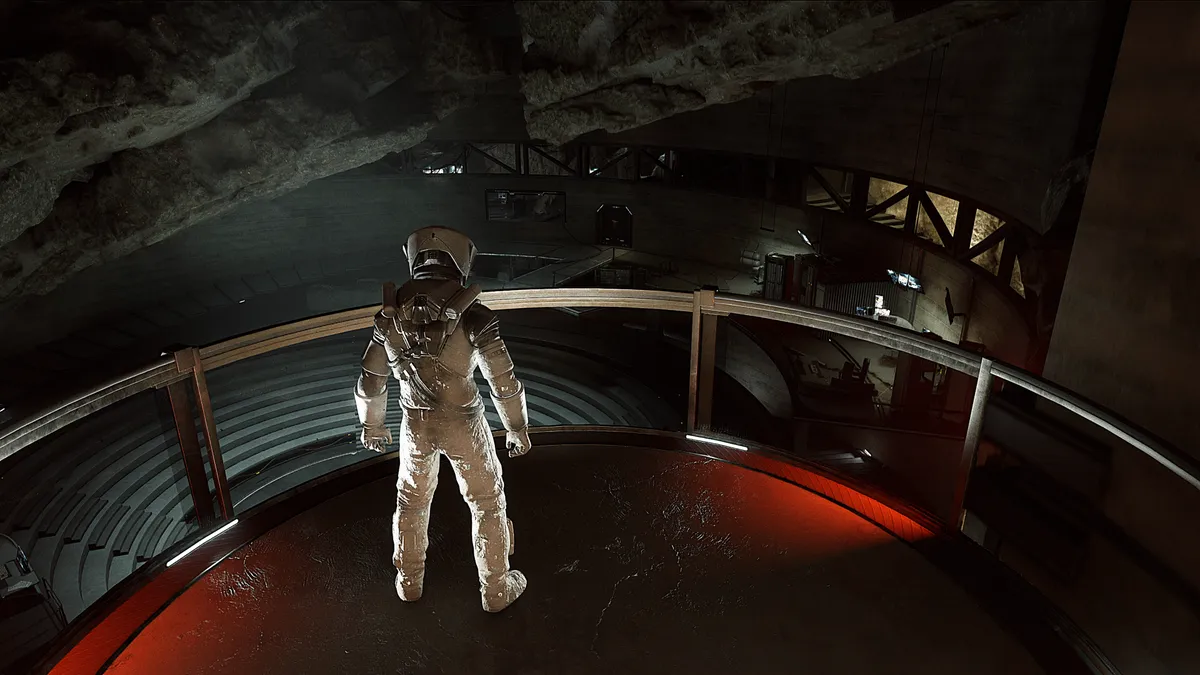
Once the terrain was in place, the focus shifted to what could be built on it, and here Lunar Strike's artists moved from using environmental data into material research. Real-world lunar engineering already points in this direction: 'regolith' – loose rock, dust, and soil that can be used for shielding, structural support, and protection against radiation and micrometeorites. From that principle comes the game’s fictional construction material, 'mooncrete', described by Pope as “a resin polymer mishmash of crushed up rock and dust from the moon”. Using this imagined substance as a basis defined the Moon colony’s architectural design.
With that in place, architecture stops being decorative and becomes a direct outcome of physics and the restrictions of mooncrete. Pope is blunt about the result, calling it “not very pretty, it’s not very sexy”. That austerity is exactly why Brutalism fits so naturally into Lunar Strike: the style's heavy forms, repetition and density are driven by function over form. So we get a game world designed by real-world constraints, and the result is something unique and very believable.
Gameplay meets realism
For all the scientific grounding and real-world data-driven design, there’s a point where Lunar Strike has to become playable. Executive producer Jan Goossen is blunt about that tension: “We’re still making a game.” That line effectively sets the boundary for what gets adjusted behind the scenes, especially around movement and traversal, where pure lunar physics don’t translate cleanly into exploration.
He explains the problem directly: “If you give that to a player and you take away the possibility that you can’t change your direction, that’s going to feel very punishing.” The team keeps the Moon’s 1/6 gravity intact, but softens its consequences so movement remains readable, responsive, and exploratory rather than restrictive.
Other systems lean into sensation over visibility; Moon dust, for example, is described in starkly physical terms by Pope, as “a series of super sharp microscopic needles that are so sharp and so tiny they can actually invade a cell wall" that can potentially "then shred the DNA”.
Sound design is equally developed around realism, so it's understood in terms of vibration and internal perception rather than air-based movement, since there’s no atmosphere to carry it. Pope jokes that players can feel sound emanating from their feet because surfaces and spacesuits carry the vibrations, creating a uniquely real, space-based audio design.
Even the UI is pared back, as Goossen notes, “everything that has to do with GUI (Graphical User Interface) often sits in the way of that feeling of like, 'okay, I am on the moon, I'm not playing a game, but I feel like being on the moon'”. The principle is consistent, though, and means that anything that brings players out of the moment and feels like a 'game' is reduced or removed.
Looking up to the player
That game design philosophy, which focuses on immersion, extends to how the game positions its player base. Goossen is explicit: “We're not talking down to our players; we're looking up to them”. The team are reframing puzzles, ethics, and narrative complexity as things to be trusted rather than simplified, and that same attitude carries over into Pope’s broader view of how gaming should be seen. He argues that “games are art, that games are stories, that games are fun on different levels,” placing Lunar Strike within a wider shift towards experiential, systems-led storytelling.
More broadly, there’s a growing cultural recognition of games beyond their commercial framing, something recently reflected in publications like Reset magazine. Pope also notes that the project received development support from Belgium’s film fund, a traditionally film-focused cultural body now extending into games. It’s a small but telling signal of where gaming and the games industry are heading, with games increasingly treated as cultural products rather than just entertainment.
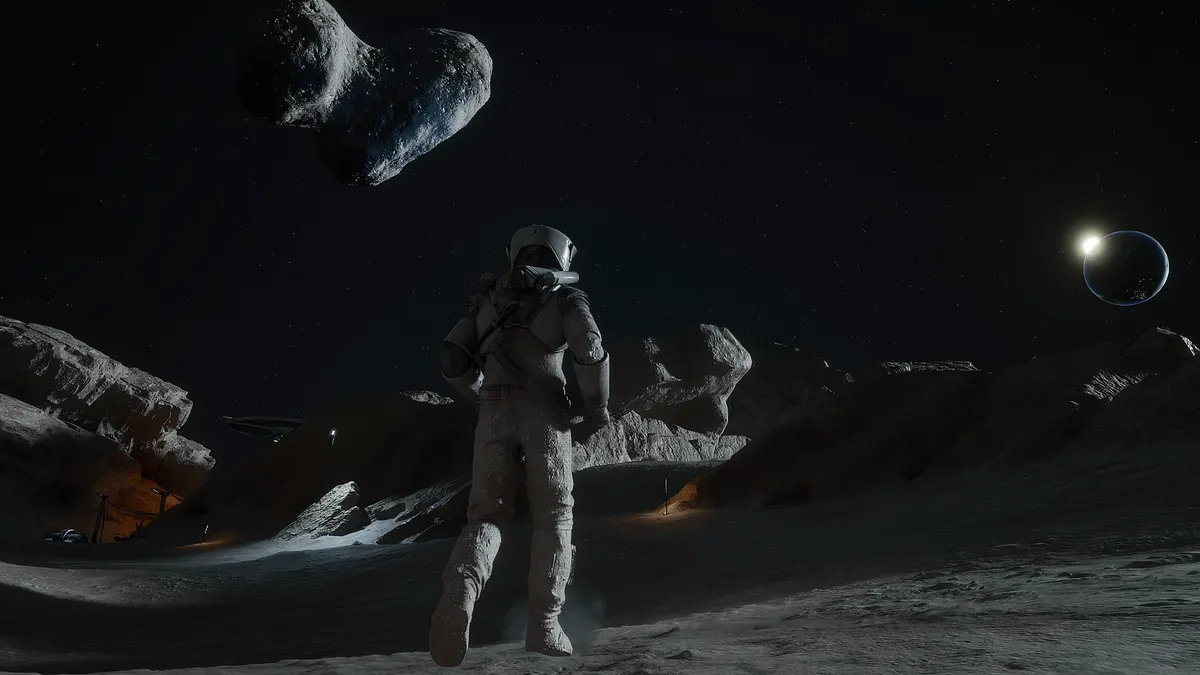
What Lunar Strike is ultimately aiming to build is not a fictional Moon but a reconstructed one assembled from observations, datasets, environmental scans, architectural realism, and scientific fact, then tuned into something playable, engaging and poignant. So NASA data defines the terrain, ESA photography provides structural reference, Earth scanning fills in geological texture, Brutalism emerges as a stylistic consequence, and Photogrammetry ties it all together, functioning as both a production tool and a gameplay metaphor.
Underneath it all runs a consistent idea that doesn’t shift across the interview: the Moon isn’t being invented so much as it is being reassembled from what we’ve already left behind, whether deliberately or not.