Look back at any long-running games series and it's not uncommon for the character design or visual style to get an overhaul over the years, or even with each entry.
It's no different for indie studio SFB Games' point-and-click mystery adventure series Detective Grimoire, which has been around for almost 20 years starting as a Flash game and has evolved with different art styles.
Except this time its latest upcoming adventure The Mermaid Mask does have an aesthetic continuity with its 2019 predecessor Tangle Tower. We spoke with the developers as part of our regular Indie Game Dev Insider series to learn more.

"This is the first time we've done a Detective Grimoire game that hasn't been a complete start-from-scratch reboot," creative director Adam Vian tells me.
"I don't want to say it's because we have plateaued as artists, but when we first started making Grimoire games, we were better artists week by week, and therefore everything we made suddenly became outdated, whereas now I look back at Tangle Tower and I still think it looks great, I don't really need it to look better than this."

Certainly, if you compare the character designs of Detective Grimoire and his partner Sally in the latest games compared to before, there's such a striking difference in expressiveness and colour along with the contrast of their blank white faces, which Vian cites The Thief and the Cobbler - legendary animator Richard Williams' unfinished animated film - as an influence.
That isn't to say that it's a case of recycling character assets, which would be tempting given they aren't always visibly on screen.


"We do have more poses per character, and they're fully animated," Vian adds. "When we were making the last game, there were a few moments where I was like, 'I wish I could have Sally whip out a notebook so that she could do jokes about what she's jotting down.'
"So we have that now. And I've just realised I want some new ones, and I'm redrawing some of Grimoire's eyes, because I've gotten better at drawing very specific tiny things. Like when people look down, their eyelids almost close, and I didn't realise that when I did Tangle Tower, so it's one little tiny thing I've gotten better at."


Inspect closer and there is however one crucial element that is new in The Mermaid Mask: 3D objects. This is specifically the case for clues, which can now be turned around and inspected all over to see what secrets they're hiding.
Incidentally, SFB's last game Crow Country was the first to use 3D, with low-poly PS1 vibes that resembles a cross between the original Resident Evil and Final Fantasy VII, though Vian credits 3D artist Kindra Dantone for the 3D modelling in The Mermaid Mask. The real alchemy is how these 3D objects still manage to resemble the painterly work of 2D artist Catherine Unger.
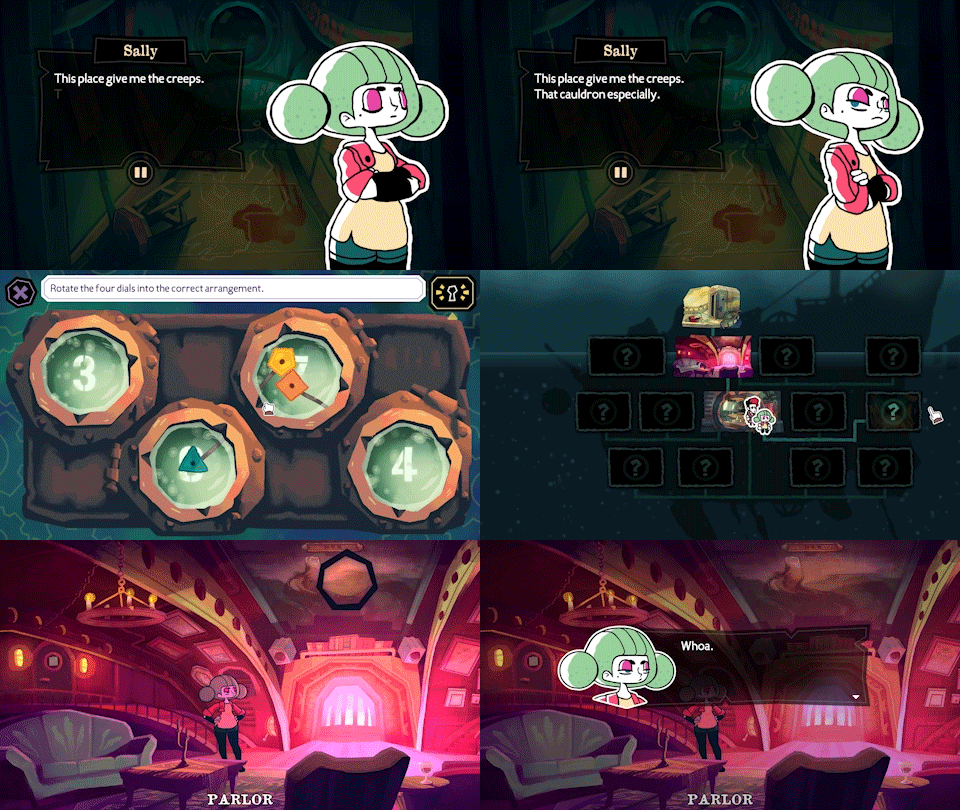
"We have a whole custom pipeline in Unity for that," Vian explains. "Kindra paints the textures and models it to look like Catherine's 2D paintings, and then my brother Tom [technical director] does an amazing bit of tech art with a dynamic outline shader that dynamically applies a wobbly coloured outline to the edge of the 3D, which is designed to look like how Catherine paints outlines.
"Obviously, 3D objects by their nature can't have outlines, but our game does, and they look exactly like they would if Catherine painted them, which makes the whole thing look exactly like a painting."

That isn't to say that it's less work because while it means you can don't have to paint a different angle of the same thing again, such as the submarine, the game's main location, it does mean having to design every side of an object that wouldn't be necessary if it was just 2D art.
Nonetheless, he believes the extra work is worth it: "The clues in this game are so fun to just look around and we added state changes so you can open them and shake them. I can't imagine going back to 2D now, that would feel so restrictive."


That said, there was no desire to also give the characters a 3D makeover.
"Getting 3D characters to be as soulful and nuanced as 2D characters is very hard, and if we did 3D, we don't have the skills to make it anywhere near as good as it would need to be," Vian admits. "2D characters are still the heart and soul of the game and I want to be a champion of 2D drawing as well."

With influences spanning the works of political cartoonist Gerald Scarfe ("master of the dynamic curve") to Samurai Jack creator Genndy Tartakovsky, the kind of 2D drawing Vian champions most then aren't fixated on realistic proportions but shapes that express energy and meaning.
"One of my philosophies is to just push everything," he concludes. "Never draw an arm that's a medium arm, it should be a skinny arm or a big curving arm. Every single line has to be a commitment. Every line that you add is an opportunity to convey meaning."
The Mermaid Mask is coming to PC and consoles this summer, and you can play the demo on Steam now.