Writing this in February 2026, I've realised something quite profound. In my home, my Flexispot E7 Pro has outlasted laptops, monitors, phones, even sofas. It arrived back in 2021 as a “sensible” ergonomic upgrade, a practical purchase for my home office. What it became, though, is something closer to a favourite piece of furniture: the calm, solid centre of my working life, and the stand that now hosts the best TV in our house.
I’ve tested other standing desks since, including newer Flexispot designs and rival models that are fancier, smarter or heavier. They have their virtues. But I still haven’t found anything that makes me want to dismantle the E7.
Its functionality is excellent, of course (smooth height adjustment, strong motors, generous weight capacity), but that’s not really why I love it. It goes a lot deeper than that.
It's worth noting that the E7 is a perfect match with my favourite ergonomic office chair, the HAG Capisco. It's one of the best office chairs for back pain.
Aesthetic appeal
When I first reviewed the Flexispot Adjustable Standing Desk Pro E7 back in 2021, I praised its quiet operation, solid construction and sensible price. It felt like a well-engineered tool. Living with it for years, though, I’ve come to appreciate it more as an object.
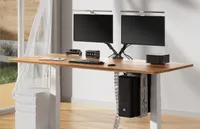
In my case, that means a simple, elegant frame with a mahogany top: warm, slightly reflective, and just textured enough to feel like real furniture rather than an accessory. The lines are clean and unfussy. There’s none of the gamer-desk fussiness, no harsh angles or obnoxious branding. Just a minimal rectangle that quietly supports whatever I put on it: laptop, sketchbook, mugs, speakers, or, sometimes, a large TV.
Like any good piece of design, it disappears when I need it to. I don’t really think of it as “tech” any more, in the sense that I think of a phone or tablet as tech. It’s become part of the architecture of the room: a surface that suits the light, the floor, the cables, and the rhythm of my day. And because it looks and feels right, I actually want to spend time at it; which matters more than any spec sheet.
Day to day use
For most of the week, the E7 is my workhorse. It’s where I write, edit, and research; where I balance a laptop, a notebook and a pair of headphones; where I park reference books. my coffee cups, my camera gear. I stand to draft, sit to refine, and adjust the height almost without thinking. The quiet motors have become part of the background soundtrack of my working life.
But when I shut down for the evening, the role of the desk subtly shifts. The same surface becomes our best TV stand. The main television in our home sits on the E7, and that has quietly transformed the way we use it. Being able to raise the screen to eye level for film nights, lower it for casual background viewing or tweak the height for gaming sessions feels oddly luxurious. It’s like having a custom-built media unit that can adapt to whoever’s in the room, and whatever we’re doing.

That dual identity – serious desk by day, relaxed entertainment station by night – is a big part of why I’ve grown so attached to it. I’m not just attached to the ergonomics; I’m attached to the little rituals around it.
Reliablility
In a way, the least interesting thing about the E7 is its headline functionality – and that’s a compliment. The motors do their job smoothly and without drama. The height presets behave exactly as you expect. The frame feels reassuringly overbuilt, more than capable of handling a heavy monitor, desktop tower, speakers and the aforementioned TV without a wobble.
If you spend your days reading about standing desks (as some of us do), you start to see a lot of noise about load limits, speed, decibels and smart add-ons. These things matter to a point, especially if you’re dealing with a very heavy, complex setup. But in daily use, the E7 has reminded me that what really counts is reliability and feel. Does it move when you need it to? Does it feel solid when it gets there? Does it blend with the rest of your environment rather than fighting it? In my experience, the answer has been yes, consistently, for years.

If you’re expecting me to say that a standing desk will revolutionise your health and productivity, I’m probably not the right evangelist. I do stand more, and feel better for it, but that’s not why I’m still using the Flexispot Adjustable Pro E7.
I’m still using it because it’s become part of the fabric of my life: a handsome, functional, adaptable piece of furniture that quietly supports both my work and my downtime. Plenty of standing desks can go up and down. Fewer can become – both literally and metaphorically – part of the furniture.
For me, that’s what makes this particular standing desk special. It doesn’t just fit my workflow; it fits my home.