Put most smartphones face down on a table, and they disappear. The industry has spent more than a decade refining the same object, and the result is black or unabrusively coloured glass, curved corners, and a camera bump. Nothing's smartphones are deliberately trying to break that visual monotony.
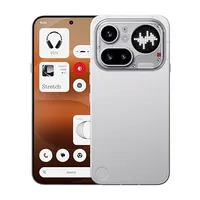
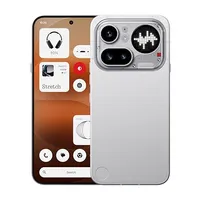
Turn over a Nothing Phone (4a), or the 4(a) Pro, and you immediately see why this small brand has carved a niche for itself in a crowded market. The transparent back reveals structural elements beneath the glass, screws and components are treated as graphic features, and the design language feels closer to industrial design or product graphics than the minimal anonymity of most phones.
For Adam Bates, Nothing’s Global Design Director, the goal is simply to create hardware that’s instantly recognisable. The phone design needs to feel and look like an image, a graphic design, “almost like a logo,” he says, holding the Nothing 4(a) Pro. And I can see it. Each new Nothing phone or pair of headphones has the same instant recognition that comes with a great logo redesign.

“And obviously, if you do a few, you're kind of using them up,” he laughs, reflecting on the push for new product designs, the circuitry patterns that make up each phone's rear panel. It's almost like a logo redesign with each new phone series. “So you're wondering, how many [designs] are there? So it's always exciting when you find a new one, yeah, and you think, ‘yeah, we've really got something there’.”
That “logo” comparison is revealing. Logos are designed for recognition at a glance; a visual shorthand that sticks in your memory. Applying that principle to a physical object, to a phone design, is unusual in tech, where most brands rely on subtle refinements rather than bold visual identities. But for a relatively young company like Nothing, recognisability matters.
A studio or tech musuem?
The design studio at Nothing looks less like a traditional tech office and more like a creative workspace. Retro electronics sit alongside materials samples, books, photography references, and unusual textures. At the launch of the Nothing Phone 4(a) Pro, the team relocated some of this inspirational tech – Super 8 cameras, a Game Boy DS, old ZX Spectrum cassette tapes – to the event so we can all see where the brand's DNA comes from.
“Yeah, absolutely,” Bates says when asked if the retro hardware scattered across the studio is genuine inspiration. “We’re the kind of people who bring their own things to the studio. I've got my Game Boy, which I bought when I was eight, on my desk. And there are old Walkmans and stereos, and other kinds of things as well, samples of different materials, bits of glass, and books. So, yeah, that's quite a good representation in that room. I mean, a lot of that stuff has just come from our studio.”
The influence is easy to spot in Nothing’s products. The exposed geometry on the back of the phones echoes the internal layouts of older electronics, while transparent plastics recall the translucent heyday of gadgets of the late-90s, but refined and reworked.


Lucy Birley, Colour and Material Design & Strategy at Nothing, says the studio environment reflects how the team works. “We're quite greedy, really. We're like, visually hungry, curious people. So we're pulling from all sorts of different areas of kind of art, culture, and music. There are a lot of people making music on the side, and others who are really deep into photography. Lots of people make stuff, you know, whatever that may be.”
Those overlapping interests feed directly into the design process, as Lucy explains, “And I think that allows us to create this world for ourselves that has lots of different interesting things, and everybody brings different stuff to the table.”
That way of working and making use of unexpected references can spark ideas. Lucy herself says she draws inspiration from the makeup counter – “Look at this incredible texture” – and for the Nothing’s team of artists and designers, the approach feels familiar, revealing how creativity often comes from collecting influences far outside your own discipline. “It's nice to bring together all of those influences,” reflects Lucy.

Redesigning the past
Nothing’s hardware often gets described as retro, designs that draw on ‘80s and ‘90s industrial and almost sci-fi influences, but Adam sees the design language differently when I ask him to describe the Nothing look.
“Yeah, it's really hard to sort of summarise in a couple of words,” he says. “We sometimes sort of think about if there was a fork in the road 30 or 40 years ago, and the future was different. Maybe that's us. So it's almost like an alternative future from maybe back in the 1980s.”
Instead of copying old electronics, the team imagines how technology might have evolved if design experimentation had continued in the same playful direction as early consumer tech. Lucy spends time exploring those historical visions of the future. “We got this amazing book recently, which was all sorts of tech and lifestyle concepts published in the year 2001,” she says. “It's really incredible. It's like a perfect time capsule of what the year 2000 millennium saw as the ideal future,” she says.
Some of the ideas are bizarre. Lucy laughs as she explains a bean bag with an entire desktop computer embedded in it, including a keyboard, which isn’t too far from today’s trend of couch laptop desks. Lucy tells me, “I'm always really fascinated by past imaginings of the future”.

Think differently
Modern smartphone design has become remarkably conservative. The same form factor, a glass rectangle with subtle variations, dominates almost every brand. Every year, Apple releases a new phone, and the debate erupts over bezel sizes, camera profiles, and why green, tan, orange, or dark red is the new black. Adam believes the industry arrived there because a few successful products set the standard everyone followed.
He explains: “I think every now and then in an industry, something happens that's a real hit, and a lot of people around just stop thinking and start replicating, so it means there's a lot of unrealised potential around because almost anyone that's come to design a phone has roughly had the same image of a product in front of them that they're trying to replicate.”
The solution, according to Nothing’s designers, is to reset the process each time. Lucy explains how the team approaches new projects. “Each time we've got a new project on the go, we sort of forget anything we ever learned before. Obviously, we can't really forget it because it's somewhere in our brains. But I think it's nice. We kind of have this philosophy of treating everything like a different, individual production by yourself.”

Working with colour
Product design is rarely linear. Ideas evolve through experimentation with materials, colour, and structure until something suddenly works. Lucy describes that moment as the point when the product feels complete. “There's always a moment where we sort of change one thing, or add something, or take something away, and it just falls into place, like a nice jigsaw.”
Up until now, save for the Nothing Phone 2(a) and Nothing Phone 3(a) Community Editions, the Nothing brand has stayed wedded to a black and white with a touch of red colour set, but with Phone 4(a), the team experimented with more colour, but inside Nothing’s translucent approach.
“What if these bright, chromatic colours live inside the transparency? What does that do to the overall object?” Says Lucy, offering the questions the team asked themselves. The result created depth within the phone's transparent structure. She picks up the new blue 4(a), turns it in the light and explains how it, “casts everything below into like shadow and relief, really, and you get this, like, suddenly, this super deep look that is really tonal and is also just a little bit unpredictable.”

With colour, Nothing is deliberately pushing against industry norms. Open Google and search for a new smartphone, and the palette is predictable: black, grey, silver. Even bold colour options tend to be muted, or “beige-ified”, says Lucy. A shift she believes represents a loss of optimism in technology design.
“It's a really interesting thing to be tasked with, expanding, quite an iconic palette that is very, very narrow,” reflects Lucy on adding more colour to the Nothing design language. Colour is also one of the most subjective aspects of design, but looking back through decades of product design reveals how expressive tech once was.
“In our own sort of research universe and archive, there is so much incredible colour, and it used to be such a big, sort of brave, optimistic part of tech, and now it isn't.” She pauses. “And that is just quite sad.”

Aim to be disruptive
Ultimately, Nothing’s design strategy comes down to visibility. The company is competing in a market dominated by giants, where brand recognition usually comes from marketing budgets rather than industrial design and the desire to be different.
Adam believes the products themselves need to carry that identity. “I think probably in everything we do, we've got to make it feel kind of a bit rebellious or striking or different.”
The idea of being a disruptor in a fairly conservative tech sector is something Lucy picks up on, and says, smiling, “It's not that difficult to be disruptive in the world that we are, and we're never pursuing sort of difference for difference's sake.”
Instead, the goal is simply to break away from the visual sameness that defines most consumer tech and embrace a mix of references we all subconsciously understand, whether it's Syd Mead, Game Boy, or the visual design of circuitry, just like a good logo should.