
As creatives, we’re navigating an industry transformed. AI is no longer an emerging trend; it’s embedded in our daily processes. But amid this revolution, one truth has only grown clearer: the more technology advances, the more irreplaceable our humanity becomes.
This has become strikingly evident over the last year in particular. As I look at projects that catch my eye, they aren’t necessarily the most technologically impressive, it's the work that makes me feel (which is in line with Adobe's trends for 2026).
It's work that leaves a trace long after I’ve moved on. It’s often work that isn’t perfect, but is profoundly human. And that’s precisely what AI cannot replicate. Not fully. Not yet. Possibly never.
AI enhances the process
When cars were invented, we didn’t strap engines to horses. We built roads, cities, highways – and a whole new culture. But with AI, we’re still feeding it reins and saddles, asking it to pull the same old cart faster.
AI shouldn’t just speed up the way we work. It should reshape what we’re working towards
AI shouldn’t just speed up the way we work. It should reshape what we’re working towards.
In an AI-driven, automated world, where design processes are democratised and design tools are accessible to all, standard work will be ubiquitous, and originality rarer. The role of designers will evolve dramatically: no longer just crafting visuals, but problem-solving at the core for clients, elevating design as a strategic tool.
Designers will also become curators – of meaning, of style, of cultural relevance. But above all, they will be emotional transmitters. Empathy will become the cornerstone. As we all begin to use AI, and as it levels the technical playing field, designers will have to push even harder to be more human than ever before. The future will belong to those who design with empathy, who reach the gut and the heart, not just the eye.
Emotion is our superpower

AI can simulate image, sound, and language. But it doesn’t know the weight of a morning that feels off. It doesn’t understand the chill of a November commute, or the sting of something left unsaid. It can write a love letter, but it’s never had its heart broken. It can draw a vase, but it has never felt the pull of wet clay between its hands – or the breathless pause as form merges from instinct.
That’s why brands like Polaroid strike a chord in their summer campaign. Not with pixel-perfect CGI, but with real stories, sensory memory, and the beautiful imperfection of analogue experience.
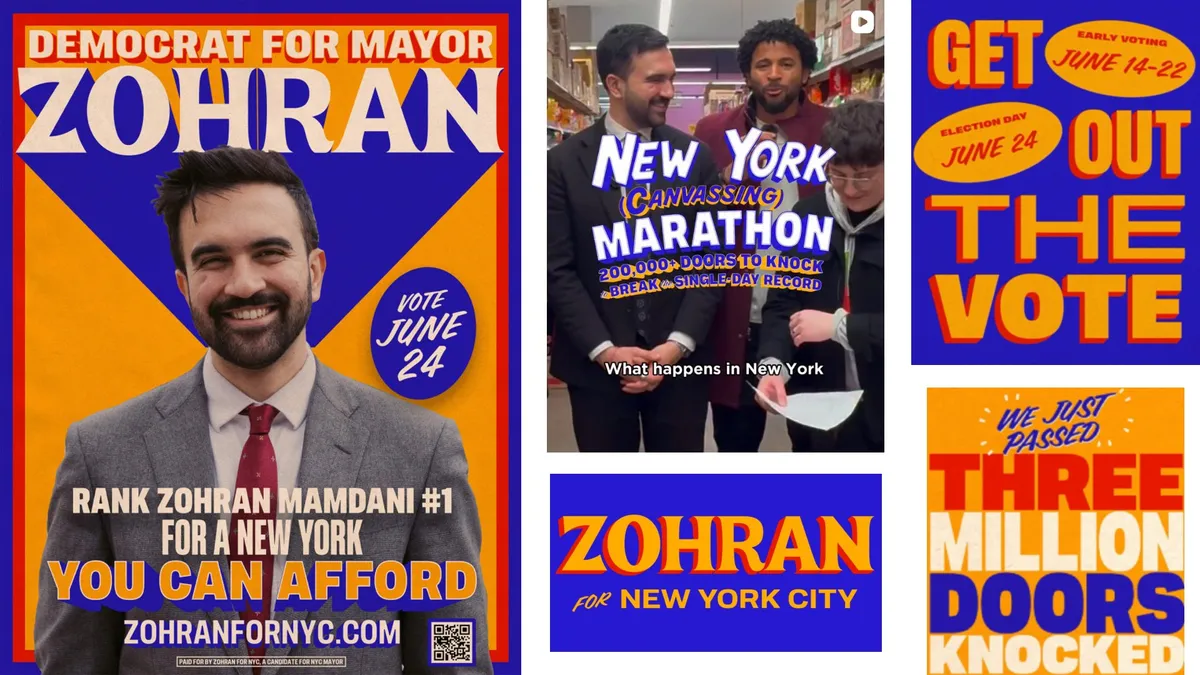
It’s why a political campaign like New York Mayoral candidate Zohran Mamdani’s breaks through. Not by being loud, but by being local, human, and honest.
It’s why even in an Excel spreadsheet – yes, I’m talking about Spotify’s Spreadbeats – emotion can sneak in and surprise us.
This year’s standout ideas across the industry embraced what it truly means to be human: irrational, absurd, weird, wacky, and always emotional. There was a rebellious resurgence of the handmade. The work felt distinctively human in both concept and execution, putting the person back into personality. The message was clear: in a landscape filled with bland and automated creative, it’s human feeling, impeccable craft, and offbeat thinking – the stuff no machine could ever conceive – that rises to the top.
Part of this is a counterpoint to the surge of AI-generated work, but the two aren’t always in opposition. The most resonant creative pieces boldly underline, with the human hand, that the work unmistakably conceived and made by people (flaws and all) connects the deepest.
In a sea of algorithmic sameness, emotional intelligence is the new creative frontier.
Creativity is not just output. It’s insight
At Lonsdale, we don’t design for show. We design for emotion. Each identity we create, each space we imagine, must feel something. Belonging. Curiosity. Confidence. Joy.
And that’s where AI becomes a mirror. It reflects, but it doesn’t feel. It computes, but it doesn’t connect. We believe in blending human insight with technological power, building on the idea that the future belongs to hybridisation.
As creators, we should not fear the machine
As creators, we should not fear the machine. We should challenge it to serve meaning. Guide it toward culture. Use it to free our minds for higher questions: What does this make people feel?
What does this say about now? What might this become?
When intelligence becomes hybrid, our creativity becomes deeper. AI accelerates, scales and strengthens, but it’s humanity that gives direction, emotion and meaning.
By mapping the moments where it can add the most value and truly amplify our creativity, a hybrid approach to AI gives us the extra room for what matters most: the listening, the thinking, the feeling. The sharp brief. The discerning choice and the relevant counsel.
A new creative contract
So here’s the new creative contract I believe in:
Let AI generate.
Let humans feel.
Let us create, not in resistance to technology, but in resonance with emotion.
Because the work that lingers isn’t always the most efficient. It’s the most human.
Creativity is about storytelling, insight, and emotional resonance – qualities that still require a human touch.

