The AI laptop wave isn’t coming. It’s already kicked the door in, rearranged the furniture, and started talking about TOPS while tying us to a chair in the corner. With AI‑equipped machines projected to make up more than half of all PCs sold by 2026, according to Gartner and others, the industry has quietly agreed that the “AI PC” is no longer a marketing slogan but the new baseline. NPUs, once obscure silicon-based technological curiosities for the niche enthusiast crowd, are now the star attraction, with next‑gen laptops routinely clearing the 40‑TOPS bar that defines Microsoft’s Copilot+ class of devices. And as vendors race to distinguish themselves from their rivals in this fast‑maturing category, the stakes for creatives are getting very real.
Because while AI hardware promises speed, efficiency and a whole lot of automated drudgery‑slaying, it also arrives in a cultural moment where many artists feel like they’re being asked to smile politely while the robots rifle through their pencil cases (or scrape all their artistic touches from their online portfolio). The tension is palpable: AI as a super‑assistant versus AI as a usurper. Will it be a paradigm-shifting workflow accelerator or a vibe-based job terminator?
So when Dell leans into the AI PC wave, and they are leaning all the way, as I have found out, the obvious question for Creative Bloq readers is: what does this actually mean for the people who make things? Not the enterprise IT buyers or the productivity‑obsessed middle managers, but the illustrators, editors, animators, designers and hybrid creative‑technologists who need their tools to be fast, reliable, and respectful of the craft.
To get a clearer picture, we spoke with Louise Quennell, Senior Director for the Client Solutions Group at Dell Technologies, about where AI laptops are headed, what they can genuinely offer creatives, and how the company is navigating the increasingly delicate line between “helpful automation” and “please don’t replace me with a stochastic parrot.”

Erlingur Einarsson: How much, on a scale of "1" to "the Tower of Pisa in a hurricane", are you leaning into the AI laptop wave at Dell?
Louise Quennell: "We’re fully embracing this wave and we’re not alone. AI PCs are predicted to represent a significant 55% of the worldwide PC market by the end of 2026, according to Gartner. It’s clear that AI PCs aren’t just a new trend – they are completely redefining how people work across essentially all industries. Soon, the tools and software you rely on every day will be built with AI in mind and having a PC that can keep up won’t be a luxury – it will be essential."
The broader hardware landscape backs up Quennell’s confidence. AI‑advanced PCs are expected to hit nearly 60% of global shipments in 2026 as NPUs become standard across mid‑to‑high‑end laptops. With Windows 10’s end‑of‑support pushing a major refresh cycle and CES 2026 dominated by AI‑centric designs from Dell, Lenovo, Nvidia and AMD, the shift isn’t theoretical; it’s happening in real time.
EE: Creatives often find AI, especially generative AI, as a bit of a dirty word when it threatens to replace their expertise (and especially when the results lack the necessary humanity and idiosyncrasy of the human experience). How are you working to address these concerns? And where, in your mind, is the line between 'more help to streamline creation, just like digital video, mirrorless cameras or editing applications rather than literal scissors and physical film adjustments' on the one hand and 'we don't need humans for this any more' on the other?
Quennell: "There is and should always be a place for human creativity, experimentation and discovery. AI’s role is to augment human creativity, not replace it. Focusing AI on automating repetitive, non-creative tasks to free up experts for higher-value, uniquely human work.
AI PCs have hardware that’s dedicated to AI, the neural processing unit (NPU). It’s designed to handle complex AI tasks directly on the device, freeing up the other key processing units - the central processing unit (CPU) and graphics processing unit (GPU) - for other parts of the creative workflow.
For creatives, this means more tangible benefits including accelerated generative AI tasks like text-to-image creation, or 50 per cent faster photo editing in the Adobe Suite.
AI automation also extends beyond the PC itself – the modern creative workspace is an ecosystem. By integrating smart peripherals like AI-enabled cameras and microphones, we enhance the entire workflow, from improving remote client collaboration with AI-powered noise cancellation to streamlining content creation.
Our objective is to handle the technical heavy lifting – much like digital editing software streamlined film cutting - to empower human artistry."
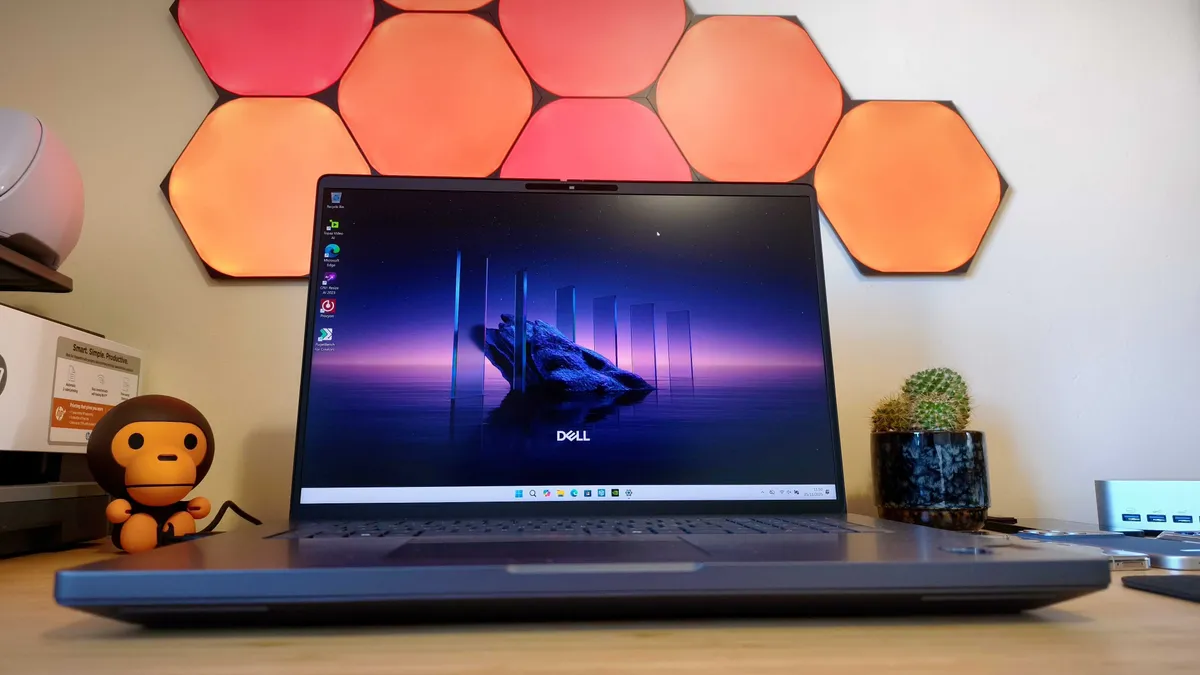
This is where the creative community’s anxiety diverges from the enterprise narrative. For many artists, the fear isn’t that AI will automate the boring bits (which is the dream) but that it will flatten the weird, human, idiosyncratic bits. Quennell’s framing of AI as an “augmenter” rather than a replacement echoes a growing industry consensus, but the proof will ultimately come from how these tools behave in the hands of real creators.
EE: To paraphrase a viral social media post, I don't want to do admin while an AI writes poetry. I want to write poetry while my AI does the admin. How will the next generation of computers help us achieve that?
Quennell: "Between meetings, communicating and searching for information, much of our days are taken up with admin-based tasks. In fact, research from Intel found that professionals can lose nearly 15 hours a week on ‘digital chores’. AI PCs and on-device AI features help ease the burden of these ‘chores’, with AI assistants being able to learn a user’s habits to mute distractions, schedule meetings and automate routine tasks.
Taking freelance creatives as an example, managing multiple briefs with varying detail and timelines creates an extensive management task. With an AI PC, these freelancers can have a device that helps ease managing these deadlines, giving them the time they need to create the creative work they specialise in."
The idea that AI PCs could claw back 15 hours a week of “digital chores”, a figure supported by Intel’s research, is particularly resonant for freelancers, who often juggle the roles of artist, project manager, accountant, and customer‑service department simultaneously. If AI hardware can meaningfully reduce that load, it may become as essential to creative work as the jump from film to digital once was. But when will it actually?
EE: Finally, at what point can I tell my AI to do my emails for me, and it will just... do it? Asking for a friend.
Quennell: "That is the dream scenario, isn’t it? While we're not at a point where AI can perfectly capture your personal tone and relationships without your input, we are getting much closer to eliminating "email admin."
AI assistants are already learning user habits to automate routine tasks, such as muting distractions or intelligently scheduling meetings. When it comes to emails, the immediate value is in AI handling the noise by summarising long threads, drafting standard replies, and highlight your key action items. This frees you up to provide the essential human element: the personal touch, the strategic points and the final approval.
As we continue to explore the possibilities of this technology, the humble email may receive a makeover, but we’ll be in the driving seat."
The holy grail, the AI that handles your inbox with the tact, nuance and passive‑aggressive charm of a seasoned creative professional, remains tantalisingly just out of reach. But with AI PCs increasingly capable of on‑device summarisation, drafting and prioritisation, the gap between “assistant” and “delegate” is narrowing fast.