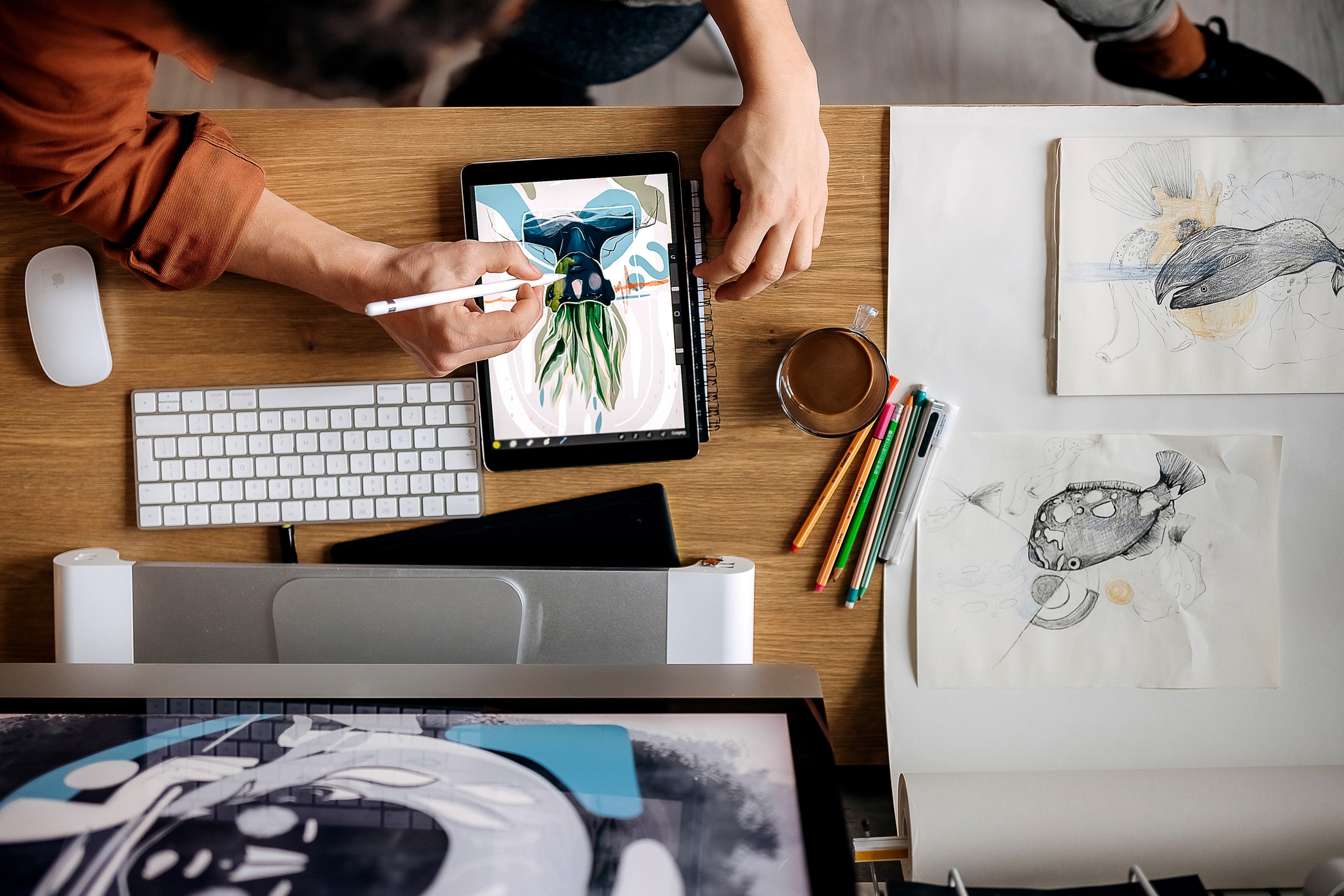



It's been almost three years since Adobe launched its Firefly AI image model, and a lot has changed. There's now a video model, sound effects, Firefly-powered tools in apps like Photoshop and Illustrator, and even non-Adobe models like Google's Nano Banana (see our Adobe software list and our guide to the best digital art software).
A lot of the AI tools have been hugely popular. Generative Fill is now one of the five most-used features in Photoshop, and Adobe users have already made millions of generations using Nano Banana. But there have been controversies too, amid opposition to AI among some traditional users and shifts in Creative Cloud pricing plans.
As we enter a new year, we caught up with Deepa Subramaniam, Adobe's Vice President of Product Marketing, Creative Cloud, to ask where the company's focus on AI is heading and how she sees creatives using AI in 2026 and beyond.
Deepa describes her objective as to "do my best to make it the best time ever to be a creative professional”. And she believes Adobe's AI tools are helping to achieve that.
"The signals we're getting from engagement and usage show we're on the right path and that there's an excitement and a desire for what we're doing and for more of it," she says,
The data on usage shows that two out of three Photoshop users in the beta version use generative AI in their workflows daily. Meanwhile, Lightroom’s AI tools, which include AI making and denoising, are used by over two-thirds of its users.
"Creatives aren’t just experimenting with creative generative AI; it’s become an essential part of their toolkit and a key competitive edge helping them stand out," Deepa notes. "We’re seeing a strong demand for AI offerings, and it’s clear that creative professionals want AI tools with power, precision, choice and control."
Adobe's also aware that people aren't only using its proprietary tools. That's why its recent updates have included the addition of third-party AI models like Runway, Flux and Nano Banana to Adobe apps, radically changing the approach of the creative software giant. It sees creative workflows becoming increasingly diverse and aims to provide a suite that pulls all of this together.
Catering to the whole creative lifecycle

Adobe sees creatives combining its tools, putting Photoshop and Firefly together, or Firefly and Premiere together. That extends beyond creation and production to the ideation part of the creative process with Firefly Boards.
Artists, graphic designers and particularly teams of creatives are using the new web-based platform to pool and organise references for inspiration and to test and iterate ideas by quickly remixing images or combining concepts.
Users can generate images and video, add their own assets and mix and remix. For example, you can take the composition from one image as a reference and mix it with colours from another. With its infinite canvas and the possibility of real-time collaboration, the platform is particularly useful for teams of creatives for creating moodboards and storyboards.
Changing paradigms
How creatives create has always been transforming. To understand where things are going, Adobe takes a cross-product view, looking at what creatives are actually doing, and what they're struggling with.
Beyond AI, it's been bringing transformative workflows from desktop applications into web and mobile to support new, less desk-based ways of working. This year Adobe launched Premiere for video editing on iOS, and an Android app is coming next year.
Deepa thinks the next evolution will be a transition beyond the confines of specific tools as AI enables broader workflows via conversational interfaces and agentic experiences, including on external platforms. Adobe recently integrated Photoshop tools into Chat GPT, which Deepa says is an example of the company "going where the creativity is regardless of whether it's in our own surfaces".
"Increasingly, you're seeing creators using Chat GPT to help them ideate, using our workflows and their tools,' she notes.
With this kind of integration, it may no longer be necessary to power-up and navigate individual apps to work through each part of a process. The user will be able to tell Chat GPT, or eventually Adobe's own planned cross-app AI assistant, Project Moonlight what they want to create. The AI will then try to realise the creative's vision using the apps required.
In this sense, creative software itself could start to become almost invisible, with its relatively complex visual UIs replaced by an intuitive conversational external interface, apart from when the creative needs to perform a task that the AI can't figure out how to do.
Another step in this direction is Project Graph, which we saw a glimpse of at Adobe MAX (see the video above) Still in development, this promises an entirely new paradigm within Creative Cloud: a node-based way to create and automate custom workflows by visually connecting AI models, Adobe tools and effects.
The idea is that creators will be able to build portable "capsules" that provide more control and adaptability than prompt-based AI while making complex tasks reusable and shareable.
For Deepa, new paradigms like Graph, agentic AI and the integration of Adobe tools into third-party platforms (and vice-versa), all form part of where creative workflows are heading: towards less defined, more flexible ways of working that AI can help bring together. She things there's still a lot that Adobe can do to advance this further, including helping users to assemble and scale assets.
In the meantime, the message from Adobe remains the same: that AI tools are only part of the ingredients in a growing professional toolkit. And that they're here to help the creative.
"Our core message is that AI is meant to enhance your workflow, not replace you," she stresses. "You are the creator. You have creative ideas. We want to give you tools and workflows that give you time back to be more creative. AI can help with that as an ingredient in a workflow that can give you back creative productivity, creative efficiency and maybe creative inspiration."