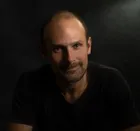
Anyone daunted by the challenge of learning how to use complex 3D animation software can take Serhan Yorganci as an inspiration. After the Turkish filmmaker had a script for a live-action movie turned down several times, he refused to give up. He pivoted, deciding to make the movie as an animation instead, and to do it by himself.
There was just one hurdle. Serhan had no experience in animation. He had to learn from scratch. The process took several years, but he's now launched Square Heads on Apple TV.
Square Heads is a feature-length animated comedy that Serhan made almost alone (apart from his voice actors) under his own studio, Digitoons. It follows three children who see money as something abstract and easy, until they have to earn it.
The film combines absurd humor with familiar observations about modern life. Rather than attempting 3D realism, the animation style is deliberately minimal. That's partly out of necessity, but it also gives the movie a look of its own that's earned it selections at events like Cartoons on the Bay Panorama and the Ischia Global Film and Music Festival.
I asked Serhan what the learning process was like, and what he would recommend to other new animators hoping to complete such a project on their own.
What was the initial inspiration for Square Heads?
The idea actually came from a very simple moment with my nephew. He was trying to buy things on his phone and in games, and all of them were digital. That’s when I realized something: for him, money isn’t really a physical thing. It feels more like a number on a screen.
That made me stop and think for a bit. If money feels that abstract, then the effort behind earning it isn’t very visible either. You don’t really see what it takes.
From there, I started asking myself what would happen if these kids suddenly had to work for it. If they actually had to earn something, how would that change the way they see it? That question is basically where the story came from.


How did you choose the animation style?
The character design actually came from a pretty practical need. Since I was working on the film on my own, I needed a style that I could produce relatively quickly but that would still look strong on screen. A simpler, stylised approach just made things more manageable.
I also wanted all the characters to come from the same base. Instead of building each one from scratch, I kept the same structure and changed things like hair, nose, and eyebrows to create variation. That helped speed things up and also kept the overall look consistent.
The larger heads also made a difference, especially for facial animation. They gave me more room to work with expressions, so it became easier to show what the characters were feeling.
So it wasn’t just an aesthetic choice. It was also about keeping the process realistic for a one-person production.
How did you go about learning 3D animation?
I started from zero. At first, instead of focusing on just one program, I tried to understand what each one actually does. Modeling, animation, rendering, rigging… just to get a sense of the whole process.
Then I moved step by step, depending on what I needed at the time. If I was building a scene, I focused on lighting and camera. If I needed a character, I looked into modeling and rigging. I didn’t try to learn everything at once.
It was mostly trial and error. I watched a lot of YouTube tutorials, tested small things, and repeated them until they made sense. Over time, those pieces started to come together.
What was the most difficult part of the process?
The hardest part wasn’t technical, it was more psychological.
At the beginning, it feels like you’re making quick progress. But after a while, you start to realize how complex everything actually is. Every time you solve one problem, another one shows up. It gives you this constant feeling that you’re still missing something.
Working alone makes it harder too. There’s no one to tell you if what you’re doing is right or not. So you’re learning, but at the same time you’re also trying to judge your own work. That uncertainty was probably the hardest part. Just continuing without really knowing if you’re on the right track.

Did your vision for the movie change during the process of making it?
The core idea stayed the same, but the way I told the story changed over time. At the beginning, I had written bigger and more complex scenes. But as I went on, I realized there were things I just couldn’t execute on my own.
Instead of forcing them, I changed parts of the script. Some scenes were removed, some were simplified, but they still served the same purpose. So the story itself didn’t really change, but the way it’s told adapted to what I could realistically do.
In the end, that actually helped the film. I focused on what works, instead of trying to make everything work.
What are you most proud of in the finished film and is there anything you would do differently if you started over today?
What I’m most proud of is simply finishing the film. It was a long process, and there were many moments where it would have been easier to stop. But I didn’t, and I managed to complete it. That’s probably the part I value the most.
If I were starting today, I’d begin with something smaller. I was learning too many things at the same time, which made the process harder than it needed to be. I’d take a more controlled approach and build things step by step.
What can other new animators learn from your experience?
I think the most important thing is not waiting until you feel ready, because that moment doesn’t really come. You start learning once you begin.
At the same time, it helps to know your limits. You need to understand what you can realistically do with what you have.
For me, it was about finding a balance. Moving forward, but also adjusting based on what was actually possible.
The story critiques the impact of certain technologies on society. How do you think that resonates in times of generative AI?
Technology has made a lot of things easier. With generative AI, creating content is now much faster and more accessible.
That’s a good thing in many ways, because more people can bring their ideas to life. But there’s also a downside. When something becomes too easy to produce, people may start to value it less.
In the past, creating something usually took more time and effort, and that made it feel more valuable. Now that balance is changing. This is actually very close to what I explore in the film. If the effort behind something becomes less visible, its value can feel different.
I’m not pessimistic about it though. What really makes something meaningful is still the idea, the perspective, and the emotion behind it. And that part still comes from people. So even if the tools change, storytelling will always matter.
What are your plans for Digitoons now?
I’ve already started working on my second film. On the first one, I was learning everything from scratch, so the process took a lot longer than expected. This time, I have a better idea of what I’m doing, so I’d like to move faster and avoid some of the same mistakes.
I’m also trying to be more structured from the beginning. I have a clearer sense of how the process should move forward. In the long term, I don’t just want to make one film. I want to build something that allows me to keep producing films regularly. That’s where I’d like to take Digitoons.
You can find Square Heads on Apple TV.
Inspired? See out pick of the best laptops for animation.