Our Verdict
While it may be a gaming laptop, there's no denying that the 2026 Razer Blade 18 is one of the most powerful portable machines you can buy, and that means it can blitz through creative work as easily as it can render spaceships. The price is high, but the speed is higher.
For
- Ridiculous power
- Built like a tank
- Thunderbolt 5
Against
- Ridiculous price
- Rather heavy
- Nope, that's it
Why you can trust Creative Bloq Our expert reviewers spend hours testing and comparing products and services so you can choose the best for you. Find out more about how we test.
Oh boy, this is a big one. While there are other 18-inch gaming laptops on the market, few have the panache of the Razer Blade 18. It’s menacing in its matte black shell, put together with the precision of the people who built the pyramids and almost as heavy. The price is also astronomical, but for those who splash the cash there are few PCs better equipped to render, calculate, edit and process at extreme speed – it's up there with the best laptops for game development and then some.
Key specifications
CPU: |
Intel Core Ultra 9 290HX Plus |
NPU: |
Intel AI Boost |
Graphics: |
Nvidia GeForce RTX 5090 |
Memory: |
32GB |
Storage: |
2TB SSD, SD card reader |
Screen size: |
18in |
Screen type: |
Dual-Mode IPS |
Resolution: |
3840 x 2400 |
Refresh rate: |
240Hz (440Hz in 1920 x 1200 mode) |
Colour gamut (measured): |
98% P3 |
Brightness (measured): |
615 nits |
Ports: |
1x Thunderbolt 5, 1x Thunderbolt 4, 3x USB 3.2 Gen 2 Type-A, 1x 2.5Gb Ethernet, 1x HDMI 2.1, 1x 3.5mm audio |
Wireless connectivity: |
Wi-Fi 7, Bluetooth 5.4 |
Dimensions: |
28 x 275 x 400mm |
Weight: |
3.2kg |
Design, build and display

• Big and heavy
• Beautifully made
Opening the box containing an 18in gaming laptop often feels like a kind of ceremony. The packaging for the Razer Blade 18 is festooned with logos for Intel, Thunderbolt, and THX Spatial Audio, but also manages to be slimmer than you’d imagine.
The same is true of the laptop itself – it’s not the thickest we’ve seen, though it disguises its bulk by utilising a stepped design that’s thinner at the edge for a few centimetres before becoming thicker toward the middle where you’ll also find the vents for the cooling system. There's no getting away from the laptop’s weight - it’s three times that of the Geekom X14 Pro – making this a desktop replacement rather than something truly portable.
Razer has always been consistent in its design language, pairing matte black with bright green accents, and the same look is found here, with the green flash visible inside the USB ports and on the logo on the back of the lid. Elsewhere, it’s plain black, such that the screen and keyboard blend into the chassis when it’s switched off. Hit the power switch, and you’re treated to the RGB keyboard, which can be customised per-key or just switched to plain white.
Design score: 4/5
Features

• Thunderbolt 5 (and 4)
• Surprising battery life
Thunderbolt 5 isn’t seen much in laptops outside of the MacBook Pro, but there's one on here as part of Razer’s policy of piling on the best tech available. Interestingly, if you’re using Thunderbolt to hook up to an external monitor, the TB5 port is connected to the Nvidia GPU, while the accompanying TB4 port goes to the CPU’s integrated graphics cores and you won’t like that if you’re trying to run a game. Good luck telling them apart, as while they’re on different sides of the laptop chassis, there are no symbols next to them to give a hint about which is which and it’s much easier to find the HDMI port, leaving the TB5 for something like the LaCie Rugged Pro 5 SSD.
The Blade 18 is well equipped for connectivity, with five USB ports in total including the two Thunderbolts. Charging is taken care of using a giant brick, connecting to a two-pin socket on the laptop using an L-shaped plug that you have to be careful to put in the right way around lest it partially block the Ethernet socket. Wi-Fi 7 should take care of your networking needs, and that THX logo on the box (and again on the front of the laptop) is justified by an array of six speakers that, while they do sound better than most laptop speakers, will still be overlooked in favour of a good headset.
And then there's the screen. It’s an absolute beauty, the extra size and 4K resolution afforded by the form factor making it more immersive to watch, and with over 600 nits of brightness on offer you’ll be fumbling for the Fn button (which, in a brilliant touch, dims the keyboard backlight so that only the symbols you’re controlling with it are lit when you press it) to turn it down anywhere other than in really bright environments. It’s colourful too, managing 98% of DCI-P3, 89% of Adobe RGB, and 100% of sRGB. It’s ever so slightly better here than that of the MSI Crosshair 16 HX, and also larger and with a higher resolution. Not bad for an IPS, and it’s a dual-mode one that will double the frame rate if you halve the resolution, a feature that will please a certain kind of gamer more than it will most video editors. Who needs 440Hz anyway? We’re sure there's someone.
Battery life, when playing a looping video at least, clocks in at over eight hours, which is unheard of for a gaming laptop with these kinds of processors onboard. It’s an easy assumption that during the test, which isn’t very stressful, it was only using its Efficient processor cores and probably its integrated GPU too, leaving the power-hungry Nvidia chip to bide its time. Put some pressure on the Blade 18 and you can expect that figure to drop, but until then it’s a fine example of how efficient Intel CPUs have become.
Feature score: 4/5
Benchmark scores

We test every one of our laptops using the same benchmarking software suite to give you a thorough overview of its suitability for creatives of all disciplines and levels. This includes:
• Geekbench: Tests the CPU for single-core and multi-core power, and the GPU for the system's potential for gaming, image processing, or video editing. Geekbench AI tests the CPU and GPU on a variety of AI-powered and AI-boosted tasks.
• Cinebench: Tests the CPU and GPU's ability to run Cinema 4D and Redshift.
• UL Procyon: Uses UL Solutions' Procyon software suite to test the system's ability for AI image generation in Stable Diffusion, its Microsoft Office performance and its battery life in a looping video test.
• Topaz Video AI: We use Topaz Video AI to test the system's ability to upscale video and convert video to slow-motion.
• PugetBench for Creators: We use the PugetBench for Creators benchmarking suite to test the system's ability to run several key tasks in Photoshop and Adobe Premiere Pro, as well as its performance when encoding/transcoding video.
• ON1 Resize AI: Tests the system's ability to resize 5 photos to 200% in a batch process. We take the total time taken to resize the images and divide by 5.
Performance

• Very fast at everything
• Gets pretty loud
As you might expect from something this highly specced, the Razer Blade 18’s performance is excellent. At the time of writing it’s the best laptop, and the second best computer overall, in Creative Bloq’s big list of Geekbench 6 GPU benchmark results, and doesn’t do too badly in the CPU results either, holding court with the likes of the Alienware 16 Area-51 and Dell Pro Max 18 Plus.
The Intel Core Ultra 9 290HX Plus is a new member of the Arrow Lake family, having been launched in early 2026 just before the third-gen chips became available. It has some enhancements over the standard second-gen lineup, including increased speed in the CPU/memory controller linkage, for lower system latency, and support for Intel’s Binary Optimization Tool, which attempts to optimise workloads for the processor even if they were written with another chip in mind. These are very gaming-focused optimisations, but the laptop is excellent at creative work, whether it’s rendering in Cinebench or producing slow-motion video in Topaz Video AI. It’s better in office apps than just about any other system we’ve tested, and supplied some of the highest Photoshop scores in Pugetbench we’ve ever seen.
A lot of this must be down to the GPU, which is Nvidia’s current best mobile GeForce chip with 24GB of its own VRAM. There are a load of cooling innovations inside the Blade 18 to cope with the heat output of these processors, including a vapour chamber over the CPU and some new thermal interface gel to give a good connection between chip and cooler. What it comes down to, though, are three fans, and they run loud. You can buy a Razer cooling pad, into which the laptop slots almost as if it had been designed to perfectly fit, but it’s quite capable of dealing with the heat on its own, as long as you don’t mind the noise.
Performance score: 5/5

Price
It’s a lot of money. It starts cheaper, but at £4,999.99 or $5,399.99 for the spec we've reviewed here you’re going to need a meeting with your company accountant or bank manager if you’re considering buying this. There are few similarly specced laptops, though it’s possible to spec a Dell 18 Pro Max up to £5,809.07 with an RTX Pro 3000 GPU, which means if you want this kind of power, you’re going to have to pay Razer’s prices for it.
Value score: 3/5
Who is it for?
• Money makers
It’s an investment, but a laptop like this can make you a lot of money by speeding up your workflow and allowing you to do more in the same amount of time. Either that, or it’s something to kick back with after making your money, playing Indiana Jones and the Great Circle with full path-tracing enabled.
Attributes |
Notes |
Rating |
|---|---|---|
Design: |
Solid black and very well made. |
4/5 |
Features: |
Lots of ports and an excellent screen. |
4/5 |
Performance: |
Very few other PCs are this good. |
5/5 |
Value: |
You get a lot for your money, but wow it's expensive. |
3/5 |

Buy it if...
- You have the cash
- You need the fastest
- And the biggest
Don't buy it if...
- Anything else will do
- You need even more power from a desktop PC
- You’d rather save money
Also consider

With this model, Apple has squeezed the kind of power you’d expect from a desktop Mac Pro in a tower case into a 14-inch laptop, and backed it up with plenty of RAM.
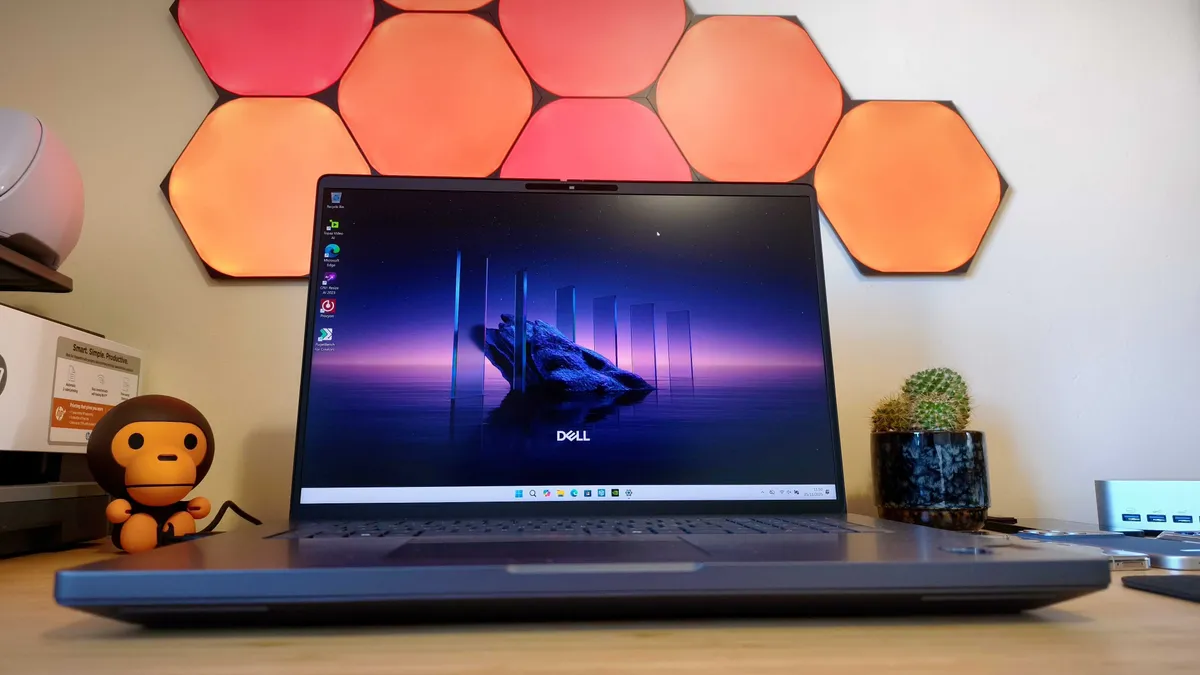
Aimed at serious 3D professionals, this laptop is customisable up to an outrageous 128GB RAM and the fastest Intel processor on Earth, to suit nuclear-plant-design-level jobs, but boy will that cost you.

A gloriously unsubtle powerhouse, delivering blistering performance, a superb display and enough RGB to light a small village.
out of 10
While it may be a gaming laptop, there's no denying that the 2026 Razer Blade 18 is one of the most powerful portable machines you can buy, and that means it can blitz through creative work as easily as it can render spaceships. The price is high, but the speed is higher.