I open the lid, and the keyboard LEDs purr to life and pulse blue and purple, lighting up my room and turning what should feel like another day at the office into more of a trip to a Vegas nightclub. That's the HP Omen Max 16's first impression, and while it’s more subtle than some gaming laptops, the gamer DNA is here. If you're demoing a portfolio to a lecture hall or a potential employer, turn the RGB off first. Everything else about this laptop is more persuasive than its lighting.
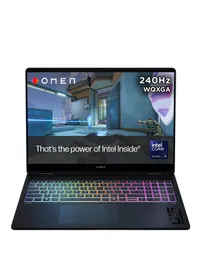
I braced for a brick when I tried out the Omen Max 16. Laptops with an RTX 5080 and a Core Ultra 9 275HX usually arrive with the heft of a paving slab. But the Omen Max 16 is lighter than it has any right to be, a machine you'll carry to a lecture, on a train or into a client meeting without resenting it. Okay, it’s not as light as less powerful laptops, but it’s not far off my usual MacBook Pro. That matters because a laptop this powerful is only useful if it goes places.
What surprised me more is how quickly it stops feeling like two machines in one chassis. Nvidia has spent years pitching RTX at two audiences at once. Gamers get DLSS 4 and the potential of DLSS 5 – frame generation and path-traced lighting. Creators get CUDA and OptiX, with the RTX cores doing the heavy lifting in Cycles. It's a neat pitch on a slide, something I’ve tried in demos, and I didn't expect it to work as a daily routine. Swapping between the two setups – Gamer Ready and Studio drivers – takes a few clicks, so you're deciding what the GPU is for that afternoon rather than struggling with what it can be.

Two worlds, one laptop
So I spent the morning in Blender, and it whizzes. The viewport stays fluid, Cycles chews through scenes that would have me making yet another cup of coffee on lesser hardware, and with 16GB of GDDR7 on the GPU, I wasn't worrying over textures and stalls. In the evening I played Control Resonant – an early review build – fully specced, ray tracing on, framerates zippy. Same lid, same desk, same bag, and all working incredibly smoothly and hassle-free – and coming from someone with a love/hate relationship with Windows, this is good, really good, in fact.
It's that blend of high-end work and play I keep thinking about, especially as back-to-school deals are all the rage and our default is to look down at cheaper offers instead of up at laptops like the Omen Max 16. Game artists are gamers; 3D artists and animators like to game on the side, and seeing how a shipped, ray-traced game runs on serious hardware is part of the education. Having the option to do both in one laptop, albeit with some caveats – it eats battery life, and lecturers may not love the LEDs as much as you – and never have to worry about performance seems a no-brainer. So why aren’t we all doing it? Ah, yes, the price.
Now the uncomfortable bit: HP's RRP for this top-end model – GeForce RTX 5080, Intel Core Ultra 9 275HX, 32 GB RAM, 1 TB SSD – is £2,999, and at the time of writing Very has it at £2,619, so that’s a £380 discount. That's a decent saving on a still frightening number. It's also the number that makes me hesitate, because at 18, as a student, borrowing is astonishingly easy. Loans arrive in your account, and overdrafts are offered like chocolate mints with a restaurant bill. Retailers will happily let you buy now and pay later, and the small print on that same Very page shows a representative APR of 44.9% if you miss the window, which is astonishing. The cost of this laptop feels oddly painless at exactly the moment you're least able to absorb it.

I used to make the easy argument here: a Chromebook or a MacBook Neo, which is essentially a large iPhone, won't open a Nanite-heavy Unreal Engine 5 scene without a wince. That's true, and it's also a straw man, because nobody serious is choosing between this and a Chromebook. The honest rival is the cheaper Omen. HP's OMEN 16 with an RTX 5060 is £1,299 right now, down from £1,600. It's a properly capable gaming laptop, and for plenty of first-years it would be plenty.
But look at what the extra £1,320 buys. That cheaper machine has 8GB of VRAM to the Max's 16GB, 16GB of RAM to 32GB, a 512GB drive to 1TB, and an eight-core Ryzen where this has 24 cores. You can upgrade storage and RAM later, but you can't improve VRAM. It's the ceiling on how dense a scene you can sculpt, how big a texture set you can bake and how much of a UE5 level you can light before things start to stutter, and you'll hit that ceiling in your final year, right when your showreel matters most.

Consider the lower specced Omen
So this is the real argument I think I’m coming around to: you're paying an extra £1,320 not to be stopped in your third year by the tech you avoided paying for years before. It won't make you talented, it won’t do all the hard graft for you, and it could tempt you to play another hour of Call of Duty when you really should be working on your Call of Duty killer.
But plenty of brilliant artists started on hardware that would make the 5060 look decadent, and if you're dabbling, you don't need the power of Omen Max 16 (RTX 5080), and the lower-end-spec Nvidia laptops (see below) can still handle both creative and gamer needs. Also, let's be real, if the only way to afford the premium Omen Max 16 is a 44.9% credit card, don't. Even then, the 1TB drive will fill faster than you think once UE5, a few projects and a Megascans library move in.
But if you already know the next four years are Blender, Unreal and games that make your GPU sweat and games you want to be inspired by to create your own worlds, this is the rare case where the indulgent option and the sensible one might be the same laptop. Now, I'm not entirely comfortable with how well that argument works on me, given the cost of things, and you’re taking advice from someone who spent their student loan on a Neo Geo AES, but there is a line of common sense in here – an Omen, or similar Nvidia RTX laptop (see below) will last you through your course and beyond if you’re serious about playing and making games.