



Content warning: this article discusses graphic violence, disturbing imagery, and mature themes in an 18+ game.
To some extent, you could say Resident Evil's history has been tied to Nintendo, as Capcom envisioned it as a spiritual successor to its 1989 Famicom game Sweet Home, which was developed alongside the Japanese horror film of the same name. But even if the series that pioneered survival horror has its roots with PlayStation, where gaming was targeting a more mature audience, Nintendo's family-friendly hardware has nonetheless played a surprising role in shaping the series, though at times also came up against technical constraints.
So, as the 30th anniversary of the franchise approaches, coinciding with the release of Resident Evil Requiem (read our Resident Evil Requiem review), it's interesting to look back at the way the series shuffled from one extreme to the other.
It wasn't with the first, but with the second in the entry, the time's fastest-selling game in North America, which was ported to a Nintendo platform. But it also seemed like an impossible task, given that Resident Evil 2 was originally made to fit on two 700MB CDs, whereas the N64 was cartridge-based with just 64MB - precisely the reason SquareSoft had jumped ship when it came to making Final Fantasy VII for PlayStation.
Yet through the technical wizardry of US-based Angel Studio (now Rockstar San Diego), finding creative ways to compress audio and video assets as well as relying on the console's realtime-processing power do the heavy lifting, Resident Evil 2 on N64 didn't just look as acceptable a conversion as the PS1 version, it even added bonus features like alternate costumes, an item randomiser mode, and even first-person 'controls' – standard analog movement replacing the old 'tank controls'. Ultimately, these bonuses also sweetened the pill to make up for technical compromises, such as less detailed pre-rendered backdrops and muffled voice audio, required to make the port work.

Resident Evil went portable
It's bizarre, then, that plans for a port of the very first game were targeted instead for Nintendo's handheld. A Game Boy Color port that began in 1999, outsourced to British company HotGen Studios, which attempted to replicate 32-bit games as blocky 8-bit sprites, seemed a stretch too far, and Capcom decided to cancel it. The near-complete playable version has since leaked online, and there is a certain charm to it when you consider it was technically the first demake of its time.
Somehow, this didn't dissuade Capcom from putting a Resident Evil game on a handheld, as the Game Boy Color instead got Resident Evil Gaiden, which felt nothing like Resident Evil, although the top-down perspective for exploration and first-person combat may have been a callback to Sweet Home.
A handheld port of the original game would, however, finally materialise as Deadly Silence, which was possible on the technically capable DS, not just including touch controls and improved character textures but also a Rebirth mode that added more enemies and new puzzles that played to the hardware's quirks.

Of course, the version of the first game better remembered is the incredible remake on GameCube, a console that, despite looking so toylike with its Fisher-Price handle, had the hardware grunt to match its rivals in the 6th generation.
This Resident Evil set a new standard for what video game remakes could look like. It may have stuck to the formula of having 3D characters on top of pre-rendered backgrounds, but the way it was pulled off with environments that weren't all static but on loop, as well as having elements foregrounding characters, as well as real-time shadows, all contributed to making this look like the best that game graphics could ever be.

Although prequel Resident Evil 0 didn't set the world alight in the same way, Capcom's continued partnership with Nintendo, with a series of games referred to as the Capcom Five, would lead to the greatest innovation of all: Resident Evil 4. With the survival horror formula getting old, this more action-focused entry didn't just reinvigorate the series, swapping out mindless zombies with frighteningly alert mobs, archaic puzzles for QTE-prompted roundhouse kicks, but the single transformational change of camera perspective would go on to influence all of the major third-person shooters that followed. Even over two decades later, it still remains amazing to play, and you're spoiled for choice over where to play it, from the Switch to the Quest in VR.
While the Resident Evil 4 remake on modern consoles is excellent, one of the best ways to experience Resident Evil 4 is arguably on Wii, making the most of its motion controls for aiming and dodging, while also including the excellent Ada Wong-starring 'Separate Ways' campaign. Yet it also highlights how the Wii's focus on a wider casual audience meant new releases were limited to on-rails shooters Umbrella and Darkside Chronicles, more of a shooting gallery running through the greatest hits rather than moving the series forward.

Yet these lighter offerings were more liked by fans and critics than the mainline's lurch into the HD era, where both Resident Evil 5 and 6's reputations as the series' nadir have only gotten worse over time.
Ironically, the salvageable entry from this same era would actually come from handheld with Resident Evil: Revelations on the 3DS, which felt more like a return to the series' survival horror roots and brought back a playable Jill Valentine after the fifth mainline game did her dirty. While far from perfect, such as its uneven episodic structure, it was deemed good enough to warrant HD ports, including as the only Resi release for the ill-fated Wii U.

The Nintendo Switch era
Enter the Switch era, a goldmine for many publishers to put their old games on the eShop, including legacy Resident Evil games. Nintendo's hybrid console would incidentally release alongside the new generation of games powered by the RE Engine, but it lacked the power to run them natively. Instead, this limitation was mitigated by Capcom putting out cloud versions, essentially PC versions of the game streamed online, assuming your internet connection was up to snuff, which also undermined the console's portability.
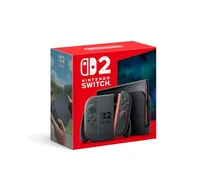
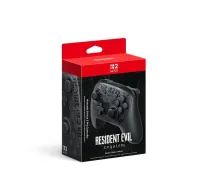
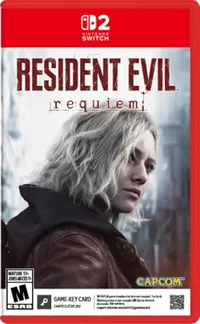
It's only now with the Switch 2 that Resident Evil seems to be finally unshackled from its technical constraints with the release of the latest instalment, Resident Evil Requiem, which balances the modern first-person fear factor with the adrenaline-pounding action highs of Resident Evil 4 through its dual protagonists, Grace Ashcroft and Leon S. Kennedy.

Up there with Cyberpunk 2077 and Final Fantasy VII Remake Intergrade as one of the best-looking AAA games on the Switch 2 so far, this really is a scarily impressive port that while of course not boasting the full grunt of a PS5 doesn't feel visually compromised, retaining all the scares when creeping around in the dark or relish of executing an ultra-gorey finish on an infected enemy.
I daresay the most nerve-wracking way to play Requiem during Grace's story is on Switch 2 in handheld, first-person mode, which maintains a smooth 60 FPS. You can also see why it made sense to release native versions of Resident Evil 7 and Village to the more powerful consoles, though the caveat of playing in handheld mode is that you'll be lucky to get two hours of playtime out of it unless you have a power supply within reach.

It doesn't mean the port isn't without issues. This is most notable in certain sections when playing as Leon, where the image resolution is very blurry when zooming in with a rifle scope. A more serious concern is that in the busier moments, where you're facing larger numbers of enemies and environmental effects are popping off, the framerate can really take a hit. The Switch 1 never received a cloud version of the Resident Evil 4 remake, which makes me doubt whether we'll get a native port for Switch 2.
Even if it's not perfect, Resident Evil on a Nintendo platform is back to its best since the GameCube era. Now, if they can just add those original games to the Nintendo Switch Online service, that would be a real tribute to its anniversary.
Also see our recent survey to find the best SNES game of all time.